On December 21, 2020, just after sunset, millions of people stepped outside to look southwest. Jupiter and Saturn stood within six arcminutes of each other, closer to the naked eye than at any time since 1623. To modern cities it looked like one bright winter star. To eighth-century scholars in Baghdad, that night would have looked like the turning of a two-hundred-year lock.
Long before lenses showed Uranus, Neptune, or Pluto, sky watchers read history by those two bright worlds. Every twenty years, Jupiter catches Saturn in the sky. Inside that twenty-year beat hides a two-century gear that shifts how empires build, trade, and rule.
Masha'allah and the Great Chronocrators
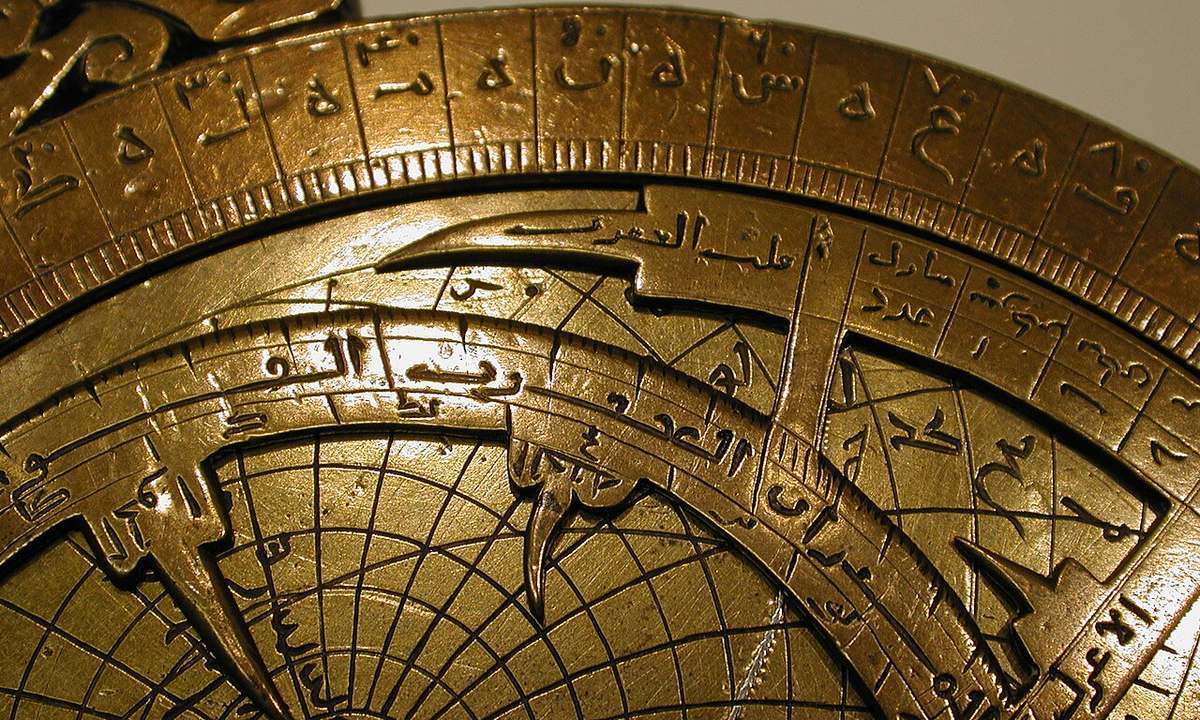
Our clearest early guide to this clock comes from Masha'allah, known in Europe as Messahala. He was an eighth-century Jewish astrologer in Abbasid Baghdad, working beside scholars who joined Persian, Indian, and Greek sky tables. His book On Conjunctions, Religions, and Peoples survived through excerpts kept by the compiler Ibn Hibinta around the tenth century. Historians Edward Kennedy and David Pingree later brought it into English.
Masha'allah worked from an older Persian model of world history. He traced the fall of the Persian kings around 650, the rise of the Abbasid rulers around 749, and later shifts of power in 809. In each case, he read the chart of the Sun entering Aries in the year of a great pairing or elemental shift. He lived in a city built on trade and translation, where scholars gathered star tables from across the known world to read the fate of kingdoms.
In old mundane astrology, Jupiter and Saturn were called the Great Chronocrators, the markers of long ages. Jupiter takes about 11.86 years to circle the Sun. Saturn takes about 29.46 years. Every 19.86 years, faster Jupiter catches slower Saturn in the zodiac.
Their meeting point never stays in one sign. Each pairing jumps ahead about two hundred forty-three degrees around the wheel. That leap lands about nine degrees farther along inside the next sign of the very same element.
For ten meetings in a row, spanning almost two hundred years, every pairing lands inside one elemental triad. Fire rules action and faith. Earth rules land and trade. Air rules speech and mind. Water rules faith, sea, and feeling. When that nine-degree drift finally crosses thirty degrees into a new element, tradition calls it the Great Mutation. Money, rule, and public life shift shape at that hinge.
In the tradition Masha'allah preserved, Jupiter stands for law, religion, and expansion, while Saturn stands for borders, stone, and time. Where those two meet shows what holds a civilization together. When they leave Earth for Air, the glue of human society changes from what can be mined and fenced to what can be thought, spoken, and linked.
Two centuries of Earth, and the Air shift
Look at the outgoing Earth era beside the opening Air era to see why the 2020s shook so many habits loose. After an early step in Virgo in 1802 and a central meeting in Capricorn in 1842, Jupiter and Saturn met in Earth signs for nearly two centuries. Only once did they step ahead into Libra in 1980 and 1981. Then the last Earth pairing fell at twenty-two degrees and forty-three minutes of Taurus on May 28, 2000.
Two hundred years of Earth built a world of coal mines, iron rails, oil wells, steel mills, gold coins, and borders drawn on dirt. Wealth lived in things you could touch, weigh, and fence. Nation states measured their strength by factories, ports, and acres of land. Even the brief Libra preview in 1980 and 1981 left a clear mark. Speaking in Berkeley during those meetings, Liz Greene and Stephen Arroyo noted in The Jupiter/Saturn Conference Lectures (1984) how culture turned toward home computers, data links, and new social contracts.
Then came December 21, 2020 at zero degrees and twenty-nine minutes of Aquarius. History crossed from Earth into Air. Next meetings fall in Libra in 2040 and Gemini in 2060. Across this two-hundred-year Air epoch running until the Water shift of 2219, the series holds to Air signs except for one brief dip near eight degrees Scorpio in December 2159. In Mundane Astrology, Baigent and Campion note what this shift means. An Air epoch moves the base of power away from physical ground. Strength flows instead into trade routes of the mind, shared speech, and invisible links.
Physics hit on a strange twin of this shift from stone to code. In 1989, physicist John Archibald Wheeler coined the phrase "it from bit." He argued that solid things ("it") arise at root from information ("bit"), yes-or-no answers registered by the world. In an Air age, wealth and rule leave heavy coal and steel behind. They move into grids, machine code, radio beams, and shared ledgers flying at light speed.
Living with weight in an Air age
Almost every rule our grandparents trusted for a safe life was built for Earth. Pick one trade, walk through one brick door for forty years, store savings in land or stone, and read the news once a day on paper. Those rules assumed a world that moved at the pace of a train or a plow.
Now Pluto in Aquarius and Uranus in Gemini join this Air tide. Work grows weightless and lives on screens. News splits attention across twenty storms before lunch. Ideas cross the sea in one second, yet neighbors two doors down barely speak.
No generation can stop a two-hundred-year turn of the Chronocrators, any more than farmers in 1840 could stop iron rails from crossing their fields. Yet human beings are not made of light signals alone. Flesh still needs deep sleep, real food, and spoken voices across a table.
Inside fast Air, hold fast to things with weight. Talk face to face with people on your own street. Check primary facts before you react to noise on a screen. Keep a craft with your hands that leaves a real mark in the room. Every twenty-year meeting of Jupiter and Saturn lands somewhere on your wheel. Open the free birth chart below to see where zero degrees Aquarius falls for you, and read further in our World Updates to trace how great cycles shape the world around you.