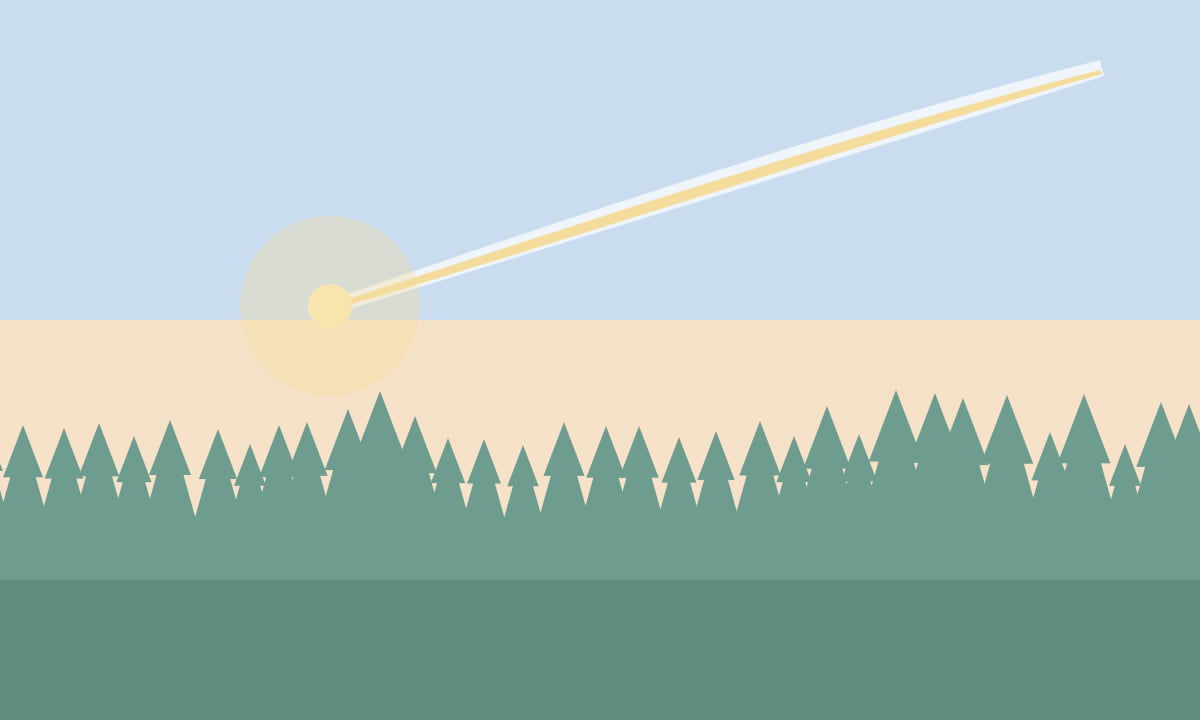
The Morning the Northern Sky Split in Two
At about 7:14 in the morning, local time, on June 30, 1908 (00:14 Universal Time; some sources say 7:15 or 7:17), a farmer named Semyon Semyonov was sitting on the porch of the trading post at Vanavara, in the forests of central Siberia. Vanavara lies about 60 kilometers (37 miles) south of the spot where the blast happened, in the forest near the Podkamennaya Tunguska River, which gave the event its name.
Years later, his words were written down. He had just lifted his axe to fit a hoop onto a wooden barrel. Then, he said, "the sky was split in two," and high above the forest the whole northern sky seemed to be on fire. A great heat hit him, as if his shirt had caught fire. Then came a bang in the sky and a mighty crash. He was thrown about six meters (twenty feet) from the porch and lost his senses for a moment.
Other people saw a column of fire and a cloud of smoke rising high into the air. The shock broke windows up to nearly 200 kilometers (120 miles) away. Earthquake stations in Russia and Germany recorded it, and air-pressure instruments around the world, including in London, picked up the waves in the air.
The land was remote, and very few people lived there. Most were Evenki families who herded reindeer, hunted and fished. At least three Evenki people are reported to have died, and many of their reindeer and dogs were killed.
Millions of Trees Laid Flat, and No Crater
Science was slow to arrive. A team led by the mineral expert Leonid Kulik tried in 1921 but did not reach the center. Kulik finally got there in 1927, nineteen years after the blast.
What he found was hard to believe. Across about 830 square miles (2,150 square kilometers), millions of trees lay flat, pointing away from the center in a huge shape like a butterfly. Right at the center, some trees still stood upright, stripped of their branches and bark like bare poles. And there was no crater at all.
Scientists still discuss the details. A 2019 study by NASA scientists found that the most likely cause was a stony space rock, somewhere between about 160 and 260 feet across, that hit the air at around 34,000 miles per hour. It broke apart several miles above the ground, so the blast hit the forest from above. Estimates of its power range widely, from a few megatons to tens of megatons.
For several nights afterward, skies across Europe and western Asia glowed. People reported that around midnight they could read a newspaper outdoors without a lamp.
Two Famous Numbers That Are Not True
You may have read that Tunguska flattened "80 million trees." You may also have read that if the rock had come 4 hours and 47 minutes later, the turning Earth would have put the old Russian capital, St. Petersburg, right under it.
In 2024, a group of impact scientists listed both as myths. The tree count came from an early guess about the size of the damaged area, made before the first photos from the air, and it is probably about four times too high. The St. Petersburg idea forgets that Earth is also racing around the Sun. Hours later, the rock would have missed Earth by about half a million kilometers.
What Stood in the Sky That Morning
We set our own engine, built on NASA JPL data, for 00:14 Universal Time on June 30, 1908, over the blast center, and checked the minutes around it. Sources disagree by a few minutes about the exact time. So we read only the planets, which barely move in that time. We do not read the horizon or the point overhead, which change every few minutes.
An eclipse two days before. On June 28, 1908, the Moon passed in front of the Sun in an annular eclipse. In this kind of eclipse the Moon covers the middle of the Sun and leaves a bright ring. Our engine puts that New Moon at about six and a half degrees of Cancer.
Six sky bodies in Cancer. On the morning of the blast, six of them stood in Cancer: the Sun, the Moon, Mercury, Venus, Mars and Neptune. Astrologers link Cancer with home, shelter and the land where we live.
Mercury facing Uranus. Mercury, the planet of messages and of things that move fast through the air, stood almost exactly opposite Uranus, less than a quarter of a degree from a perfect face-off (180 degrees apart). Astrologers link Uranus with sudden shocks, a "bolt from the blue." Neptune, the planet of mist and mystery, sat about one degree from Mercury, and it too faced Uranus, within one degree.
Mars beside Procyon. Mars, the planet of fire and force, stood about a quarter of a degree from Procyon, a bright star in the Little Dog. Its Greek name means "before the dog," because it rises ahead of Sirius, the Dog Star. The ancient astronomer Ptolemy wrote that Procyon is like Mercury and, a little less, like Mars.
A Day to Look Up
In 2016, the United Nations named June 30 International Asteroid Day. It is a quiet reminder that rocks from space still cross our path, and that watching the sky carefully is how we learn to keep people safe.
Astrology cannot predict a rock falling from space. It describes the weather of a time, not a fate. Knowing your own transits, the planets passing over your birth chart, can help you choose when to rest, when to take care, and when to push. If you would like to see where Mercury, Mars and Uranus stood when you were born, your free birth chart is waiting below.
A note from Mike Astrology: This is a case study. We look at the sky at moments history remembers. The sky does not cause what happens, and nothing here blames or judges anyone.
We remember everyone involved with respect.
Sources: event time from Wikipedia, "Tunguska event" (about 7:14 local, 00:14 UT; other sources 7:15–7:17); eclipse from NASA's eclipse catalogue; myths from Boslough et al., GSA 2024; no birth data used; sky positions from Mike Astrology's own engine.