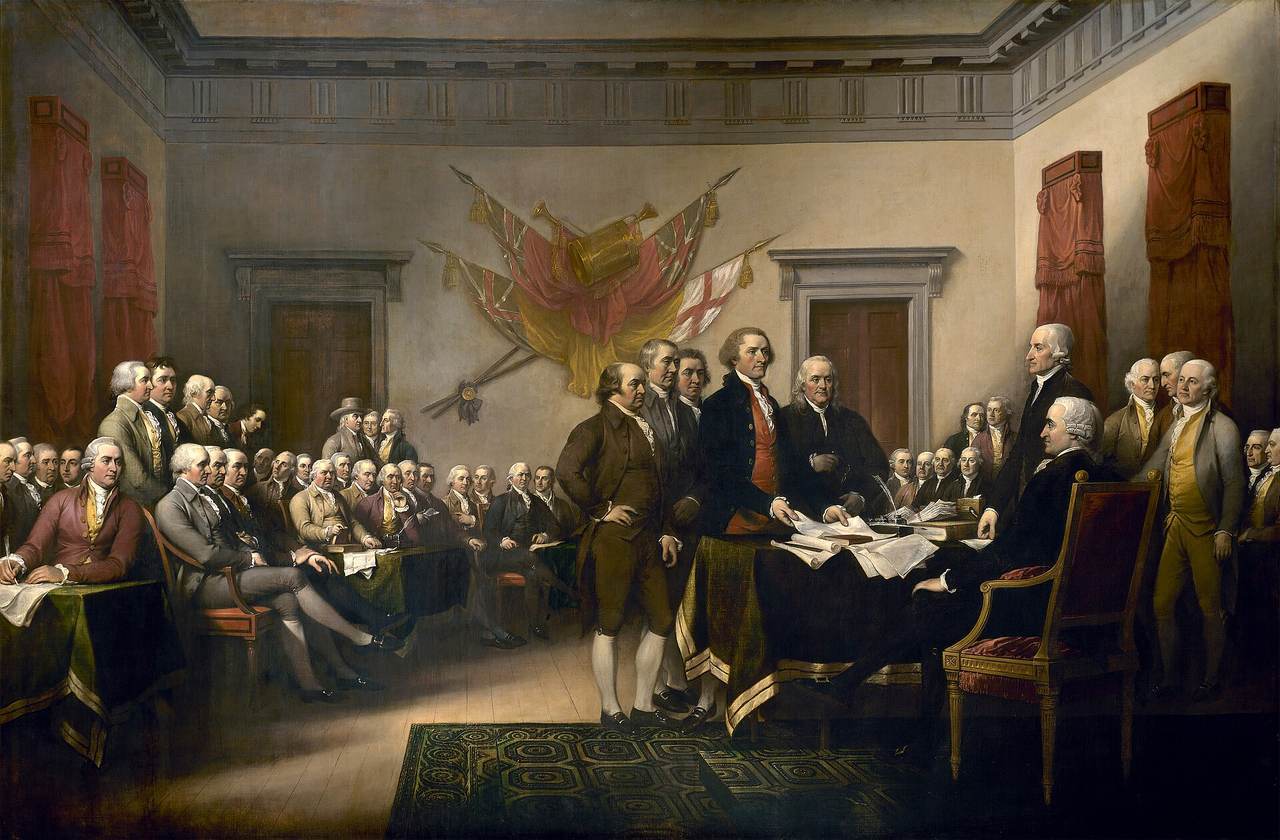
Every country has a founding story, yet few nations return as restlessly to a single afternoon as the United States returns to July 4, 1776. Whenever constitutional arguments sharpen or new technologies outrun old laws, people ask the same quiet question: is the experiment bending toward renewal, or straining against the frame built in Philadelphia two and a half centuries ago?
Mundane astrologers have watched a parallel clock since the republic’s first decade. Nobody stood on the floor in 1776 with a stopwatch to log the exact minute of adoption, so astrologers still debate the rising sign. Yet the slower planets overhead keep returning to their 1776 positions right on schedule, no matter where anyone draws the house walls.
Ebenezer Sibly’s Map and the Gemini-Rising Debate
In 1787, English astrologer Ebenezer Sibly published a natal chart for the United States set for 5:10 PM local mean time on July 4, 1776, in Philadelphia, later collated in his 1790 New and Complete Illustration of the Occult Sciences. As Michael Baigent, Nicholas Campion, and Charles Harvey note in Chapter 15 of Mundane Astrology, Sibly’s hour aligns closely with the Philadelphia Historical Society’s bulletin and places Sagittarius rising.
Honesty requires noting an active alternative. Around 1939, American astrologers championed an earlier Gemini-rising chart (8°47' Gemini on the horizon), arguing that a restless Air sign suits American speech and movement. Whichever rising degree one prefers, the planetary sky of July 4, 1776, holds steady: the Sun in Cancer stands in a tight square (a 90-degree friction aspect) to Saturn in Libra, Mars in Gemini forms a trine (a 120-degree flow) to that same Saturn, Pluto sits in late Capricorn (27°33'), and Uranus sits at 8°55' Gemini.
Both Baigent and Liz Greene read that Sun–Saturn square as bold constitutional ambition paired with an undercurrent of self-doubt—a recurring drive to prove legitimacy. Beside it, Mars trine Saturn reflects practical speed, industrial scale, and relentless reinvention.
How the 84-Year Uranus Clock Keeps Time
In Mundane Astrology, Baigent observes that the United States chart reacts sharply to Uranus—the planet linked since 1781 with invention, shock, and democratic upheaval—both when transiting Uranus crosses natal planets and when it completes its 84-year orbit home.
During Watergate, on June 17, 1972, when the break-in was discovered, transiting Uranus in Libra stood directly on the United States’ natal Saturn, while transiting Pluto neared the Sibly Midheaven—mirroring sudden upheaval inside executive authority and hard disillusionment in public trust. Equally telling are Uranus’s 84-year transits across Sibly’s Sagittarius Ascendant: between March 1899 and December 1900 (post-Spanish-American War overseas power, the Wright brothers’ first full-scale glider, Detroit auto mass production, Texas oil strikes) and again between January 1983 and February 1984 (shifting strategic alliances and personal computing).
The Pluto Return Window and the 2027–2028 Uranus Return
Two slow clocks overlap across the 2020s. Because Pluto takes roughly 248 years to circle the Sun, the republic’s first Pluto Return arrived in 2022, with three exact passes over 27°33' Capricorn before Pluto entered Aquarius across 2023–2024—pulling hidden debts, institutional fatigue, and questions of legitimacy into daylight.
Right behind it comes the third Uranus Return to 8°55' Gemini. On its first return, Uranus entered Gemini in 1859 on the eve of the Civil War and crossed 8°55' Gemini across 1860–1861 as fractures over union and slavery broke open. On its second return in 1943–1944, Uranus passed 8°55' Gemini in late May 1944—days before D-Day, at the height of World War II and wartime electronics.
Now that 84-year clock arrives in 2027–2028. Uranus crosses 8°55' Gemini in late July 2027, stations retrograde (pausing and reversing from Earth’s view) at 9°57' Gemini on September 15, 2027, and passes direct past 8°55' Gemini in Spring 2028. Because Gemini governs speech, media, and networks, a stationed return highlights a prolonged hinge around truth, artificial intelligence, and civic trust—not repeating 1861 or 1944 mechanically, yet asking how a diverse republic updates its tools without tearing its common ground apart.
What a National Return Reveals Inside Ordinary Life
Living through a Pluto-to-Uranus handoff from 2022 into 2027 can make daily life feel curiously unmoored.
Pause for a breath and look beneath the noise.
Astrologer Pam Gregory often cites Nobel chemist Ilya Prigogine’s work on dissipative structures: when any complex system is pushed far from equilibrium, old scaffolding shakes loose not to destroy the whole, but so it can reorganize at a higher order. In Prigogine’s words, "small islands of coherence" inside a sea of turbulence help tip how that shift settles. Your steadiness is not a footnote to national history; it is part of the room’s weather.
Notice too how Sibly’s Sun–Saturn square shows up inside ordinary nervous systems. Under pressure, we default to power-over reflexes—what Dr. Heather Ensworth calls the old habit of armoring up, arguing to win, or gripping control to outrun fear. The friction of 2026–2028 exposes those habits in broad daylight so we can outgrow them.
And as Molly McCord notes of tense oppositions, staring straight at a brick wall—refreshing polarized feeds or rehearsing worst-case scenarios—only locks your jaw tighter. The real shift usually arrives in your peripheral vision. You turn your head an inch, step out of the argument, and tend one honest thing within reach: how you listen to a neighbor who disagrees, how slowly you verify claims before sharing them, and how reliably you keep your word at home.
As Richard Tarnas wrote in Cosmos and Psyche, planetary cycles never act like mechanical fate. You cannot steer a capital single-handedly, yet you choose the steadiness you carry into every room—and coherence is quietly contagious.
Astrology describes the wider climate of a time; your own birth chart shows where that weather meets the ground of your personal life.
Sources & Thinkers Cited: Michael Baigent, Nicholas Campion & Charles Harvey (Mundane Astrology, Ch. 15); Ebenezer Sibly (1787/1790 US chart); Liz Greene (The Outer Planets and Their Cycles); Richard Tarnas (Cosmos and Psyche); Pam Gregory, Ilya Prigogine, Dr. Heather Ensworth & Molly McCord; JPL DE440s & NASA ephemeris tables.