Along the brown mudbanks of the upper Nile, a ridge of scales floats below the water's glare, still as driftwood for hours. When a hoof touches the shallow rim, the river explodes in one sudden arc of jaw and tail.
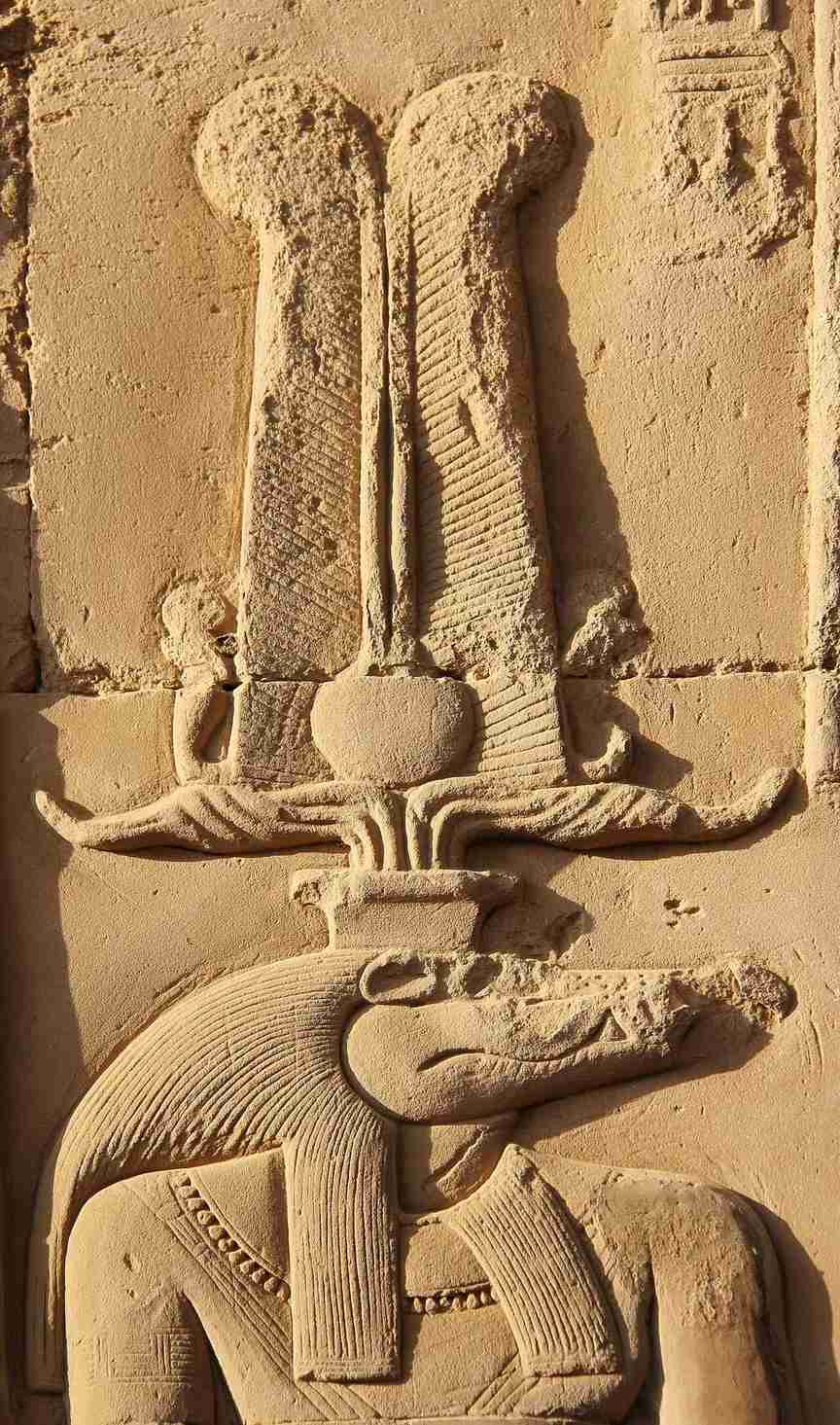
Sobek is the crocodile god of ancient Egypt, Lord of Kom Ombo and the marshes of Fayum, and fierce shield of Ra. Egypt did not push terror outside the city wall and call it evil. The Nile peoples placed the crocodile right inside the sanctuary beside Horus the falcon. Sobek is a consciousness of survival power, flood surge and fearless instinct. At Kom Ombo they made a place of stone and dark water where a human being could meet him and live.
Stillness inside the moving current
Every living body looks solid across a room. Yet every cell trades atoms with water and air every hour.
In The Web of Life, systems theorist Fritjof Capra quotes mathematician Norbert Wiener on what keeps life intact inside endless change. Wiener wrote that we are whirlpools in a river of ever-flowing water, never stuff that abides, only patterns that perpetuate themselves. A whirlpool holds a crisp spiral at the center of a stream even though every drop passing through it is brand new a second later.
A Nile crocodile works by a strict rule of river energy. Cold-blooded muscle wastes nothing on restless fidgeting. It lies flat inside the eddy, matching water temperature and current. Every spark stays banked until the moment to strike arrives.
Sobek is Egypt's emblem for that living eddy of force. Instinct that can lie still in the current is power, and it is ready.
The net, the flood and the twin sanctuary
This account comes from the Pyramid Texts, temple reliefs at Kom Ombo, and Plutarch's record of the Nile marshes.
Sobek sprang from Neith, the weaver goddess who spun the world before the sun rose. When the Nile swelled brown across dry fields each summer, people saw Sobek's thick tail driving the floodwaters forward. The surge brought fat fish, reeds and wet mud for the harvest.
In the tales of Osiris, the four sons of Horus fell into the river waters before they could guard the four winds. Ra commanded Sobek to cast his fishing net into the surge. The god whose jaws close on everything drew up the four of them, one by one, and closed his jaws on none. When Isis drifted in a boat of woven papyrus hunting the bones of Osiris, no crocodile in the marshes touched her skiff. From that day on, Plutarch wrote, travelers in papyrus boats crossed crocodile water unharmed out of respect for that truce.
Above Aswan, where the Nile bends around a sandstone bluff, Egypt raised a remarkable temple at Kom Ombo. Builders split the sanctuary straight down the center into two equal halves. One doorway and altar belonged to Horus the Elder, the falcon of sky clarity. The mirror doorway beside it belonged to Sobek, Lord of the Crocodiles. Priests entered both doors with equal offerings, honoring the high eye and the deep belly side by side.
Laws of the dark water
First, stillness stores the force that motion spills. A hunter thrashing through reeds scares off every fish and wears out its legs. Sobek lies below the ripple line until one crisp lunge finishes the work.
Second, higher sight breaks down whenever it denies animal instinct. A falcon that cannot see what waits in the reeds dies when it lands to drink. Kom Ombo sets falcon and crocodile under one roof because clarity in the head and survival power in the spine belong to one circuit.
The dark pool at Kom Ombo
Tom Kenyon tells the story in his essay Wrestling Crocodiles In the Courtyard of the Sun. Beneath the temple of Sobek at Kom Ombo, Kenyon writes, candidates dropped into an underground pool filled with live crocodiles. They had to swim below the surface toward two openings in the stone. One opening glowed with light, while the second yawned pitch black. Candidates had one breath to choose. Those who swam toward the tempting glow hit a dead end and lost their air. Those with the nerve to enter the black tunnel broke out into fresh air and life.
For Kenyon the dark opening is also a door into inner space, into the space between the particles. He calls it the quantum womb, the Mother of matter itself. And look at the plan. Above, the temple has two doors. Below, the pool has two openings. It is one drawing, made twice.
Maia Nartoomid adds an Akashic reading of the crocodile in What a Croc! My Crocodile Dream. She quotes E.A. Wallis Budge on Ab-sham-Tuat, the giant crocodile guarding the seventh division of the underworld, and notes plaques where Horus stands atop two crocodiles. Kaylasa Jaguarstar Giselle, who comments on the dream, says the crocodile is the reptile brain, the oldest power at the base of the spine. The same energy that breeds fear and chaos, she writes, becomes the Shamir when it is transmuted. The Shamir is the manna of the gods, the fire of immortality.
Reading the twin doors and armored hide
The temple and its god are one diagram.
Two halls and two sanctuaries stand side by side, and neither ranks above the other. One half belongs to the sky, and one to the mud.
Along his back runs a ridge of bone. Blows turn aside on it, and the belly beneath stays soft and quick.
On his head are ram horns, tall plumes and the disk of the sun. Below is the oldest power, the reptile. Above his crown it has become light. That is the Shamir, cut in stone.
Last is the papyrus skiff of Isis. Reeds lashed in simple order ride over deep jaws because they do not thrash against the river.
Neith's son and Horus's partner
Sobek stands inside a vital circuit between primordial matter and sky vision.
Neith, his mother, is the weaver of raw fabric before stars or kings exist. Through her, Sobek inherits the wild pulse of fertility that makes crops sprout in wet silt. Opposite him across the centerline at Kom Ombo stands Horus the Elder, keeper of distance, aim and daylight truth.
When Sobek pulls Horus's four sons out of the flood in his net, instinct serves the future instead of eating it. When Horus stands calmly upon the backs of two crocodiles, solar awareness rides primal vitality the way a boatman rides a current.
Sobek across Mars, Pluto and transit pressure
As Sobek-Ra he belonged to the Sun. Astrologers today hear him in Mars and Pluto, in Scorpio, the sign they share, and in the first and eighth houses, when the birth time is known. Mars governs hot blood, swift strike and muscular nerve. Pluto governs deep water, hidden fear and total renewal after a crisis strips away bluff.
Then look to the times when Mars or Pluto crosses the Sun, Moon or Ascendant. Mars usually passes in a few days. Pluto stays for a year or more. What lay under the surface rises like scales in muddy water, and hesitation costs air. Meeting a transit with Sobek's rule means holding still until the hour is ripe. Then you pass by the bright opening and take the dark one.
How to interface with Sobek
Call on Sobek for courage, at the edge of a dark water that has to be crossed. The crocodile strikes only for need, and wastes nothing on show.
Choose the low sun of late afternoon or stand beside moving water or a tub of cool water. Set a pebble near your feet. The crocodile swallows stones so that he can lie low in the river.
Sit on a low stool or the edge of a chair with both feet planted wide, knees apart and hands heavy on your thighs. Feel the base of your spine and the low belly below your navel. Drop your shoulders away from your ears. Let your breath sink behind your belt until your ribs widen at the back.
Recall Kenyon's pool at Kom Ombo. See the two openings. Name the bright one that leads nowhere, and let it go. Name the dark one that leads through. Then be still for seven slow breaths, the way the crocodile rests below the glare.
Now strike once. Speak aloud, in six words or fewer, the step that takes you through.
Close the circuit firmly before walking away. Exhale hard down through your legs into the floor. Stand up slowly, and put the pebble in your pocket. Press both palms flat against stone or a wall, and rinse both wrists under cold running water. Thank the Lord of Kom Ombo and carry that stillness into your step.
Questions people ask about Sobek
Who is Sobek in Egyptian mythology?
Sobek is the crocodile-headed god of the Nile, fertility, survival power and military protection. Son of the weaver goddess Neith, he netted the four sons of Horus from the river and shared a twin temple at Kom Ombo with Horus the Elder.
Why did Egypt build a twin temple for Sobek and Horus?
Kom Ombo honored Horus for sky vision and Sobek for primal river instinct side by side. The symmetrical plan taught that wholeness needs both sharp discernment and fearless bodily strength.
What is the crocodile initiation at Kom Ombo?
In Tom Kenyon's account of Kom Ombo, initiates swam through an underground crocodile pool toward two tunnels. The lit opening was a trap and the black opening led to air, testing nerve against false light.
Why did crocodiles leave papyrus boats alone in myth?
Plutarch recorded that Isis traveled in a papyrus skiff while searching for Osiris. Crocodiles honored the reed boat and never harmed travelers inside one, marking harmony between wild instinct and sacred purpose.
How does Sobek show up in astrology transits?
Sobek answers to Mars and Pluto, and to Scorpio, the sign they share. His hours are the transits of those two planets to the Sun, the Moon or the Ascendant.
The jaw beneath the glare
Sobek is the patient river power, instinct turned from panic into calm force.
Your Transits follows Mars, Pluto and the other planets across your birth chart for the next eighteen months.