Aldebaran in Astrology
Aldebaran is the archetype of greatness earned and then tested.
The eye that watches — that sees what is coming from the East, from the direction of beginnings — carries both the gift of perception and the responsibility of what perception demands. The eye that sees truly cannot then pretend not to have seen. The Bull's Eye does not look away from what charges toward it. Orion is always there, directly across the sky, and Aldebaran does not blink.
The Persian framework that Brady recovers makes the archetype precise: this is the star of Mithras, the warrior of contracts, the one who gives victory but only on terms of absolute integrity. The honors are real — the tradition from Robson through the Anonymous of 379 AD through Alvidas is unusually consistent about this. Splendid and illustrious life. Glorious, mighty and commanding nature. Fame, bountiful resources, well known in cities and regions. High military and ecclesiastical preferment. The tradition is not cautious about Aldebaran's capacity to elevate those born under it.
Mythology & History
The Bull of Heaven:
The constellation Taurus is among the oldest in the sky. In Babylonian astronomical tradition, the Bull was a creature of mythological weight before it became a star map. The great Epic of Gilgamesh — one of the oldest literary texts we possess — includes the Bull of Heaven: a divine creature sent by Anu at the goddess Ishtar's request to destroy the hero Gilgamesh after he refused her advances. The bull descended from the sky, and its breath opened pits in the earth that swallowed hundreds of men. Gilgamesh and his companion Enkidu killed it together. The bull's slaughter was a triumph — and its consequences were catastrophic, because killing a divine creature exacted a price. The mythology encodes the same teaching that would appear in Persia and later in the astrological tradition: the great beast can be faced and overcome, but the victory is never clean, and it always costs something.
In Babylonian astronomical tradition, Taurus was Mul.Apin — one of the most important constellations in the sky. The Hyades cluster, which forms the bull's face, was an important marker for calendrical and celestial tracking.
The Perseus-Andromeda Myth and the Charging Bull:
In the classical Greek tradition, the constellation Taurus was associated with the bull Zeus assumed when he abducted the Phoenician princess Europa — he mingled with her father's herd on the seashore, tame and beautiful, and when she climbed on his back, he rushed into the sea and carried her to Crete. This is the form Robson records. An alternative account makes the bull Io, whom Zeus turned into a heifer to disguise his affair from his wife Hera. What both versions share: the bull as a figure of enormous power worn in a form that appears manageable, even gentle, until the moment it is not.
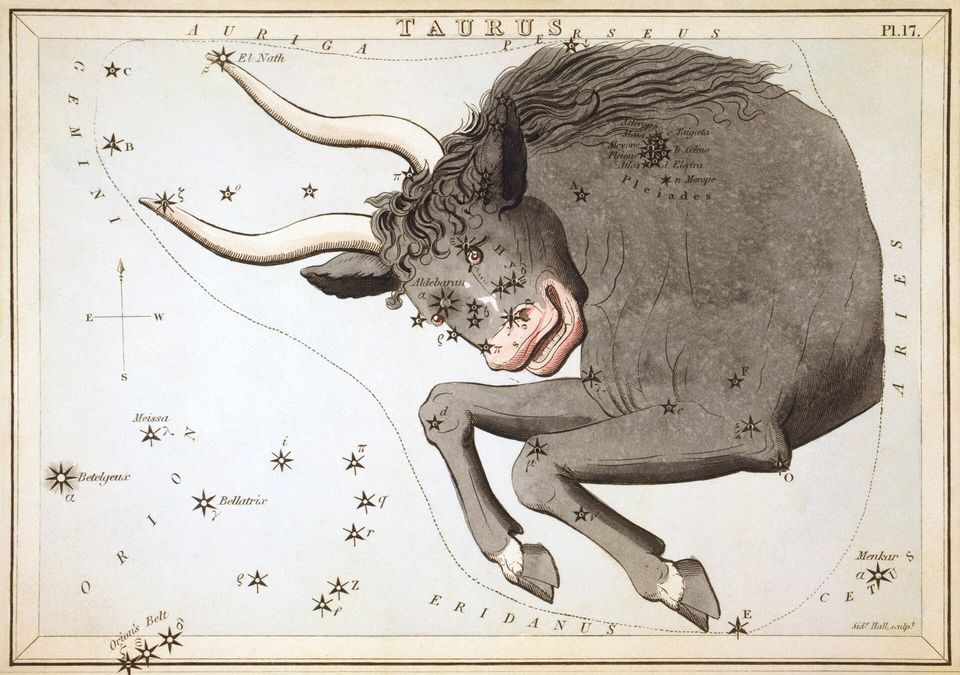
The figure in the sky is significant. Taurus is depicted as only the forepart of a charging bull — head and shoulders, horns lowered, no hindquarters. It is a beast arrested in the act of charging. And Aldebaran is its eye: the orange-red blaze of the right eye, staring forward into the dark, at what is coming from the East.
Orion strides across the winter sky a short distance to the west. Taurus faces him. The two constellations have confronted each other in the sky since human beings first mapped the stars, and the confrontation is encoded into the mechanics: they can never occupy the same sky simultaneously. When Orion rises in the east, the Bull is already crossing toward the west. They are locked in an eternal face-off, the hunter and the beast he perpetually charges toward, neither able to reach the other, neither turning away.
This is not an accidental mythological detail. It is the key to the star.
Mithras and the Persian Royal Watcher:
The deepest layer of Aldebaran's meaning comes from Persia, and the astrologer Bernadette Brady has done the most to surface it in modern astrological writing.
Around 3000 BCE — approximately, this is an astronomical estimate subject to the usual cautions about precession calculations — the vernal equinox fell in the region of Aldebaran. The Persians designated four stars as the Royal Watchers of the Heavens, stationed at the four cardinal points of the sky, each presiding over a season. Aldebaran was the Watcher of the East, guardian of the vernal equinox, the beginning of the year. The other three Royal Stars were Regulus (Leo, Watcher of the North, summer), Antares (Scorpius, Watcher of the West, autumn), and Fomalhaut (Piscis Austrinus, Watcher of the South, winter). Four great stars, four directions, four seasons — a celestial architecture of extraordinary completeness.
Brady connects Aldebaran specifically to the god Mithras — or in the Zoroastrian theology that emerged from the same culture, Ahura Mazda. Mithras was the slayer of the cosmic bull: in the famous tauroctony image of the Mithraic mysteries, the god stands above the bull with his knee on its back and his knife at its throat. The bull's death was cosmological — from the slain bull's body came grain, vine, and the substances of life. The killing was simultaneously destruction and creation.
Mithras was, Brady writes, a warrior god who gave victories to his followers — but only if they followed the strictest procedure in his worship. He was the lord of contracts. He considered all exchanges sacred and oversaw the honesty of his followers' dealings. The violation of this code brought a specific consequence: the ordeal of fire, in which the suspected person was made to run through flames, and survival meant innocence.
This is the foundation of the tradition's most consistent teaching about Aldebaran: the star of honor, glory, and high achievement — but the condition attaches. The honors are maintained only so long as integrity is maintained. They are not taken away by enemies or by circumstance. They are forfeited from within.
Zarathustra — founder of Zoroastrianism, whose name in Persian means "star worshipper" — was said to have received his teachings from Ahura Mazda. His mission, the tradition records, was to restore belief in the sanctity of the material world and ultimately to return the earth to its original state of perfection. Whether the mythological connection between Aldebaran, Mithras, and Zarathustra is exact or approximate, the thread it traces is clear: this is a star associated with the great civilizational project of bringing cosmic order into earthly life. The Watcher of the East watches over beginnings, over new cycles, over the dawn.
Rohini — the Hindu Nakshatra:
In the Vedic tradition, Aldebaran falls within the nakshatra Rohini — though the precise placement depends on the ayanamsa applied, and readers should note that this analysis uses the Lahiri ayanamsa most commonly employed in contemporary Jyotish. In that system, Rohini spans approximately 10°00' to 23°20' sidereal Taurus, and Aldebaran at approximately 15°47' sidereal Taurus falls solidly within it.
Rohini means "The Red One" or "The Rising One." The nakshatra is presided over by Brahma or Prajapati, the creator deity, and associated with the Moon — the Moon is exalted in Taurus, and particularly in Rohini, and the Moon's exaltation degree is traditionally given as 3° sidereal Taurus, within the nakshatra's span. The Vedic tradition describes Rohini as the most beloved of the Moon god Chandra's twenty-seven wives — the one he favored above all the others, the one he would not leave, which caused a quarrel with the other nakshatra-wives and eventually required divine mediation. This is the nakshatra of desire, of beauty, of what cannot be let go.
Rohini governs abundance, sensual experience, creative power, and material beauty. It is the nakshatra associated with fertility, with the deep pleasure of embodied life, with the capacity to bring forth. Krishna, the great Vedic deity of love and divine play, is said in the Bhagavata Purana to have been born under Rohini — the god of beauty born under the nakshatra of beauty, the red star of the Bull's eye presiding over his arrival.
The quality of "the rising one" maps directly onto Aldebaran's traditional associations: the one who rises, who achieves, who ascends. But Rohini also carries the shadow of attachment — Chandra's inability to leave his favorite nakshatra was itself a problem requiring divine intervention. The nakshatra's gift of material abundance and creative desire can become the inability to let go, to move, to see past the beautiful face of what one has chosen to follow.
The Follower, always, is Aldebaran's name. It follows the Pleiades. What is the eye following, and why?
Muddy Reception vs. Clear Reception
The star does not change. Only the quality of the receiver changes what arrives.
The Aldebaran energy without awareness is enormous force in search of a worthy target. The eye perceives — it sees what is coming, it sees what needs to be done — but the discipline of Mithras is absent. The exchange is not held sacred. The contract is not honored. The native achieves the honors but not on the terms that keep them. The tradition is consistent: "high material honors but the danger of losing them," "honor and riches ending in disgrace and ruin."
At the muddiest end: the violence that the tradition notes so frequently. The charges through the law, the fevers, the quarrels. The Bull's charge is not directed — it is simply the release of enormous pent force in whatever direction presents itself. The sedition the tradition notes ("Enemies of Quiet and Peace") is this energy at scale: the disruption caused by force that has not found worthy discipline.
The integrity condition violated from within: this is Aldebaran's shadow. Not the enemy who brings the native down. The native who, having achieved the heights, makes the choice that forfeits everything. The tradition lists "Great Wickedness" under Saturn for this star — not as a separate malefic influence but as the opposite pole of the same archetype. The extreme of virtue and the extreme of vice are both available through the same star, because they are both expressions of enormous intensity operating in the domain of honor and public life.
The full archetype: the Watcher of the East who sees what is coming from the direction of beginnings and remains at the post. The eye that does not look away. The Bull that charges not from unruly force but from genuine commitment to what lies directly in its path.
At the clearest reception, the Aldebaran native knows that the honors are the consequence, not the goal. The goal is what the eye sees. The goal is what the integrity demands. The honors follow, or they don't, but the native has already made the choice that preserves what matters most about what they carry.
Brady's reading of Edward VIII is the image: the man who gave up the crown rather than corrupt the contract. By conventional measure he lost everything. By Aldebaran's measure he passed the test that the star was always going to give him.
The clearest Aldebaran expression is this: the willingness to stake the honors on the integrity, knowing that the integrity is the only thing that was ever real.
Working With Aldebaran
You do not need elaborate ritual. You need three things: your gaze, your intention, and something in the physical world that carries this star's resonance.
Fix your attention on the orange-red eye burning in the face of the charging bull. Not the horns forward, not the charge itself — the eye. The organ of perception in the middle of all that force. The thing that sees where the force is going.
Stone: Carbuncle or ruby — the deep red stone, the color of blood and fire, the color of Aldebaran's own light. The carbuncle was traditionally engraved or held when working with this star's frequency. · Herbs: Milky thistle and matry-silva (a form of spurge — the exact identification of the Latin varies in medieval botanical sources, and should be approached with appropriate caution as herbal traditions were not always consistent in their nomenclature).
What have you seen clearly that you haven't yet staked everything on?
Natal Conjunctions
Find your conjunctions →Great energy and perseverance, high material honors but the danger of losing them, danger from quarrels and the law. One older source — recorded in Robson via the traditional Arabic reading — states plainly: a happy beginning toward good fortune, the native relying on martial commanders who will bestow many badges of honor, but "the end will be tragical, and the native lose all again both Honor and Estate." This is not prophecy; it is the description of what happens when the solar identity carries Aldebaran's frequency at its lower end. At higher expression: the identity organized around what the eye sees, the life built on the foundation of what integrity demands, the honors that come and stay because they were earned on Mithras's terms.
Paran Interpretations
Find your parans →Parans form when Aldebaran and a planet simultaneously occupy the four angles at your birth location. The planet's angle determines the life period: Rising = youth, Culminating = prime, Setting = later years, Nadir = lifelong foundation.
Parans are timing signatures — they mark which life period Aldebaran governs for you personally. The four angles below (Rising, Culminating, Setting, Nadir) correspond to youth, prime, later years, and your lifelong foundation. This requires your birth date and place to calculate.
Your Fixed Stars reading names the stars on your planets and in your parans, and what each one means for you.
Get Your Fixed Stars Reading — $44Frequently Asked Questions
Is Aldebaran ruling your life?
Your Fixed Stars reading names the stars on your planets and in your parans, and what each one means for you.
Get Your Fixed Stars Reading — $44