Alphecca in Astrology
Alphecca carries the archetype of the gift given after the wound.
Not the reward for achievement. Not the crown at the end of a hero's journey where the hero did the conquering. Ariadne did not conquer anything. She loved completely, she gave everything, and she was left. The crown came after that.
What Alphecca describes in a chart is not simply honour and dignity — although it does bring those things, the traditional record is consistent on this. It describes the particular quality of recognition that arrives when you had stopped expecting it. The person who sees what was left on that shore and understands its worth. The god who shows up on Naxos.
When Alphecca Is Angular
Alphecca carries additional weight when it falls on one of the chart angles, independent of any planet conjunction.
Glorious. A friend of leaders. Famous and loved by many. Very learned, fond of philosophical dissertations, eloquent, creative, insightful. Fond of music and the arts. Kind-hearted, agreeable. Self-taught. Esteemed for rare knowledge. The body itself carries the Gem's quality — the native who enters a room and the room knows something has arrived, without being told what.
A splendid and illustrious life — glorious, mighty and commanding nature. Famous. Active with many things. Bountiful resources. Well known in cities and regions. Prosperity from youth and in own city. The traditional description here is unusually consistent across sources. The crown placed on the public life.
Mythology & History
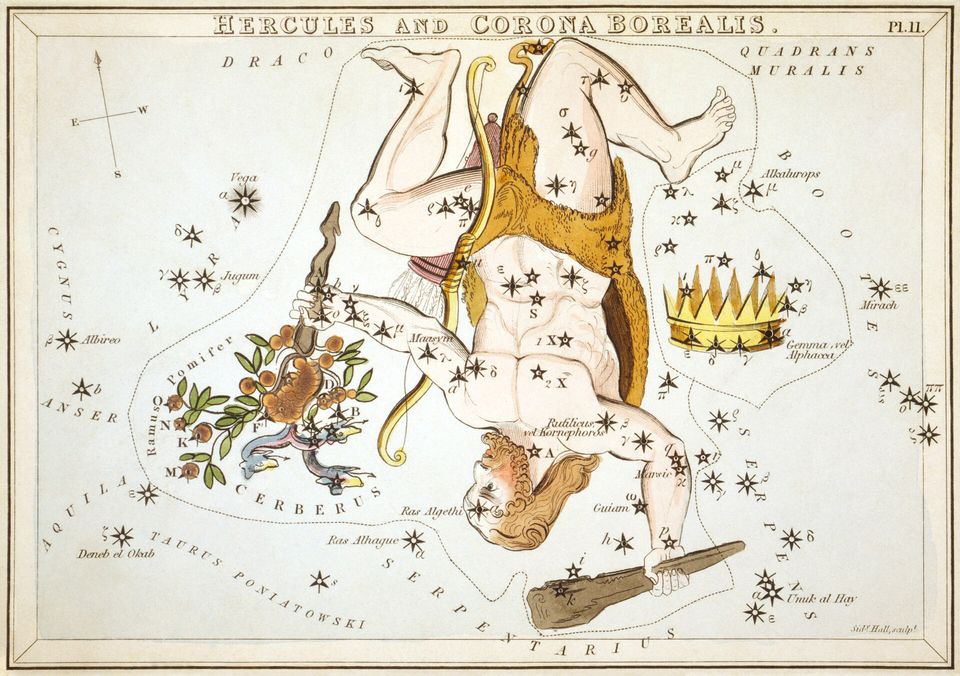
The constellation Corona Borealis is not a warrior's crown. It is not the crown of a king or the laurel of an athlete. It is Ariadne's crown.
And the story of Ariadne's crown does not begin with a wedding. It begins with abandonment.
Ariadne was the daughter of Minos, King of Crete. She was the one who understood the labyrinth — who knew the thread, who gave it to Theseus so he could kill the Minotaur and find his way back out. She saved him. She helped him accomplish the thing that would make him a hero.
And then Theseus sailed away without her.
The ancient sources vary in their accounts of why — some say he simply forgot her, others that a god commanded it, others that he left deliberately once she had served her purpose. What is consistent across every version of the myth is the image it leaves behind: Ariadne on the shore of Naxos, watching the ship disappear.
She had given everything. She had betrayed her own father for him. She had made his glory possible. And she was left alone on an island shore.
Dionysus found her weeping.
He came to the island — the god of wine, of ecstasy, of what cannot be contained — and he found her there. Not defeated. Weeping, but alive. Still present.
He fell in love with her.
He made her his wife, and he gave her a crown of gold set with nine gems — the crown that Vulcan had made, that Ovid describes as auro gemmisque novem, gold and nine jewels. When Ariadne died, Dionysus took the crown and threw it into the sky, where its gems became stars.
The seven brightest stars of Corona Borealis are Ariadne's crown, still turning overhead.
And Alphecca — the Gem, the Bright One at the centre — is the star that Manilius in the 1st century AD called the memorial of deserted Ariadne.
This is the essential quality the myth encodes:
The crown is not a crown of conquest. It is not inherited or seized. It is the gift that arrived after the worst that could happen. It was given by someone who looked at what Theseus left on that shore and saw not wreckage but someone worth crowning.
Dionysus did not find a broken woman. He found someone whose capacity for love and loyalty had survived intact the thing that had been done to her.
The crown in the sky is not a memorial to the abandonment. It is the evidence of what the abandonment could not destroy.
Muddy Reception vs. Clear Reception
The star does not change. Only the quality of the receiver changes what arrives.
The lower Alphecca frequency is lassitude — that word appears in the traditional record and it is precisely chosen. Not depression exactly. Not failure. A kind of disillusionment that sets in when the giving has not been met, when the person who carried the thread is not the one they tell stories about.
The lower expression waits. It gives but withholds something essential, keeping one thread back in case this person, too, sails away. It courts recognition through effort rather than through being — producing art, charm, accomplishment that is genuinely excellent and quietly, exhaustedly desperate to be seen. The person who decorates their surface because they learned to distrust what is beneath it.
Or the lower expression swings the other way entirely: the pleasure-seeking the medieval writers describe, the life of pure sensory and romantic indulgence as a substitute for the deeper thing that was taken away. Venus and Mercury without the Scorpionic depth that would give them meaning.
The Gem at the brow of the crown. The person who has been through the wound and emerged not hardened but clarified — with a quality of radiance that comes specifically from the journey through loss.
At its clearest, Alphecca produces the artist who writes from an interior that has been fully inhabited. The person who gives gifts — creative, intellectual, relational — not because they are seeking anything back but because what they contain is genuinely overflowing. The Venus-Mercury nature fully expressed: beauty and eloquence in the service of something true.
The crown is worn lightly. Not because it isn't real but because the person who wears it is no longer wondering whether they deserve to be there.
Dionysus knew. That is Alphecca.
Working With Alphecca
You do not need elaborate ritual. You need three things: your gaze, your intention, and something in the physical world that carries this star's resonance.
Fix your gaze on the arc of Corona Borealis and find the brightest star — the Gem at its mid-forehead. You are looking at Ariadne's crown.
Stone: Topaz · Herbs: Rosemary, trefoil, ivy
Natal Conjunctions
Find your conjunctions →An active and brilliant mind. Self-seeking at lower expression — the Sun wanting the crown to confirm its own worth. Subject to scandal that does not ultimately destroy the position. Preferment in writings, public affairs, and anything requiring the Sun's public facing brightness combined with Alphecca's artistic depth. At clearest expression: the identity is the Gem itself — not trying to acquire recognition but naturally drawing it.
Paran Interpretations
Find your parans →Parans form when Alphecca and a planet simultaneously occupy the four angles at your birth location. The planet's angle determines the life period: Rising = youth, Culminating = prime, Setting = later years, Nadir = lifelong foundation.
Parans are timing signatures — they mark which life period Alphecca governs for you personally. The four angles below (Rising, Culminating, Setting, Nadir) correspond to youth, prime, later years, and your lifelong foundation. This requires your birth date and place to calculate.
Your Fixed Stars reading names the stars on your planets and in your parans, and what each one means for you.
Get Your Fixed Stars Reading — $44Frequently Asked Questions
Is Alphecca ruling your life?
Your Fixed Stars reading names the stars on your planets and in your parans, and what each one means for you.
Get Your Fixed Stars Reading — $44