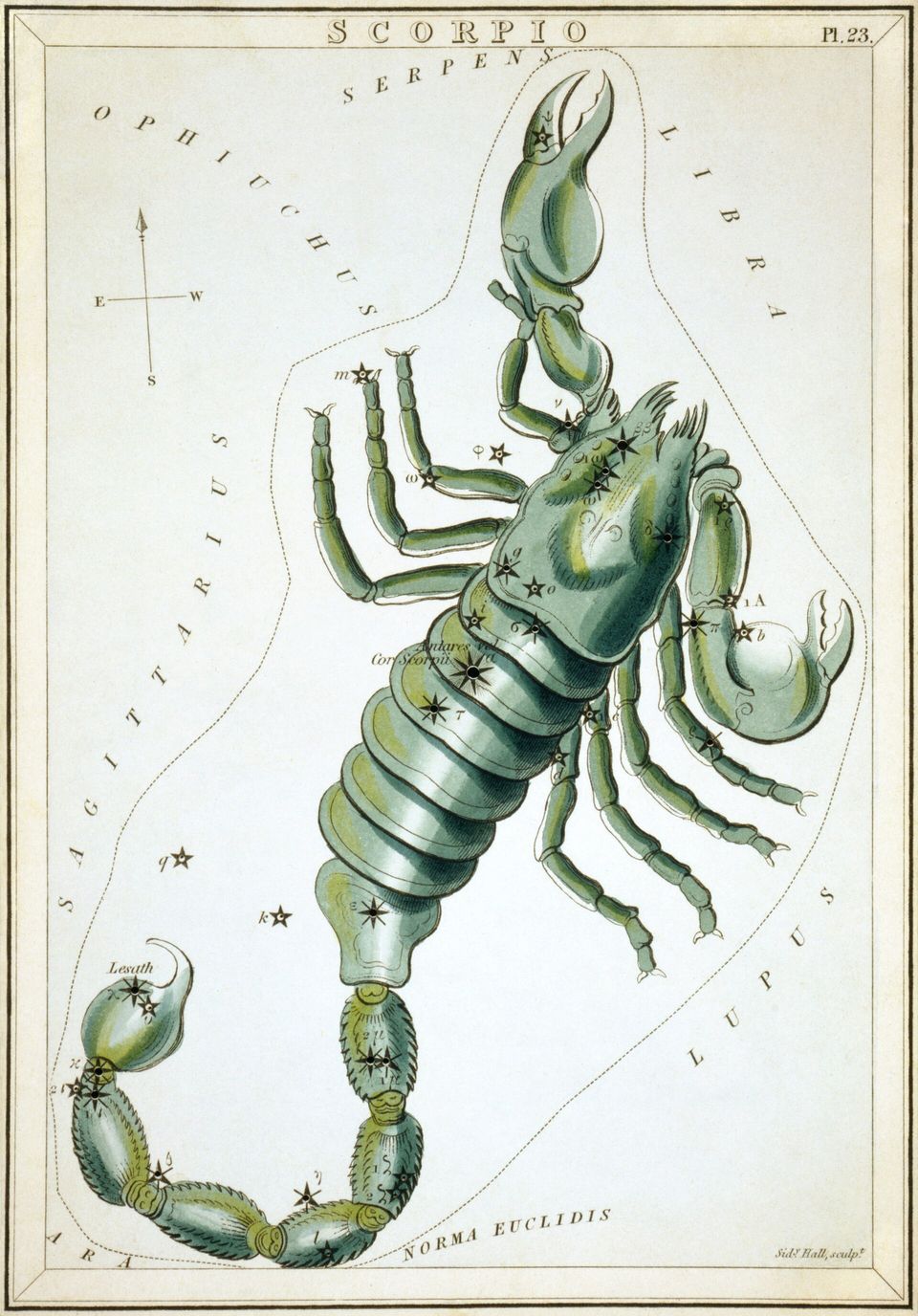
Antares in Astrology
Antares is the archetype of intensity that does not flinch.
Not the display of courage — the courage that needs to be seen, that performs its willingness to fight in order to be acknowledged for it. The scorpion is not performing. It is waiting. It is low to the ground in the shadow of the rock, armored by its own nature, its sting not raised but ready. When the moment comes, it does not hesitate.
The rival of Mars is not lesser than Mars. It is not imitating Mars. It is the thing that meets Mars as an equal — the intensity that matches the god of war's intensity not by being the same type of force but by carrying equivalent weight. Mars charges. Antares waits and then strikes precisely. These are not the same energy. They are rival energies: forces of equivalent magnitude operating by entirely different methods.
When Antares Is Angular
Antares carries additional weight when it falls on one of the chart angles, independent of any planet conjunction.
Riches and honor. Military honor and preferment. Violence. Sickness. Benefits seldom last. Mental alertness, strategic ability, and courage making daredevils. The star rising with the native marks the entire life with Antares's frequency — the intensity is present from the beginning, the armor is built in, the scorpion's quality is the quality of the person's engagement with the world. The note about benefits not lasting is worth attending: the honors come through intensity, and intensity is not a sustainable foundation for long-term consolidation. What the scorpion wins, it must win again. Also: unfortunate for the eyes, in the classical tradition's consistent warning.
Great honor through violence attended by difficulties and casualties. The career and public reputation organized around Antares's frequency — the person who becomes publicly known through the full range of what the scorpion heart can accomplish. The honor is genuine. The violence and casualties are the cost of the method. This contact in the tradition is one of the most explicit statements about the Antares paradox: the honor is not despite the violence. It comes through it, with it, inseparable from it.
Mythology & History
The Scorpion and Orion:
Every culture that watched the night sky carefully eventually noticed the same astronomical fact: Scorpius and Orion never share the sky at the same time. When Antares rises, Rigel and Betelgeuse have already set. When Orion climbs the eastern horizon in winter, Scorpius has descended in the west. The two great figures face each other across the zodiac and take turns being absent.
The Greeks explained this with myth.
Orion was the greatest hunter the world had seen — a figure of extraordinary scale and capacity, born (in the most widely preserved version of his origin story) of the combined generosity of three gods: Jupiter, Neptune, and Mercury. He carried their gifts in him simultaneously. He was enormous. He was skilled beyond any mortal hunter. And he made the boast that destroyed him: he announced that he would kill every creature on earth.
Gaia, the earth herself, could not allow the declaration to stand. She sent a scorpion.
In the version most consistently preserved, the scorpion did not meet Orion face to face. It did not charge at the great hunter across the open ground where he would have seen it coming, where his club and his skill would have applied. It came from below. It emerged from the earth itself — from a crack, from the low ground, from the place the enormous figure had no reason to watch. And it struck.
Orion died. The scorpion succeeded where nothing else had.
The gods placed both of them in the sky, but kept them separate — an eternal arrangement that acknowledges what happened without resolving it. The sky preserves the logic: these two cannot occupy the same space.
Antares is the Heart of the scorpion that killed the greatest hunter. Not by strength — the scorpion was not larger than Orion. Not by skill in the conventional sense — the hunt was not a fair contest between rivals of equal type. The scorpion won by going where the giant would not look, by using the one angle the enormous figure's confidence had left unguarded, by striking from the ground.
This is the Antares teaching, carried in the mythology: intensity deployed from below. The courage that does not require the opponent to see it coming.
The Four Royal Stars — Watcher of the West:
In ancient Persian astronomical tradition, going back to at least 3000 BCE, four stars held the sky's four directions and governed the turning of the year. They were the Watchers — the royal fixed points around which the celestial year organized itself.
Aldebaran, the red eye of Taurus, held the east — the spring, the rising, the beginning. Regulus, the heart of Leo, held the south — the height of summer, the zenith of power. Fomalhaut, in Piscis Austrinus, held the north by some reckonings. And Antares held the west.
The west is where the sun descends. The west is the direction of the dying light, of the year's decline, of the transition from what was into what will be. The Persians identified Antares as Satevis, one of the four Archangel stars. Later synthesis, working to correlate the Royal Stars with Archangels, associated this group variously with Gabriel, Raphael, Michael, and Uriel — though which correspondence went to which star varied across different traditions and should not be stated with false precision.
What is consistent: Antares governs the threshold of endings. The west where things complete themselves. The direction of the descending sun that is also the direction of the beginning of night. The Watcher of the West is the one who faces the direction that others find difficult to face — the direction of decline, of the closing of what was open.
Brady's research on the Persian tradition adds a specific layer: as the Watcher of the West, Antares was associated in some traditions with Yima, a god of the dead. The west for both Persian and Egyptian cosmology was the land of the dead — where the sun goes, where souls begin their journey. The Egyptians placed the entrance to the afterlife in the west. The direction this star watches is not simply autumnal or declining. It is the direction of the great transition.
The Hindu Tradition — Jyeshtha:
In Vedic astrology, the Moon passes through 27 (or 28) nakshatras — lunar mansions — on its monthly circuit of the sky. Antares falls in the region of Jyeshtha nakshatra, which spans from 16°40' to 30°00' Scorpius in the sidereal zodiac (using the Lahiri ayanamsa most commonly employed today). At approximately 15°46' Scorpius sidereal, Antares falls near the boundary between Jyeshtha and the preceding nakshatra Anuradha; interpretations vary by the precise ayanamsa used, and this should be understood as an approximate placement rather than a settled position.
The name Jyeshtha means "The Eldest" or "The Chief." It is the nakshatra of seniority, of earned authority, of the one who has been through enough that they carry genuine weight. The ruling deity is Indra — the king of the gods, the warrior deity, the one who defeats the serpent Vritra to release the waters of life. Indra is not a peaceful god. He is the god who fights the battles that cannot be avoided, who confronts the darkness that would hold the world in drought and stagnation.
Jyeshtha is associated with protection of the vulnerable — with the elder who uses their power not for personal accumulation but for the defense of those who cannot defend themselves. The symbol is a circular amulet: a talisman of protection, something worn against harm. This is Antares's Vedic face: the one who has earned the right to confront what is dangerous, who wears the capacity to protect as a permanent condition.
The Babylonian Record:
Babylonian astronomical texts, including the MUL.APIN compendium compiled around 1000 BCE and star catalogues dating back to at least 1100 BCE, recorded Antares as GABA.GIR.TAB — the Breast or Heart of the Scorpion. The same anatomical identification appears across the Babylonian, Arabic, Greek, and Roman traditions, with remarkable consistency: this star sits at the creature's center, its vital core.
In the MUL.APIN tradition, the star marks the breast of the goddess Ishara, who is associated with the scorpion constellation and connected to underworld powers. The Babylonian record, like the Greek myth and the Persian royal star tradition, consistently places Antares at the intersection of intensity, underworld passage, and the forces that operate from concealment.
Muddy Reception vs. Clear Reception
The star does not change. Only the quality of the receiver changes what arrives.
The Antares energy without consciousness is the intensity that has become compulsive. The scorpion that cannot stop stinging — not because it is evil but because the sting is its nature and it has not yet learned when to withhold it. The native whose courage becomes recklessness, whose willingness to go into the dangerous territory becomes a refusal to recognize when the dangerous territory should not be entered. The person who generates crises because the only state in which they feel fully alive is the heightened state of genuine stakes.
Robson's catalogue of muddy Antares expressions includes: malevolence, destructiveness, rash and headstrong behavior, self-destruction through obstinacy. The tradition notes at the lower frequencies: suspicion of friends, accusations, difficulty in business relationships, the intensity that poisons the very connections it needs. The person who burns what they are trying to warm themselves beside.
At this end of the spectrum, the martial honors the tradition consistently attributes to Antares arrive with what one classical source called exactly that phrasing: "difficulties and casualties." The honor is real. So are the wounds. The native reaches genuine eminence and finds that the path there left marks they hadn't intended to leave.
The sacred warrior: the full Antares archetype with consciousness behind it. The person who has learned exactly when the intensity is required and can withhold it completely until that moment arrives, and then act with everything they have. The protection of the vulnerable, which Jyeshtha carries as its highest note — using the scorpion's power not for the scorpion's sake but for those who cannot access that kind of force themselves.
At the clearest expression, the rival of Mars is not competing with the war god — it is the complementary force that Mars cannot be. Mars charges forward with the full display of its power. Antares is the thing that moves when Mars is looking the other way, that operates from the direction the confident hero wasn't watching, that wins by understanding the terrain rather than by overwhelming it.
This is also the Watcher of the West at full expression: the willingness to face the direction of endings. The one who can sit with what is completing itself — the declining light, the year's dark threshold, the transition that others call terrifying — and hold that vigil without breaking. The courage that does not require forward motion is sometimes a deeper courage than the charge.
Working With Antares
You do not need elaborate ritual. You need three things: your gaze, your intention, and something in the physical world that carries this star's resonance.
Fix your attention on the Heart of the Scorpion — not the sting, not the claws, but the center. The pulse at the core of the creature. The red light in the chest of the thing that faces west.
Stone: Sardonyx and amethyst · Herbs: Long aristolochy and saffron
Is the sacred warrior's courage available in you only when the situation is already critical — or can you hold that quality before the fight begins?
Natal Conjunctions
Find your conjunctions →Pretended or genuine religiosity — the tradition is careful about this distinction and so must we be. At the lower expression: insincere honor, positions attained through the display of fervor rather than its substance, "honor and riches ending in disgrace and ruin" in Robson's precise phrase. At the higher expression: the identity organized around genuine conviction, military or religious preferment that is earned, the native whose solar force carries the scorpion's absolute commitment to their purpose. The danger to the right eye appears in multiple classical sources and should be noted without mystification — traditional astrologers consistently observed this correlation, the mechanism of which is not clear. The Sun through Antares carries the full honor-and-risk tension of the star without mediation: what this person is carries both the gift and the wound in undivided form.
Paran Interpretations
Find your parans →Parans form when Antares and a planet simultaneously occupy the four angles at your birth location. The planet's angle determines the life period: Rising = youth, Culminating = prime, Setting = later years, Nadir = lifelong foundation.
Parans are timing signatures — they mark which life period Antares governs for you personally. The four angles below (Rising, Culminating, Setting, Nadir) correspond to youth, prime, later years, and your lifelong foundation. This requires your birth date and place to calculate.
Your Fixed Stars reading names the stars on your planets and in your parans, and what each one means for you.
Get Your Fixed Stars Reading — $44Frequently Asked Questions
Is Antares ruling your life?
Your Fixed Stars reading names the stars on your planets and in your parans, and what each one means for you.
Get Your Fixed Stars Reading — $44