Asterion in Astrology
The architecture of Asterion is defined by four core dimensions:
The Nature: The Starry Beast. A paradox of raw, primal instinct and high, celestial intelligence. It is the realization that the animal nature is not a monster to be destroyed, but the vessel of the star itself.
The Domain: The Labyrinth and the Trail. The dark meanders of the human mind, the complex structures of society, and the wilderness of the cosmic track.
The Gift: The penetrating mind. An absolute, unwavering capacity for focus, investigation, and tracking. The ability to find a signal in the absolute dark, to see through complexity, and to earn profound respect through silent, dedicated service.
The Wound: The Minotaur's isolation. A deep, Saturnian melancholy; the feeling of being shut away from the "royal court" of humanity; the sense of being treated as a monster or an outcast because of one's raw, uncompromised instincts. The trauma of the stolen inheritance.
Mythology & History
In the mythological topography of ancient Crete, the name Asterion carries a dual, paradoxical weight. It is the name of two distinct figures whose stories trace the descent of celestial light into the physical meanders of the earth:
The Sovereign Container: King Asterion of Crete
The first Asterion was the sacred King of Crete, son of Tectamus (or, in alternative lineages, of Neleus and Chloris). He represents the mortal vessel designed to harbor divine seed. When Europa was carried across the wine-dark sea by Zeus in the guise of the solar Cretan Bull, King Asterion took her as his queen. He adopted and raised her three demigod sons—Minos, Rhadamanthus, and Sarpedon—who would later become the ultimate judges of the Underworld and the guardians of cosmic justice. By marrying the woman touched by the divine bull, King Asterion sanctified the union of the earthly court with the starry heavens. Upon his death, he passed his kingdom to Minos, providing the legal and structural inheritance upon which the Cretan empire was built.
The Starry Beast: Asterion the Minotaur
The second Asterion is the tragedy at the center of the palace. When Minos refused to sacrifice the magnificent white bull sent by Poseidon, the god cursed his queen, Pasiphae, with an unnatural passion for the beast. The offspring of this union was a child named Asterion—though the Greeks, coining a moniker of fear, called him the Minotaur (the Bull of Minos). He possessed the body of a man but the head of a sacred bull.
The compiler of the Bibliotheca (III.1.4) explicitly records: "And she gave birth to Asterius, who was called the Minotaur." His true birth name was Asterion—the Starry One.
To hide this living monument of broken covenants, King Minos commissioned Daedalus to build the Labyrinth: a dark, winding stone prison of infinite meanders. In his classic studies, mythologist Karl Kerenyi points out that fifth-century coins from Knossos depict the meander of the Labyrinth on the reverse, with a star-rosette or a sickle moon placed precisely at the center. The Labyrinth was not merely a dungeon; it was a physical map of the night sky or the underworld meanders, and the Minotaur—Asterion—was the star at its core. He is the divine, primordial light trapped within the dense, twisting walls of mortal flesh and intellectual complexity.
The Hunting Dogs
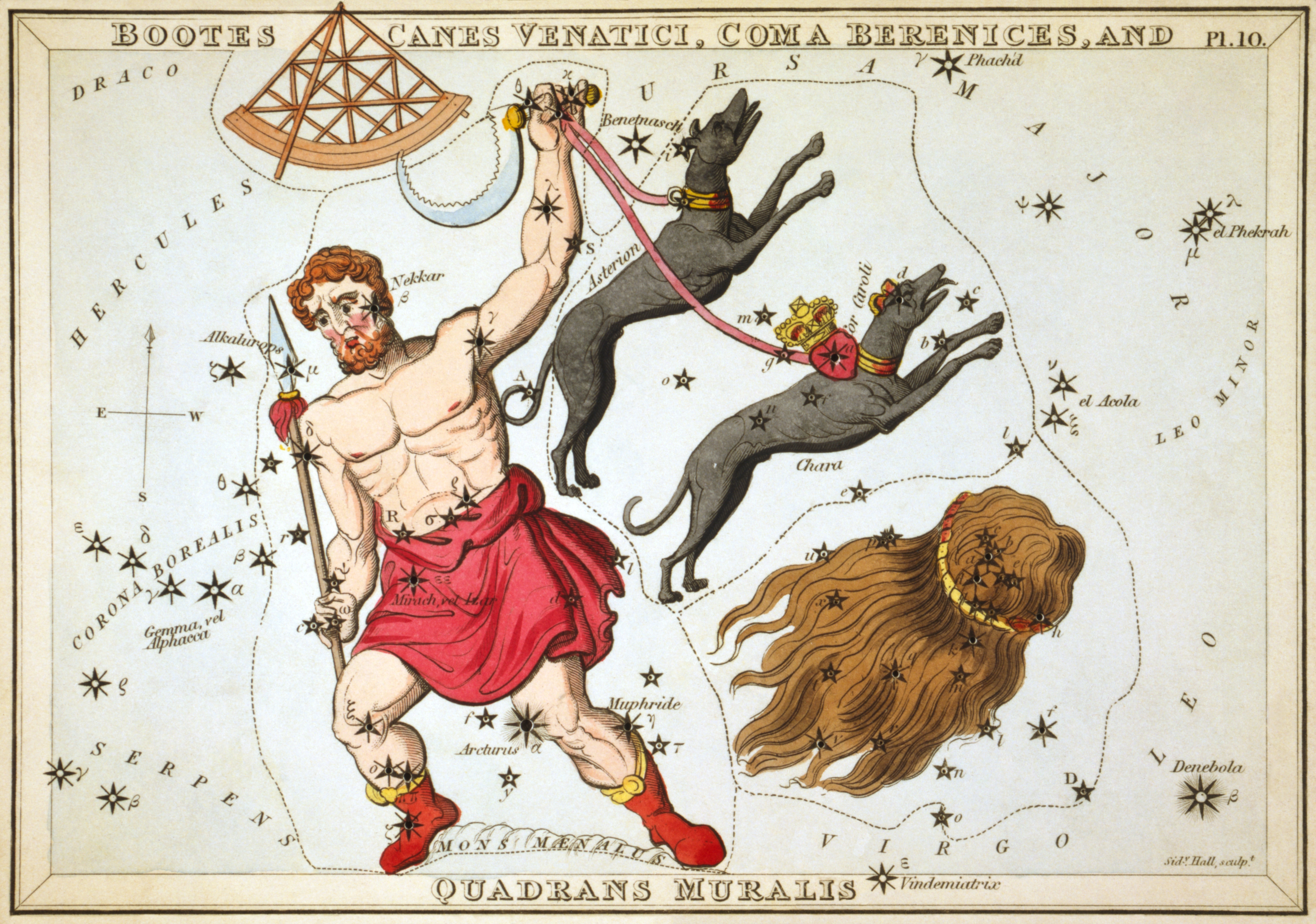
In the sky, Asterion is held on a leash by Boötes the Herdsman. The dog does not run free; it is tethered, sniffing the cosmic wind, pursuing the Great Bear (Ursa Major) around the northern pole. This represents the mind as a hunting hound—relentless, focused, sniffing out the scent of the divine through the dark forest of material life, tracking the eternal rotation of cosmic fate.
Paran Interpretations
Find your parans →Parans form when Asterion and a planet simultaneously occupy the four angles at your birth location. The planet's angle determines the life period: Rising = youth, Culminating = prime, Setting = later years, Nadir = lifelong foundation.
Parans are timing signatures — they mark which life period Asterion governs for you personally. The four angles below (Rising, Culminating, Setting, Nadir) correspond to youth, prime, later years, and your lifelong foundation. This requires your birth date and place to calculate.
Your Fixed Stars reading names the stars on your planets and in your parans, and what each one means for you.
Get Your Fixed Stars Reading — $44Is Asterion ruling your life?
Your Fixed Stars reading names the stars on your planets and in your parans, and what each one means for you.
Get Your Fixed Stars Reading — $44