Biham in Astrology
Core Synthesised Meaning: The Sentinel of the Thirsty Camels / The Celestial Spring of Varuna.
Nature: Exceptionally intuitive, highly ambitious, dreamily enthusiastic, and alchemically sharp; holding absolute poise at the boundary of flight.
Domain: Aviation and aeronautics, pharmaceutical research, deep-sea archaeology, diplomatic mediation, and the direction of large-scale environmental transitions.
Gift: The capacity to rise above extreme material or relational difficulties (flight); grounding high, intuitive currents into permanent, scientific forms (Shatabhisha); speaking with the diagnostic voice of the hundred healers.
Wound: The Bellerophon fall; sudden downfalls, accidents, or public downfalls due to unmanaged arrogance or caprice; chronic jaw, jaw-joint, or throat tension; carrying the silent weight of unexpressed spiritual longings.
Mythology & History
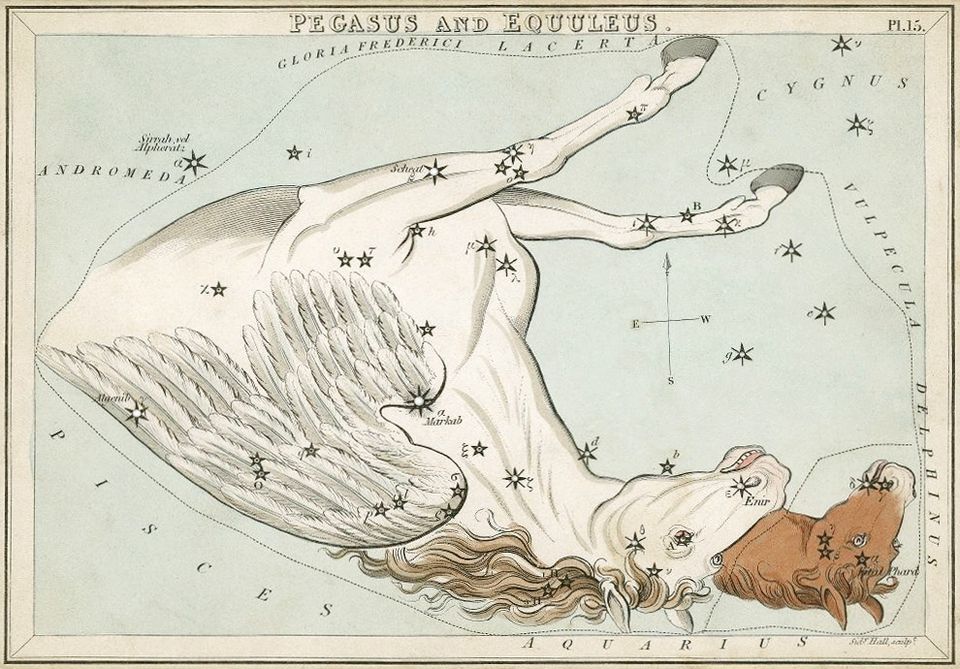
Biham’s mythological identity is nested in the birth of the Winged Horse, the tragic fall of Bellerophon, and the binding oaths of Varuna.
The Blood of Medusa:
In Hellenic myth, Pegasus was born from the blood of the gorgon Medusa after Perseus cut off her head. Pegasus represents the sublime synthesis of wisdom (Medusa) and raw emotion (his father Poseidon/Neptune). Tamed by the hero Bellerophon with a golden bridle, the winged horse fought and slew the fire-breathing Chimaera.
However, filled with hubris, Bellerophon attempted to fly Pegasus to the summit of Mount Olympus to enter the company of the gods. Offended by this arrogance, Zeus sent a gadfly to sting Pegasus, causing him to rear. Bellerophon fell back to Earth, wandering the rest of his days blind, lame, and reproached by all. Pegasus continued his course, entering heaven to carry Zeus' lightning bolts. The winged horse represents the capacity of the soul to rise above material difficulties, but warns of the "Pegasus Syndrome"—the risk of overreaching one's potential and the painful descent that restores humility.
The Thirsty Beasts:
Ptolemy assigned to the stars of Pegasus the planetary nature of Mars and Mercury, representing ambitious drive, high intuition, enthusiasm, but a risk of caprice and bad judgment.
In the Vedic tradition, the star resides in Shatabhisha, presided over by Varuna, the god of cosmic laws, ocean currents, and binding oaths. Shatabhisha is symbolized by a circle or a hundred healers, representing the silent containment of secrets and the restorative, celestial waters that cure all diseases.
Muddy Reception vs. Clear Reception
The star does not change. Only the quality of the receiver changes what arrives.
Expresses as a state of chronic vanity, restless ambition, and emotional instability. The native acts as Bellerophon without the bridle, driving their life-vehicle with self-willed force, crashing into every transition due to an uncontrolled ego (the shadow of the ungrounded Mars-Mercury nature). They reject all advice, falling victim to physical and spiritual blindness. They suffer from severe jaw and vocal cord blockages, choking on their own unexpressed thirst, unable to find their footing in the material world.
The highest expression of the "Shatabhisha Sentinel." Here, the native operates as a master alchemist of Varuna's spring. They do not fight their limitations; they use the Saturnian yokes as the very reins that guide their flight. Guided by the brilliant white light of Pegasus, they stand at the gate of the cosmic circle, using their sharp, A2V intellect to satisfy their deep spiritual thirst, standing as exceptionally stable, warm anchors who use their voice to heal their community and guide humanity to the shores of Olympus.
Paran Interpretations
Find your parans →Parans form when Biham and a planet simultaneously occupy the four angles at your birth location. The planet's angle determines the life period: Rising = youth, Culminating = prime, Setting = later years, Nadir = lifelong foundation.
Parans are timing signatures — they mark which life period Biham governs for you personally. The four angles below (Rising, Culminating, Setting, Nadir) correspond to youth, prime, later years, and your lifelong foundation. This requires your birth date and place to calculate.
Your Fixed Stars reading names the stars on your planets and in your parans, and what each one means for you.
Get Your Fixed Stars Reading — $44Is Biham ruling your life?
Your Fixed Stars reading names the stars on your planets and in your parans, and what each one means for you.
Get Your Fixed Stars Reading — $44