Canopus in Astrology
Canopus is the archetype of the navigator who holds course.
Not the hero who seeks the prize. Not the sailor who works the rigging or rows through the storm. The pilot: the one whose specific knowledge is where things are, where you are going, and how to hold the course between here and there in the dark, in unknown water, when everything familiar is behind you.
This is an archetype of orientation. Of knowing — not through vision of the goal, but through reading of the present sky, the present current, the present wind — where you actually are. The navigator cannot afford to believe the ship is where he wishes it to be. He must know where it is.
Mythology & History
The Pilot:
The figure behind the star is not a hero.
Canopus was not Jason, who commanded the voyage. He was not Heracles, who pulled the oars with the strength of a god. He was not Orpheus, who charmed the sea with his music, or the Dioscuri, who calmed the storms. Canopus was the pilot — the kubernêtês, the one who holds the helm — of a different fleet entirely, the fleet of Menelaus returning from the wreck of Troy.
This distinction matters enormously. The great stories of the Argo are about the quest, the golden prize at the journey's end, the hero's transformation. The story of Canopus is about the return. Not the going-out in glory but the coming-back: the long, difficult, storm-battered voyage home from a war that was itself a catastrophe. The pilot who guides the ship home after the extraordinary thing has already happened. Who holds the rudder in the dark, through unknown waters, so that the people who survived can reach land.
He died before he finished. He got the fleet to Egypt and then he died there, far from home, doing the work. A monument went up. A city was named. A star — the star you steer by when you are south enough to see it — was given his name.
The Coptic name Kahi Nub, Golden Earth, is not a myth but an image: the thing of immense value that lies at the foundation, at the level of the ground and the water, that makes the journey possible without being seen from the bow of the ship.
The Argo:
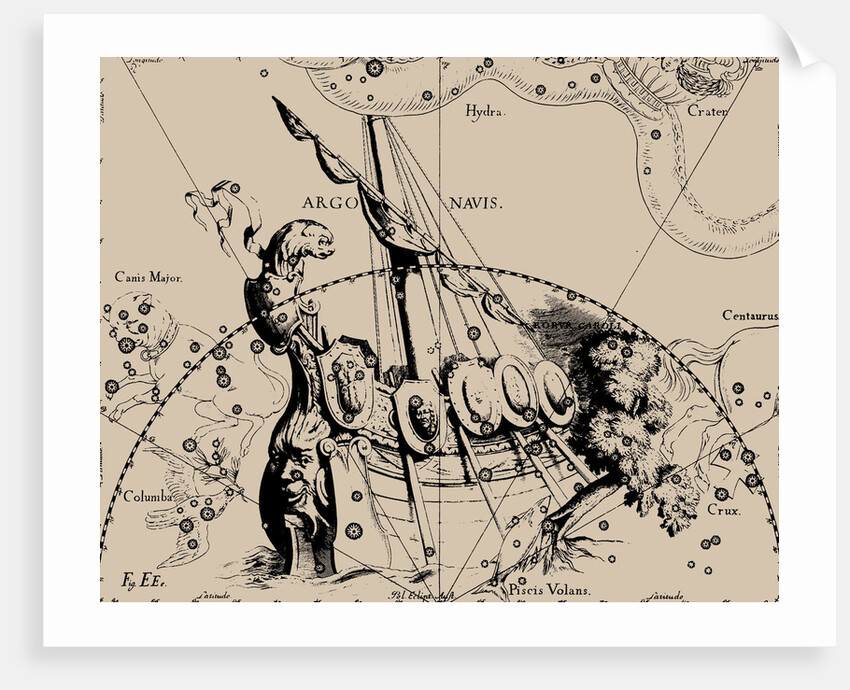
Canopus is the Alpha of Carina — the brightest star in the Keel of the ship. It was once the Alpha of the entire constellation Argo Navis, the great Ship Argo, before the French astronomer Lacaille divided the unwieldy mega-constellation in 1752 into its components: Carina the Keel, Puppis the Stern, Vela the Sails.
The constellation it anchors is the ship that carried Jason and the Argonauts to Colchis in search of the Golden Fleece — traditionally held to be the first ship ever built, the vessel that opened the sea to human ambition. The bright stars of Argo Navis were assigned by Ptolemy the nature of Saturn and Jupiter: not the passionate warrior-nature of Mars, not the brilliant mental speed of Mercury, but the combination of deep time, wisdom, gravity, and the expansion that comes with knowledge of the world.
The ship that goes out and returns. The keel is what the ship is built upon — the lowest structural member, the bone of the vessel, the thing that holds the hull together and cuts the water. Without the keel the ship is a raft, not a ship; it cannot steer, cannot hold a course, cannot survive a crossing. The keel is invisible from above. No one stands on the keel or polishes it or praises it. But remove it and everything else becomes wreckage.
The Egyptian Connection:
The city of Canopus on the Nile Delta was one of the most important port cities in the ancient Mediterranean world. It was a center of commerce, of the cult of Serapis (the syncretic deity combining Osiris and the sacred bull Apis — the Egyptian god of the afterlife meeting the Greek world), and later a site of genuine philosophical ferment. The ancient accounts describe it as a place of pleasure, of foreigners, of the mingling of peoples and traditions. The city where Greek and Egyptian culture first truly met.
The Serapeum there — the great temple to Serapis — was where Ptolemy worked. Serapis was the face of Osiris in his chthonic aspect: lord of the lower world, of death and transformation, of what lies beneath. The city named for the pilot of the homecoming voyage became the place where the sky was mapped from. From Canopus the astronomer, mapping the southern stars that were invisible from Athens or Rome.
There is also the tradition, noted in the source material, that Canopus was worshipped on the Nile as far back as 6400 BC — which would place its veneration in the predynastic period. The form of this worship is not fully documented in the sources I have access to, so this claim should be held as attested but not elaborated with specifics.
Agastya:
In the Vedic tradition, Canopus is identified with the sage Agastya — one of the great rishis, the seers of ancient India.
The myth of Agastya that is most relevant here: the ocean, that vast and seemingly unconquerable force, became a hiding place for demons. They had been defeated in battle by the gods and retreated into the sea, concealing themselves in its depths, beyond reach, beyond sight. From there they raided by night, destroying the sacred fires and disrupting the order of the world. The gods could not fight what they could not find. The ocean protected the demons and would not yield its secrets.
The gods went to Agastya. The sage was known for a power that went beyond ordinary spiritual practice — he was said to possess the capacity to drink the ocean dry. He was invited to come to the shore and perform this feat, to reveal what was hidden in the depths so the gods could finally prevail.
Agastya walked to the sea and he drank it.
The entire ocean. He held it within himself until the demons, stranded on the revealed seabed, could be defeated. Then he released what he had contained.
The myth has the quality of a cosmic impossibility made briefly actual: the thing that seemed permanent and unconquerable turned out to be containable — not by force, not by war, not by cleverness, but by the capacity of one person to hold within themselves what others could not hold, long enough for the impossible to be accomplished.
In Vedic astrology, Agastya is associated with the star's heliacal rising — particularly important for navigation in the Indian Ocean, where sailors tracked Canopus's appearance as a guide to the southern skies. The connection between the sage who mapped human knowledge and the star that mapped the southern celestial pole is exact.
The Old Man of the South Pole:
The Chinese sky-watchers called Canopus Laoren — the Old Man — and named the asterism containing it Laoren Xing, the Star of the Old Man (also translated as the Star of the South Pole). This asterism was associated with longevity, with a contented old age well-lived, with the attainment of wisdom across time. In Chinese astronomical tradition, the appearance of the Old Man Star was taken as an auspicious omen for the emperor and the state — its visibility predicted long rule, prosperity, and peace. Its absence from the sky was an ill sign.
The Old Man is not the young hero who sets out. He is the one who has made the voyage, survived it, arrived, and now knows what the ocean costs. He holds his knowledge lightly because he knows how much he does not know. He has been south enough to see what most people never see.
Muddy Reception vs. Clear Reception
The star does not change. Only the quality of the receiver changes what arrives.
The Canopus energy without consciousness is the restlessness that cannot be stilled. The insistence on moving, on voyaging, on new knowledge — that will not or cannot settle into the ordinary business of domestic life. The person who is extraordinarily capable in the world at large and mysteriously incompetent at the breakfast table. Who can navigate unknown oceans but not the needs of a person who sleeps beside them.
At the muddier end there is also the weight of the star's history with loss through those trusted: the navigator's absence means those at home are also waiting, also exposed, also navigating without their own pilot. The sources note loss through friends, trouble through enemies, legal difficulties — the difficulties of someone whose energies are dispersed across great distances and who cannot tend what is near.
The Jupiter-Canopus shadow is the one the tradition names most sharply: honor and preferment, but reversal through public dissatisfaction. The recognition arrives — and then overreaches. The compass that reads correctly is used to justify an overcorrection. Religion used for business ends. The comprehensive knowledge that becomes certainty, and then becomes the thing that closes the mind it was supposed to open.
The Old Man of the South Pole: wisdom worn lightly, because the person who has truly accumulated it knows how much remains unknown. The comprehensive knowledge of Canopus at its clearest is not pride — it is the capacity for orientation that makes you useful to every vessel passing through.
The pilot does not need to be the hero. He needs to get the ship home. Whether songs are sung about it is not the question. The question is whether the people aboard survive to sing about anyone at all.
The transformation of evil to good — the tradition's most distinctive attribution for this star — is clearest here: the Canopus person at their highest reception is not the one who avoided the dark water. They are the one who crossed it, who knows it from the inside, who can now hold a course through it for others. Kahi Nub, Golden Earth: the luminous thing at the foundation, in the water, giving the whole structure its direction.
Working With Canopus
You do not need elaborate ritual. You need three things: your gaze, your intention, and something in the physical world that carries this star's resonance.
Fix your attention on the rudder — not the bow of the ship, not the hero at the mast, but the stem-post where the rudder hangs, half in the water, touching both the vessel's weight and the sea's resistance. The small thing that determines the entire course.
Maps, charts, compasses — instruments of orientation, of knowing where you are.
What am I willing to navigate all the way through, without turning back, so the people aboard can reach shore?
Natal Conjunctions
Find your conjunctions →Fame possible, though the sources suggest it may not be lasting in nature. Preferment in business and public matters. The identity carries Canopus's navigating quality — an ability to orient in complex situations that tends to attract public recognition, though the same sources note domestic affliction, possible trouble with parental figures, and a need for vigilance around financial decisions. The Sun here wants to make the voyage visible; the star's nature suggests the real work is in the holding of the rudder, not the arrival.
Paran Interpretations
Find your parans →Parans form when Canopus and a planet simultaneously occupy the four angles at your birth location. The planet's angle determines the life period: Rising = youth, Culminating = prime, Setting = later years, Nadir = lifelong foundation.
Parans are timing signatures — they mark which life period Canopus governs for you personally. The four angles below (Rising, Culminating, Setting, Nadir) correspond to youth, prime, later years, and your lifelong foundation. This requires your birth date and place to calculate.
Your Fixed Stars reading names the stars on your planets and in your parans, and what each one means for you.
Get Your Fixed Stars Reading — $44Frequently Asked Questions
Is Canopus ruling your life?
Your Fixed Stars reading names the stars on your planets and in your parans, and what each one means for you.
Get Your Fixed Stars Reading — $44