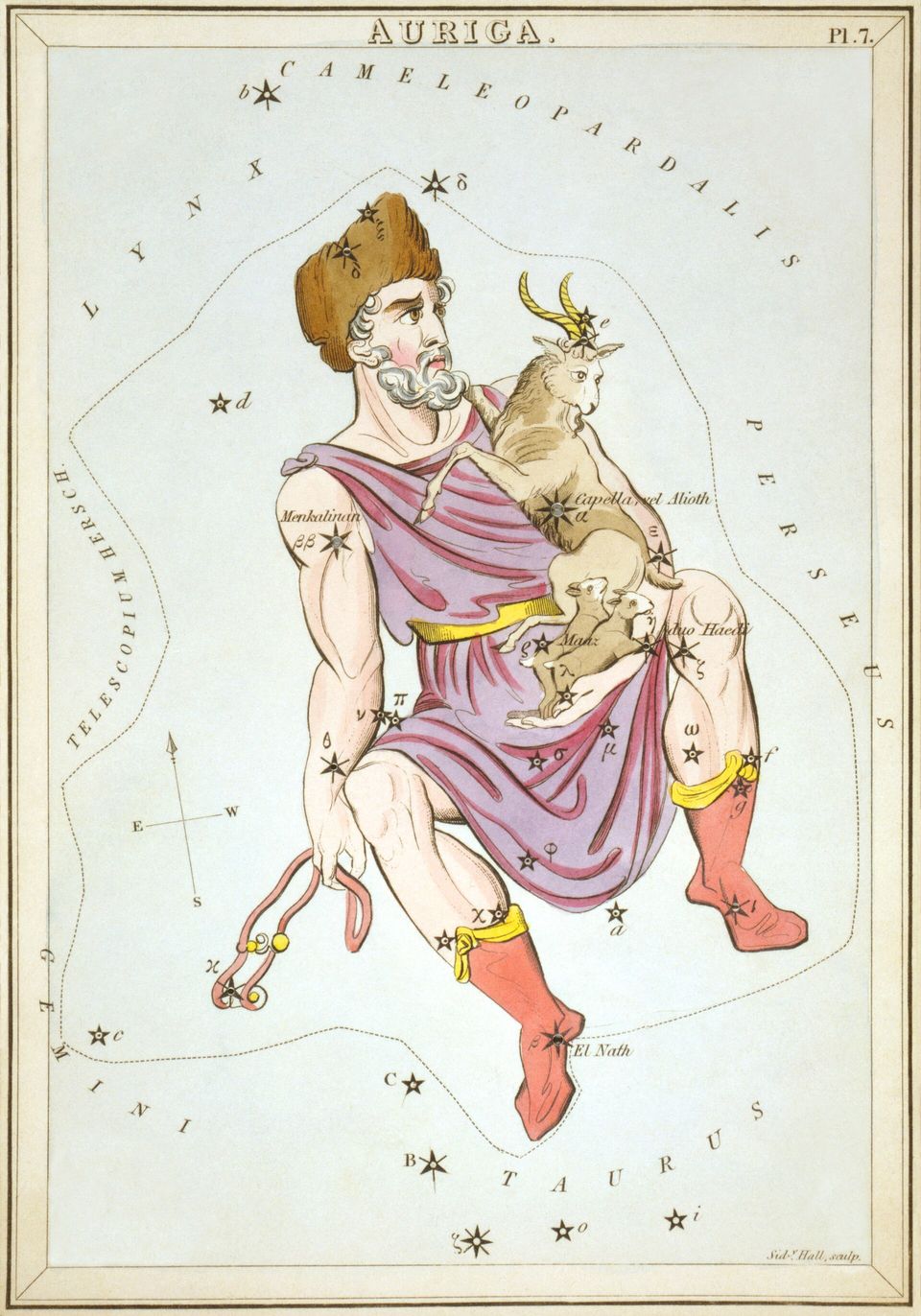
Capella in Astrology
Capella is the archetype of the nourisher who sustained the god before the god could sustain himself.
This is not the same archetype as the mother who gives birth, or the teacher who transmits knowledge, or the benefactor who endows a legacy. Amalthea's act was more specific: she provided what was needed during the period of concealment, when the divine potential was hidden and helpless and could not yet be what it would become. The nursing happened in secret. There was no recognition at the time, no reward during the period of service. The goat in the cave did not know she was nursing the future ruler of Olympus. She nursed the infant in front of her.
The horn that broke in play was not broken deliberately. It was broken in the ordinary contact between a living creature and the god she was caring for. The breaking was accidental — and from it came inexhaustible abundance. The Cornucopia is not a created object; it is what happened when Amalthea's ordinary horn broke under the pressure of the ordinary.
Mythology & History
Amalthea:
The myth begins with a problem that no god should have: a father who eats his children.
Kronos, the Titan who ruled before Zeus, had been warned by prophecy that one of his own offspring would overthrow him, just as he himself had overthrown his father Ouranos. His solution was to swallow each child his wife Rhea bore, one by one, before they could grow old enough to threaten him. Rhea endured this for five children — Hestia, Demeter, Hera, Hades, Poseidon — each swallowed at birth. When she was pregnant with Zeus, her sixth, she had reached the limit of what she could bear.
Rhea traveled to Crete. She gave birth to Zeus in a cave on Mount Ida — or, in the variant preserved by some sources, on Mount Dikte. Then she wrapped a stone in swaddling clothes, returned to Kronos, and presented the stone as the newborn infant. Kronos swallowed it without question.
The real infant remained hidden in the cave on Crete.
A goat named Amalthea nursed him. The sources are not unified on exactly what Amalthea was — some say she was the goat herself, divine in her own right; others say she was a nymph who fed the child on goat's milk and honey, with Melissa her sister. But the image that survived across centuries is the one that became the star: a she-goat in a cave, providing milk to the hidden infant god.
The versions of the story told by Manilius, Aratus, Pliny, and Ovid all preserve what happened next, and here the myth reaches its pivot. One day, as Zeus played — for even infant gods play — one of Amalthea's horns broke off. The broken horn then did something extraordinary: it began to overflow with whatever was needed. Food, flowers, fruit — whatever was called for appeared from it. This was the origin of the Cornucopia — the Horn of Plenty — and the word cornucopiae is simply the Latin phrase for that: the horn of abundance.
The ancient sources differ on the details. Some say the infant Zeus himself broke the horn while playing too roughly with the goat. Some say it broke naturally and the horn's overflowing abundance was Amalthea's gift to the child she had nursed. Some say Zeus later fashioned a horn from his own power and gave it to her in gratitude. What all versions agree on is that a horn broke, abundance came out of the breaking, and the horn became a symbol that passed through the ancient world as the image of inexhaustible plenty.
When Zeus grew to his power and overthrew Kronos — fulfilling the prophecy Kronos had tried to prevent — he did not forget the goat who had sustained him in the cave. He placed her in the sky. Manilius wrote of this placement as a reward and an honor: the nursing goat, repaid with heaven.
The two kid stars in the constellation — Hoedus I and Hoedus II, the Haedi — are sometimes said to be Amalthea's own offspring, placed beside her.
The Charioteer:
The constellation's secondary mythological identity — Erichthonius — adds a dimension worth noting. According to Apollodorus and the tradition recorded by Hyginus, Erichthonius was born of the earth after Hephaestus attempted to assault Athena. She refused him; his seed fell to the earth; the earth bore a child. Athena took the infant and raised him. He was lame from birth, and his lameness was his shame — but he turned it into ingenuity. He invented the four-horse chariot, the quadriga, as a way of moving through the world without his deficiency being visible.
Athena rewarded his invention with a place in the sky.
The two mythological identities of Auriga — the goatherd and the ingenious inventor — coexist in the constellation and both contribute to what the stars within it transmit. The same figure who carries the nurse-goat on his shoulder is the one who found a way to transform limitation into mastery.
Muddy Reception vs. Clear Reception
The star does not change. Only the quality of the receiver changes what arrives.
The Capella energy without consciousness is the curiosity that will not resolve. The questions keep coming — about everything, quickly, moving on before the last answer has landed — and the native can become timorous, the word Robson uses, anxious at new information precisely because they have sought so much of it. The loquacity noted by nearly every ancient source is the shadow of the same quality that makes Capella natives vital companions and brilliant conversationalists at the higher register: at the lower end, the speech runs faster than the thought, and what is said is misunderstood or criticized before it can be corrected.
The domestic disharmony attributed to Capella across multiple sources — Robson is consistent, the planet conjunction entries return to it repeatedly — is the natural consequence of this restlessness. The charioteer is always moving. The goat is on his shoulder. He has places to go. The home requires a quality of settled, patient presence that does not come naturally to the Capella frequency, and the relationships built in that domestic space feel the absence.
The Cornucopia shadow is subtler. From the breaking of the horn came inexhaustible abundance — but what does inexhaustible abundance do to the one who holds it? The tradition notes: money made but not kept. Fond of luxury and pleasure. Extravagant. The abundance flows in and flows out. The Horn of Plenty does not accumulate — it pours.
The full Amalthea quality. The nourisher who acts before recognition. The support offered during the period of concealment, when the one being sustained cannot yet show what they will become. Manilius's line — the Nursing Goat's repaid with Heaven — describes the promise: the reward comes, but it comes after the service, not as its precondition.
The horn that broke became the Cornucopia. The abundance that flows from Capella at its clearest is not held back by the question of whether the giver will be remembered for giving. The goat in the cave nursed the hidden god. That was enough.
At the clearest expression: the Capella native is the person who feeds the not-yet-famous, who sustains the not-yet-recognized, who has genuine renown (the sources promise this) and wears it without the restlessness that drove them here exhausting the relationships around them. The civic honors. The eminent friends. The public position of trust. These arrive. The tradition is reliable on this. What the tradition asks is: can the native hold what they receive without the compulsion to keep moving, keep seeking, keep the horn pouring?
Working With Capella
You do not need elaborate ritual. You need three things: your gaze, your intention, and something in the physical world that carries this star's resonance.
Fix your attention on the image of the cave on Crete. The infant Zeus, hidden from his father, dependent on what is provided. And the goat — not a divine goat, not a goat who knew what she was doing — providing milk because this is what she had to give, because the creature in front of her needed it.
Stone: Sapphire — associated in the Western tradition with truth, loyalty, and clarity of mind. The stone of fidelity to what one knows. Not the flash of new information but the depth of settled understanding. · Herbs: Horehound, mint, mugwort, mandrake — plants historically associated with clarity, protection, and the opening of what is blocked.
Who or what are you sustaining in the dark — and are you willing to keep giving before the god reveals himself?
Natal Conjunctions
Find your conjunctions →Vacillating, changeable, loquacious, quick speech, misunderstood and criticized; martial honor and wealth — and when the Moon or Jupiter is also present, ample fortune and great honor. The Sun through Capella carries the archetype's central paradox at the level of identity: the native who is genuinely gifted, genuinely curious, genuinely vital, and who also moves through public life in ways that attract both admirers and criticism. The loquacity is named directly. The impulse toward quick, abundant communication that is the gift is also the source of the misunderstanding. The honors come. So does the criticism. The tradition holds both without apology.
Paran Interpretations
Find your parans →Parans form when Capella and a planet simultaneously occupy the four angles at your birth location. The planet's angle determines the life period: Rising = youth, Culminating = prime, Setting = later years, Nadir = lifelong foundation.
Parans are timing signatures — they mark which life period Capella governs for you personally. The four angles below (Rising, Culminating, Setting, Nadir) correspond to youth, prime, later years, and your lifelong foundation. This requires your birth date and place to calculate.
Your Fixed Stars reading names the stars on your planets and in your parans, and what each one means for you.
Get Your Fixed Stars Reading — $44Frequently Asked Questions
Is Capella ruling your life?
Your Fixed Stars reading names the stars on your planets and in your parans, and what each one means for you.
Get Your Fixed Stars Reading — $44