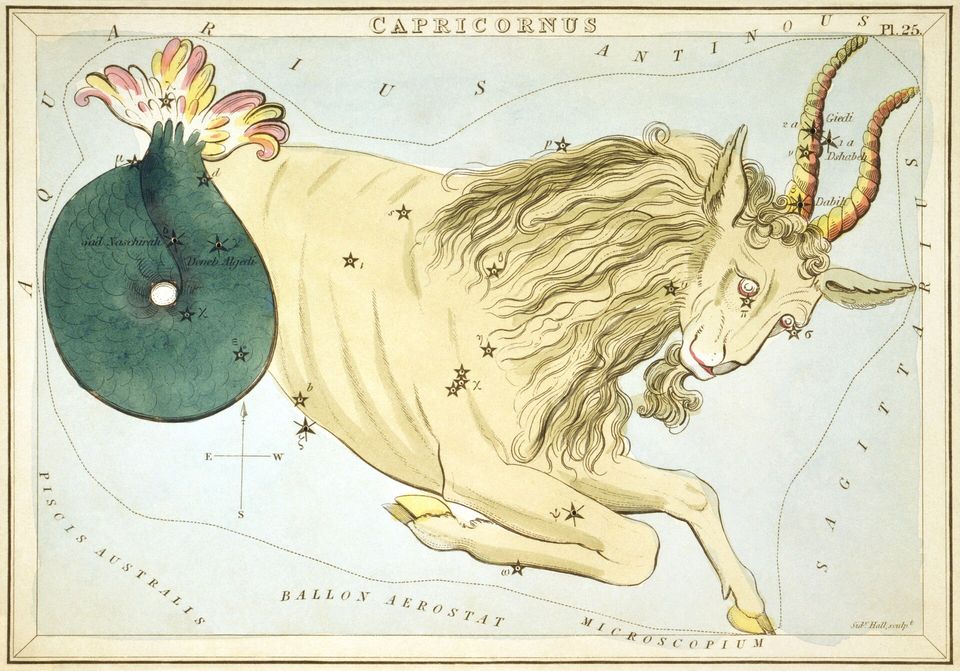
Dabih in Astrology
Core Synthesised Meaning: The Gatekeeper of the Sacrifice.
Nature: Receptive, vigilant, and surgically decisive; combining structural patience with swift, uncompromising action.
Domain: Gateways, bridges, physical and metaphysical thresholds, and high-stakes crises where hesitation is fatal.
Gift: Seemingly inexhaustible strength in difficult times; the ability to act as a tower of strength for others under immense strain; the courage to make the necessary cut to preserve the integrity of the whole.
Wound: The weight of the witness; carrying a deep, internal melancholy or solitary sorrow; the feeling that one’s life is marked by constant, evolutionary endings and the shedding of vital parts of the self.
Mythology & History
Dabih is bound to the massive, evolutionary mythology of the constellation Capricornus, the Sea-Goat. In the ancient Mesopotamian sands, this figure was Enki (Ea), the Babylonian lord of water, wisdom, and creation. Emerging from the Abzu—the primordial, sweet waters beneath the earth—Enki was represented as a creature with the head and torso of a goat and the lower body of a fish. He brought civilization, agriculture, writing, and the sacred laws (Me) to humanity. Enki’s wisdom is not martial; it is structural and irrigational, carving channels for the waters of consciousness to fertilize the barren mud of the physical plane.
In Greek lore, the Sea-Goat is identified as Pricus, the immortal father of the sea-goats, created by Chronos (Time). Pricus possessed the terrifying power of his creator: the ability to manipulate time itself. His children, the sea-goats, were driven by an evolutionary hunger to climb out of the ocean and onto the craggy, sunlit cliffs of the earth. Yet, the moment they stepped onto dry land, their fish tails transformed into goat legs; they lost their intelligence, their speech, and their memory of the oceanic deep, becoming wild, mute beasts of the land. Desperate to save them, Pricus would reverse time, pulling his children back into the waves. Yet, every time the cycle reset, the children would climb the cliffs again, driven by a destiny beyond their father's control. Realizing that evolution cannot be reversed, Pricus chose to stop turning back time. He accepted his eternal, solitary watch, and Chronos placed him in the heavens as Capricornus—the tragic, silent witness to the ascent of his lineage.
Alternatively, Capricornus is Pan, who, during the assault of the titanic monster Typhon, leaped into the River Nile. Pan sought to transform completely into a fish to escape, but the haste of the crisis split his form: his lower half became a fish, adapting to the deep water, while his upper half remained a goat, clinging to the high bank.
The title "the Slaughterer" connects to the ultimate spiritual sacrifice. The goat is the animal that climbs the highest, representing the peak of material effort and ambition. At the apex, however, the goat must be offered. The sacrifice is the cosmic exchange: the shedding of the material container to release the life-force, fertilizing the earth so that a new cycle can begin. Dabih is the eye that watches this blade fall.
Muddy Reception vs. Clear Reception
The star does not change. Only the quality of the receiver changes what arrives.
Expresses as paranoia, cold suspicion, and chronic mistrust of the environment. The native projects their fear of the "slaughterer" outward, isolating themselves behind rigid, defensive walls. They become stubborn, cynical, and manipulative, engaging in double-dealing or preemptive betrayal to avoid being hurt. They cling desperately to stagnant structures, refusing to make the necessary internal sacrifices, which manifests as severe domestic disharmony, enmity, and bitter legal or relational disputes.
The highest expression of the "Slaughterer" and "Vishnu's Strides." Here, the native acts as a conscious gatekeeper of evolutionary transitions. Utilizing the receptive, intuitive vision of the Goat's left eye, they perceive the deep karmic currents of any situation. Guided by the absolute, fear-free decisiveness of the Aries Navamsha, they execute the necessary sacrifice—cutting away dead habits, toxic attachments, or obsolete structures without hesitation. Their actions are swift, compassionate, and aligned with cosmic law. They do not run from endings; they transform the act of sacrifice into a sacred bridge of ascension for the collective.
Paran Interpretations
Find your parans →Parans form when Dabih and a planet simultaneously occupy the four angles at your birth location. The planet's angle determines the life period: Rising = youth, Culminating = prime, Setting = later years, Nadir = lifelong foundation.
Parans are timing signatures — they mark which life period Dabih governs for you personally. The four angles below (Rising, Culminating, Setting, Nadir) correspond to youth, prime, later years, and your lifelong foundation. This requires your birth date and place to calculate.
Your Fixed Stars reading names the stars on your planets and in your parans, and what each one means for you.
Get Your Fixed Stars Reading — $44Is Dabih ruling your life?
Your Fixed Stars reading names the stars on your planets and in your parans, and what each one means for you.
Get Your Fixed Stars Reading — $44