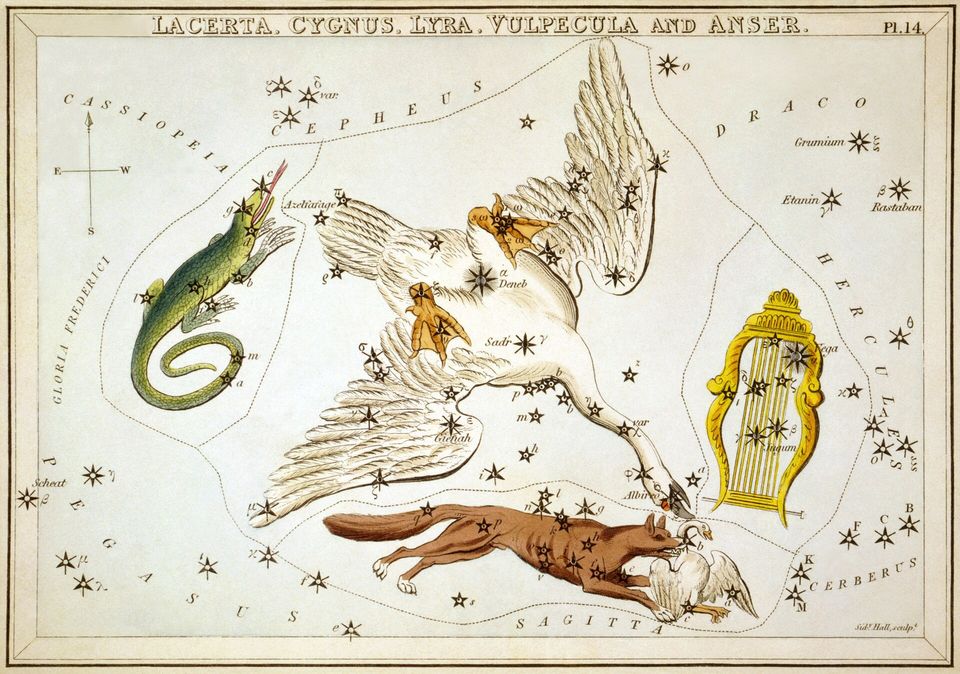
Deneb Adige in Astrology
Deneb Adige is the archetype of the vast gift concealed inside the ordinary form — and of what emerges when that gift is taken to its completion through transformation.
The thread running through all three swan myths is a single movement: something of divine or transcendent nature arrives in the form of the beautiful creature, produces consequences beyond anything the encounter suggests, and becomes most fully itself at the threshold. The god inside the feathers. The poet who survives dismemberment and keeps singing. The companion who transforms through grief into the form grief required.
What Brady identifies in Mother Teresa and van Gogh — two very different lives both touched by this star — is the same quality: the gift that reaches its fullest expression on its own schedule, not the world's. Van Gogh's recognition came after death; Mother Teresa's sanctity expressed itself in the daily work of tending the dying. Both received the frequency. Both gave it back in forms that were complete precisely because they were not calibrated to external approval.
When Deneb Adige Is Angular
Deneb Adige carries additional weight when it falls on one of the chart angles, independent of any planet conjunction.
A splendid and illustrious life; glorious, mighty and commanding nature; fame, busy with many activities, bountiful resources, well known or feared in cities and regions. The vocation carries the full public expression of the swan's gift.
Mythology & History
Three Swans of Cygnus:
The constellation Cygnus carries more than one myth, and none contradicts the others. Each is a different story of how a being became a swan — or was always a swan — and each adds a layer to what Deneb Adige transmits.
Zeus and Leda:
Zeus desired Leda, queen of Sparta, and came to her disguised as a swan — a creature she would not flee from, something beautiful and unthreatening, a white bird that landed near her by the river.
Manilius records the placement in the first century AD: "Hard by is the place allotted to the Swan: as a reward for the shape with which he snared the admiring Leda, when, a god changed into a snow-white swan, he came down and offered his feathered form to the unsuspecting woman."
From that union — on the same night Leda also lay with her husband Tyndareus — came two eggs, which hatched into four: Helen of Troy, Polydeuces, Castor, Clytemnestra. The swan's visitation rearranged the ancient world. The god wore the creature's form to reach what the visible divine power could not. Divinity disguised itself in feathers and beauty to accomplish what command and thunder could not.
Cygnus and Phaethon — the Swan of Grief:
Phaethon was the son of Helios, the sun-god. He demanded to drive his father's solar chariot. Helios, who had sworn by the river Styx to grant his son any wish, could not refuse. Phaethon lost control of the horses, careened too close to the earth and set it burning, then too far out and scorched the sky. Zeus struck him down with a thunderbolt before the world caught fire entirely. He fell like a comet into the river Eridanus.
Cygnus was Phaethon's companion — his closest friend, in some accounts his cousin — and he refused to leave the river. He dove into the water again and again, calling over the surface of the Eridanus. The gods, moved by the completeness of his grief, transformed him into a swan: so that he could search the water more freely, so that the form matched what he had already become. And they gave him white feathers because he feared the fire that had taken his friend. The swan stays near water. It does not approach the burning sky.
Cygnus's grief became his nature. The transformation was not a reward — it was the gods doing the only thing available for a being whose sorrow had already made him something other than human.
The Milky Way passes directly through Cygnus. The swan flies along the river of stars — or in the tradition of the galactic dark rift, along the dark corridor cut through the galaxy's brightness. Phaethon fell from that sky into water. Cygnus has been searching the river ever since.
Orpheus Transformed:
When Orpheus was torn apart by the Maenads, his head floated down the river Hebrus still singing, his lyre beside it. The Muses gathered what remained of him and buried it at the foot of Mount Olympus. Jupiter placed the lyre among the stars as Lyra.
Orpheus himself, in the tradition preserved by later writers and recorded by Allen, was transformed into a swan — the greatest singer becoming the creature most associated with sacred song at the threshold. The swan sings, in the ancient and medieval tradition, most beautifully at the moment of its death. This is where the word swansong originates: the final, most perfect performance, offered at the crossing.
The logic is exact: the lyre of Orpheus, placed in the sky as Vega, and the Swan of Cygnus flying along the same Milky Way are the two halves of the same myth. The musician and his instrument, separated at death, given two places among the stars.
Muddy Reception vs. Clear Reception
The star does not change. Only the quality of the receiver changes what arrives.
The Cygnus description from the tradition: "contemplative, dreamy, cultured and adaptable — the affections ill-regulated and unsteady, the talents developing late." At the lower reception, "late" does not become eventual arrival — it becomes perpetual preparation. The native lives in the future self that will emerge rather than in the work at hand. The quick mind moves so fast across ideas that it does not land. The artistic gift disperses into impressions that are gathered and never offered.
The love of swimming and water — which at the lower expression becomes love of the element where form dissolves rather than where it must be held. The native prefers immersion to definition.
There is also the Cygnus who cannot leave the riverbank. The grief that transforms, at the lower end, into the attachment that will not name itself as attachment. The companion who is still wading the Eridanus long after there is no longer anything to find there.
Brady's van Gogh: the wild, post-impressionist brushstrokes capturing the sacred in a patch of sky, in a vase of flowers, in a face — the work not calibrated to the recognition it would never receive in his lifetime, but complete in itself, fully itself, carrying the Deneb Adige instruction to find the mystical in the immediate.
At the clearest reception, the swansong is not a tragedy. It is the completion of the arc — the gift given fully, offered with nothing held back, at the moment when holding back is no longer possible. The Judgment card clarifies this: the angel blowing the horn above the opened graves is calling forward what was perfected in the dark. The swan does not rise along the Milky Way toward ending. It rises toward the river of stars it was always indigenous to.
Working With Deneb Adige
You do not need elaborate ritual. You need three things: your gaze, your intention, and something in the physical world that carries this star's resonance.
Fix your attention on the swan in full flight along the Milky Way. Not the ornamental swan. Not the swan drifting. The great white bird with wings fully extended, flying the river of stars, moving with purpose.
What am I willing to carry to its full completion — even if the recognition arrives only on the other side of the threshold?
Natal Conjunctions
Find your conjunctions →Preferment in writings, astrology, and matters dealing with the public. Early life experiences mark this native more deeply than most — for good or ill, a formative quality that carries through the entire arc. Ingenious and apt to excel across many fields; the identity carries the star's quality of vast capacity appearing through an ordinary surface.
Paran Interpretations
Find your parans →Parans form when Deneb Adige and a planet simultaneously occupy the four angles at your birth location. The planet's angle determines the life period: Rising = youth, Culminating = prime, Setting = later years, Nadir = lifelong foundation.
Parans are timing signatures — they mark which life period Deneb Adige governs for you personally. The four angles below (Rising, Culminating, Setting, Nadir) correspond to youth, prime, later years, and your lifelong foundation. This requires your birth date and place to calculate.
Your Fixed Stars reading names the stars on your planets and in your parans, and what each one means for you.
Get Your Fixed Stars Reading — $44Frequently Asked Questions
Is Deneb Adige ruling your life?
Your Fixed Stars reading names the stars on your planets and in your parans, and what each one means for you.
Get Your Fixed Stars Reading — $44