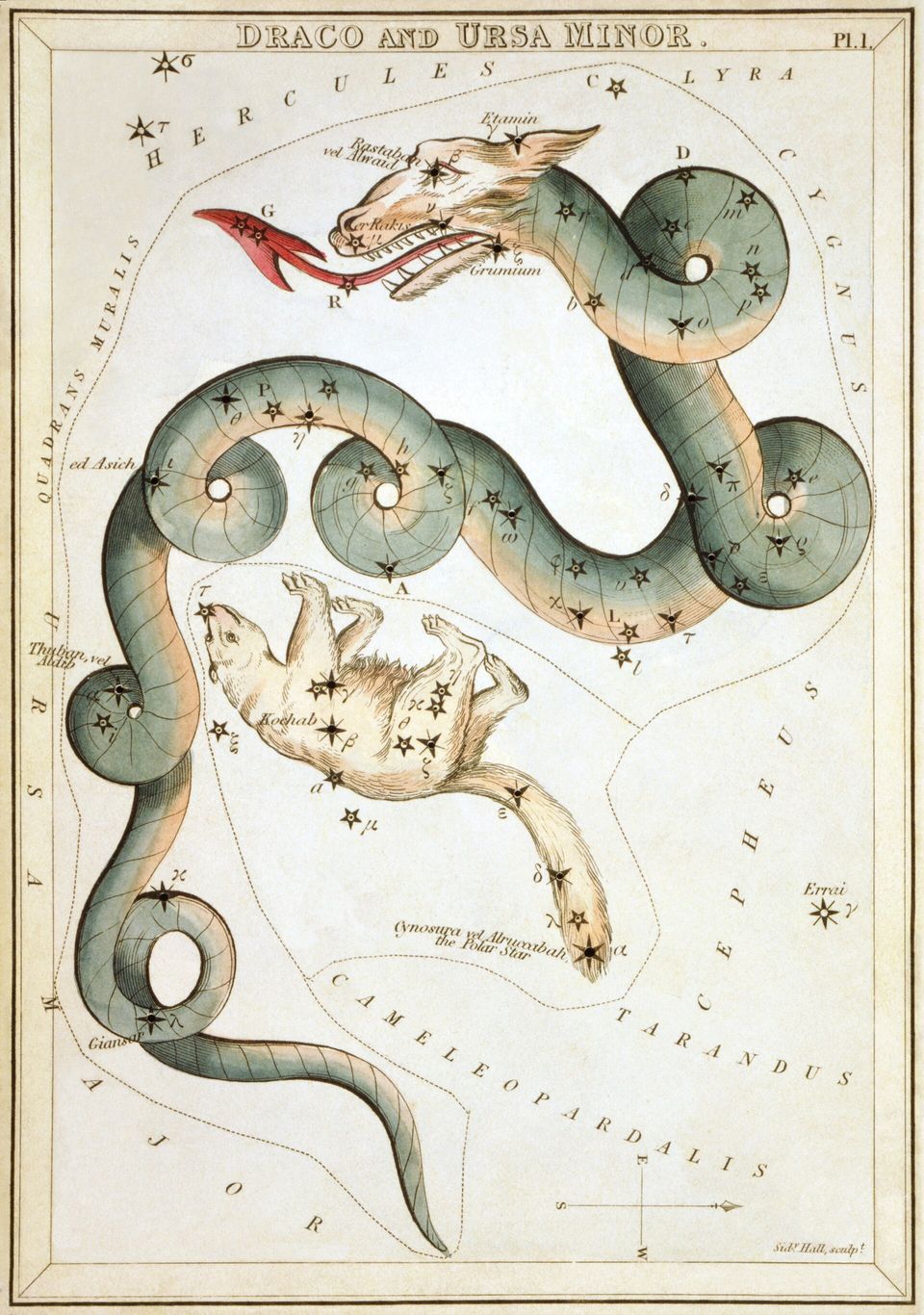
Dziban in Astrology
Core Synthesised Meaning: The Palace Governess of the coiling Dragon / The Sleepless Sentinel of the Written Law.
Nature: Meticulously analytical, quietly observant, deeply structured, patient, and highly instructional; operating with a quiet, overnight containment.
Domain: Meticulous archiving, legislative security, historical research, child education, literary translation, and the taming of wild, instinctual forces.
Gift: The capacity to maintain absolute mental clarity and organization in the midst of chaotic, winding crises; taming the "wolf" of raw passion through the written word; acting as a quiet, sleepless guide who coordinates behind the scenes.
Wound: The silenced tutor; the loss of personal voice through excessive dedication to the service of others; carrying the heavy weight of collective secrets; chronic left shoulder, clavicle, or respiratory tension.
Mythology & History
The mythological stream of Dziban is the story of Ladon, the sleepless hundred-headed dragon, and the silent, maternal instruction of the palace chambers.
The Golden Apples of the Hesperides:
In Hellenistic myth, Draco represents Ladon, the colossal dragon sent by Juno to guard the golden apples in the sacred garden of the Hesperides. Ladon never slept, coiling around the trunk of the apple tree and whispering in a hundred voices simultaneously to warn away intruders. Hercules slew the beast during his eleventh labor to retrieve the golden fruit, and Juno, in her grief, placed the dragon among the stars. As a star in this coiling beast, Dziban represents the quiet, sleepless vigilance that guards the deepest treasures of wisdom.
The Tutor of the Inner Court:
Unlike the aggressive, visible battles of the outer empire, the Chinese myth of Niu She (the Palace Governess) represents the power of quiet, internal alignment. The Governess does not command armies; she tames the wild passions of the court through the teaching of history, literature, and the alchemical laws of time. She is the keeper of the court's diaries and letters, representing the silent observer who witnesses all transitions (the coiling of the dragon) and uses her refined intellect to protect the line of succession.
In the Vedic tradition, the star resides at the absolute threshold of Ardra Nakshatra—symbolized by a teardrop, ruled by Rahu and presided over by Rudra (the storm god of dissolution and transformation)—at the very cusp where the storm-howl of Rudra yields to the boundless, protective maternal space of Aditi in Punarvasu.
Muddy Reception vs. Clear Reception
The star does not change. Only the quality of the receiver changes what arrives.
The native experiences the shadow of the paranoid sentinel. They are cold, highly suspicious, and malicious, using their sharp, analytical intellect to weave complex lies and spy on those around them. They hoard collective secrets to manipulate others, constant pacing their "cage" of ungrounded Saturnian worry, which ultimately results in sudden, public reversals, lawsuits, and chronic chest or shoulder tension.
The highest expression of the "Palace Governess." Here, the native operates as a pure channel for the coiling dragon's wisdom. They do not seek outer fame or competitive conquest; they recognize that all true power is built in the quiet chambers of the mind. Standing in serene, Jupiterian sovereignty (Pisces Navamsha), they use their double-star waltz of logic and intuition to tame the wild storms of their society, writing and teaching laws that protect their entire community with the quiet, effortless grace of the spirit.
Paran Interpretations
Find your parans →Parans form when Dziban and a planet simultaneously occupy the four angles at your birth location. The planet's angle determines the life period: Rising = youth, Culminating = prime, Setting = later years, Nadir = lifelong foundation.
Parans are timing signatures — they mark which life period Dziban governs for you personally. The four angles below (Rising, Culminating, Setting, Nadir) correspond to youth, prime, later years, and your lifelong foundation. This requires your birth date and place to calculate.
Your Fixed Stars reading names the stars on your planets and in your parans, and what each one means for you.
Get Your Fixed Stars Reading — $44Is Dziban ruling your life?
Your Fixed Stars reading names the stars on your planets and in your parans, and what each one means for you.
Get Your Fixed Stars Reading — $44