Hamal in Astrology
Hamal is the archetype of the force that opens the way by paying what the opening costs.
Not blind aggression. Not calculated cruelty. The force that leads — that goes first, that takes the direction before the others have decided, that charges into what needs charging — and that carries, embedded in its nature, the awareness that going first has a cost, and the willingness to pay it.
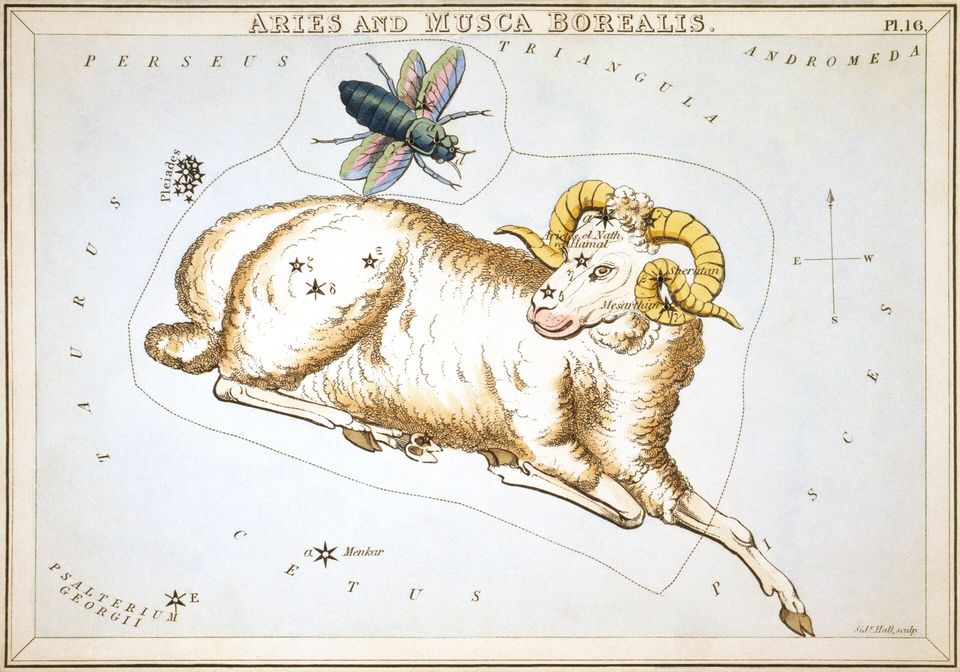
The myth turns on the sacrifice. The ram could have remained alive in Colchis, divine and golden, honored for the crossing it accomplished. Instead Phrixus offered it. The animal that saved his life became the offering that created the fleece that became the reason the Argonauts sailed. The force of rescue became the object of the quest.
Mythology & History
The Golden Ram:
The myth of Aries begins with a mortal family in crisis and ends with the greatest quest in Greek mythology. The distance between those two events — one household, one fleece, one impossible journey — is the full arc of what this star carries.
Phrixus and his sister Helle were children of the Boeotian king Athamas. Their stepmother Ino hated them and plotted to have them killed. The crisis was real: children condemned, nowhere to go, the family that should protect them the source of the danger.
A golden ram appeared.
In most versions of the myth, the ram was a gift from Mercury — from Hermes, the god of messages and crossings. Others say Poseidon sent it, or that it was divine without a named origin. What matters is this: the animal was not an ordinary creature. Its fleece was gold. It could fly. It came specifically for the children, and it spoke — at least in some versions it warned Helle not to look down.
The two children climbed onto the ram's back, and it carried them across the sea toward Colchis on the eastern shore of the Black Sea. Helle looked down. She fell. She drowned in the water that now bears her name — the Hellespont, the strait between Europe and Asia. Phrixus made it. He arrived in Colchis, safe, alive, carried across the impossible distance.
Then came the decision that defines the myth.
Phrixus sacrificed the ram to Zeus. He offered the creature that had saved him. The golden fleece — the most extraordinary thing in the known world, the object whose very existence testified to divine intervention — was hung in the sacred grove of Ares in Colchis, guarded by a serpent that never slept. And there it became the prize that Jason and the Argonauts sailed to retrieve a generation later. The greatest quest in Greek mythology was set in motion not by a war or a prophecy or a divine command, but by a ram that gave its life so that a boy could survive.
The ram was offered up. The fleece that remained became the goal of the world's most famous journey.
This is the central dramatic moment of the myth: the sacrifice that transforms the rescuer into the treasure, the gift into the quest-object, the creature into something that outlasts its own life by becoming the reason a whole generation of heroes puts to sea.
The Equinoctial Ram:
Before the myth crystallized into the story of Phrixus and the fleece, Aries carried a different layer of meaning — astronomical and sacred simultaneously.
When the vernal equinox stood at Hamal, the year began here. The Ram presided over spring. In many ancient cultures, the ram was the sacrificial animal of the new year — the blood offering that opened the cycle, that paid the price for the abundance about to come. The Jewish tradition of the shofar — the ram's horn blown at the new year — is a thread of this same ancient weave. The ram opens the year. The ram carries the cost of the year's beginning.
Brady's reading of Hamal recovers what the Christian era obscured: when the age of Pisces arrived and the god of the Fish displaced the god of the Ram, the old horned figure of Aries was systematically demonized. The ram became associated with evil, with the adversary, with what had to be rejected. What had been the sacred leader of the heavenly flock became, in the new symbolic order, its opposite. Brady's insight: strip that layer of medieval censorship away, and what remains is a forceful star of independence, of action taken from inner conviction, of the kind of courage that does not require permission.
Joan of Arc had Mercury culminating when Hamal rose. A peasant girl who insisted she be taken to the heir to the French throne, who spoke with the force of personal certainty in a world that had every reason not to listen to her, who died because she would not recant what she had said. The independent and forceful influence of Hamal expressed through a mind that could not be made to say what it had not seen.
Madame Blavatsky had Hamal culminating as Jupiter set — expressing in her adult years as a highly critical attitude toward mainstream thinking and vigorous promotion of alternative philosophy. She co-founded the Theosophical Society. She did not ask permission to rethink the categories.
Muddy Reception vs. Clear Reception
The star does not change. Only the quality of the receiver changes what arrives.
The Hamal energy without wisdom is force in search of a target. The tradition places it under War, under Premeditated Crime, under Theft and Robbery, under Falls. The Mars-Saturn combination produces, at its lowest expression, the calculation that enables cruelty — not the sudden rage of unchecked Mars but the deliberate, planned force that the Saturn addition makes possible. The ram that has decided to charge and has done the mental arithmetic of whether it can win before it lowers its head.
The domestic troubles the tradition notes — ill-health to native or family, difficulty in love affairs — arise from this same quality. The force that is magnificent in an outward charge is exhausting and damaging in intimate space. The person who meets every household difficulty with a lowered head will eventually empty the room.
At the lowest reception: cruelty as a substitute for courage. The force of the Ram turned inward against what is smaller, or outward against what was never the right target.
The full archetype: the force that leads because it genuinely knows what direction is required and is willing to pay what going first costs. Joan of Arc's insistence. Blavatsky's total commitment to a worldview no one around her shared. Not the charge for its own sake, but the charge at the exact moment it is necessary, aimed at the exact thing that requires it.
At the clearest expression, the Hamal native carries the golden fleece quality: they are not merely powerful. They are the reason someone else sets out on the quest. Their action, their sacrifice, their willingness to be consumed by what they came to do — it becomes the goal that outlasts them, the thing that makes the greater journey possible.
The ram sacrificed itself. What remained became the prize that mobilised a generation of heroes.
Working With Hamal
You do not need elaborate ritual. You need three things: your gaze, your intention, and something in the physical world that carries this star's resonance.
Fix your attention on the forehead of the Ram — not the golden fleece, not the charge itself, but the head that leads both. The place where the decision to go forward is made. The point of contact with what resists.
What are you willing to charge toward, fully and irreversibly, knowing that the act itself is the complete offering?
Natal Conjunctions
Find your conjunctions →High preferment in government affairs, writings, martial and financial matters. The native is persistent, forges ahead, overcomes obstacles — the solar identity carries the Ram's forward momentum as its defining quality. At higher expression: leadership grounded in genuine conviction. At lower: dissipation, evil associates, loss and disgrace — the Sun in the Ram's head without the wisdom to direct it.
Paran Interpretations
Find your parans →Parans form when Hamal and a planet simultaneously occupy the four angles at your birth location. The planet's angle determines the life period: Rising = youth, Culminating = prime, Setting = later years, Nadir = lifelong foundation.
Parans are timing signatures — they mark which life period Hamal governs for you personally. The four angles below (Rising, Culminating, Setting, Nadir) correspond to youth, prime, later years, and your lifelong foundation. This requires your birth date and place to calculate.
Your Fixed Stars reading names the stars on your planets and in your parans, and what each one means for you.
Get Your Fixed Stars Reading — $44Frequently Asked Questions
Is Hamal ruling your life?
Your Fixed Stars reading names the stars on your planets and in your parans, and what each one means for you.
Get Your Fixed Stars Reading — $44