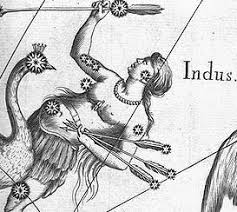
Indus in Astrology
Core Synthesised Meaning: The Sovereign of the Deep Interior / The Bringer of Scythian Silver.
Nature: Exceptionally independent, quiet, deeply philosophical, and fiercely protective of territory; operating with a serene, overnight containment.
Domain: Indigenous rights, land stewardship, archeological preservation, metalwork, internal meditation, and the defense of spiritual sanctuaries.
Gift: Internal industry—the capacity to generate massive creative resources from within without relying on external networks; finding undisputed victory through quiet, virtuous concentration; stabilizing volatile spaces.
Wound: The colonized native; carrying the heavy weight of systemic alienation, displacement, or the fear of having one's inner treasures looted by the outer world; chronic hip, thigh, or liver tension.
Mythology & History
The mythological stream of Indus is the story of the Scythian silver-bringer, the heifer Io’s internal pilgrimage, and the peacock of Argus.
The Scythian Silver-King:
In classical myth, Indus was the legendary king of Scythia who first discovered silver (the lunar metal of reflection, intuition, and pure psychic receptivity), which Erichthonius (Auriga) later brought to the civilized halls of Athens. In this light, Indus represents the discovery of the precious, uncorrupted metal of the soul—the capacity to extract the pure, quiet wisdom of the earth before it is commodified by the external structures of society.
The Pilgrimage of Io:
Esoterically, the constellation has been associated with Io, the royal heifer who was pursued across the earth by Hera's wrath. Her long, agonizing flight represents the internal pilgrimage of the soul—constantly moving through alien territories to return to her original, sacred lineage.
According to Ptolemy, the stars of Indus have a nature resembling Saturn and Venus, denoting a highly disciplined, patient, and deeply artistic or reflective character. By the Kabalists, Sagittarius is associated with the Hebrew letter Samekh and the 14th Tarot Trump, "Temperance." Indus represents the alchemical blending of internal fires, ensuring that the soul's native resources are distilled with absolute precision and grace.
Muddy Reception vs. Clear Reception
The star does not change. Only the quality of the receiver changes what arrives.
The native experiences the shadow of the displaced sovereign. They are deeply suspicious, hostile, and emotionally isolated, constantly hiding their great inner gifts behind a wall of silent, self-sabotaging anger. They use their sharp, analytical mind to build walls of defensive pride, suffering from chronic liver stagnation, sciatic nerve spasms, or physical depletion—trapped in the cold, dry abyss of their own ungrounded exile.
The highest expression of the "Vargottama Sovereign." Here, the native operates as a pure channel for the river Sindhu. They do not seek outer fame or competitive conquest; they recognize that all true riches are forged in the silent, silver mines of the deep interior. Standing in serene, equatorial detachment, they use their profound, expansive wisdom to protect the original laws of the earth, guiding the lost with the quiet, effortless grace of the spirit.
Paran Interpretations
Find your parans →Parans form when Indus and a planet simultaneously occupy the four angles at your birth location. The planet's angle determines the life period: Rising = youth, Culminating = prime, Setting = later years, Nadir = lifelong foundation.
Parans are timing signatures — they mark which life period Indus governs for you personally. The four angles below (Rising, Culminating, Setting, Nadir) correspond to youth, prime, later years, and your lifelong foundation. This requires your birth date and place to calculate.
Your Fixed Stars reading names the stars on your planets and in your parans, and what each one means for you.
Get Your Fixed Stars Reading — $44Is Indus ruling your life?
Your Fixed Stars reading names the stars on your planets and in your parans, and what each one means for you.
Get Your Fixed Stars Reading — $44