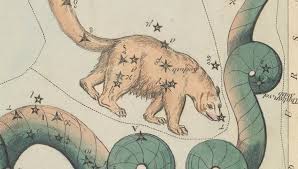
Kochab in Astrology
The core synthesized meaning of Kochab is The Sentinel of the Exiled Axis.
Nature: Unyielding, watchful, structured, and deeply protective.
Domain: Thresholds, transition phases, systemic changes, and the preservation of structural integrity during epochs of collapse.
The Gift: The ability to remain constant and loyal when all around is shifting. Kochab offers the rare gift of holding the perimeter, safeguarding resources, and maintaining organizational or moral boundaries when a system is undergoing a massive reorientation.
The Wound: The grief of the unseated center. Because Kochab was once the Pole Star, it carries an inherent cellular memory of holding the supreme position. Its wound is the tendency to cling to outdated structures, obsolete laws, and dead axes out of fear of change, leading to isolation or a "do-or-die" self-destruction when the structure they guard finally crumbles.
Mythology & History
The mythological layers of Kochab are inextricably bound to the constellation of Ursa Minor, the Lesser Bear.
Arcas and the Tail of the Bear
In classical Greek mythology, the constellation represents Arcas, the son of the nymph Callisto and the king of the gods, Jupiter (Zeus). Callisto, having been transformed into a monstrous bear by the jealous wrath of Juno (Hera), spent years wandering the deep forests. Her son Arcas, raised by humans to become a skilled hunter, encountered his mother in her ursine form. Unaware of her true identity, Arcas raised his spear to slay her.
To prevent this tragic matricide, Jupiter intervened by transforming Arcas into a bear as well. Grasping both mother and son by their tails, he swung them into the heavens, placing them among the stars. The tremendous force of this celestial ascent stretched their tails to unnatural lengths, explaining the anomalous long tails of both Ursa Major and Ursa Minor. Arcas became the Little Bear, circling his mother eternally, forever vigilant, forever bound to the northern crown.
Cynosura, the Cretean Sentinel
An older, alternative Greek myth identifies the constellation as Cynosura, one of the Idaean nymphs who hid and nursed the infant Jupiter in the cave of Dicte on Crete to protect him from his father, Saturn (Cronus), who sought to devour him. Alongside her sister Helice (represented by Ursa Major), Cynosura beat brass shields to drown out the infant’s cries. To reward her fierce, protective guardianship, Jupiter immortalized her in the stars closest to the cosmic pole, ensuring she would never set beneath the ocean waves.
The Treaty of the Desert
In the pre-Islamic desert cultures, the poets spoke of a sacred, perpetual treaty made between night travelers and Al Farkad (the twin stars Kochab and Pherkad). In a landscape devoid of physical landmarks, these circumpolar stars were praised as the ultimate symbols of constancy, reliability, and sleepless loyalty. They were the faithful companions who guided the traveler through the trackless sands, standing as guardians of the gate of night.
Working With Kochab
You do not need elaborate ritual. You need three things: your gaze, your intention, and something in the physical world that carries this star's resonance.
Where have you allowed your axis to wobble? What sacred truth are you currently called to guard? What obsolete structures must you gracefully surrender to the precession of time?
Paran Interpretations
Find your parans →Parans form when Kochab and a planet simultaneously occupy the four angles at your birth location. The planet's angle determines the life period: Rising = youth, Culminating = prime, Setting = later years, Nadir = lifelong foundation.
Parans are timing signatures — they mark which life period Kochab governs for you personally. The four angles below (Rising, Culminating, Setting, Nadir) correspond to youth, prime, later years, and your lifelong foundation. This requires your birth date and place to calculate.
Your Fixed Stars reading names the stars on your planets and in your parans, and what each one means for you.
Get Your Fixed Stars Reading — $44Is Kochab ruling your life?
Your Fixed Stars reading names the stars on your planets and in your parans, and what each one means for you.
Get Your Fixed Stars Reading — $44