Markab in Astrology
Markab is the archetype of the extraordinary capacity that can be ridden but not owned.
Not the wings themselves — that would be Scheat, the star of Pegasus that carries more of the horse's dangerous, uncontrollable energy. Markab is the Saddle: the functional interface, the place where the extraordinary capacity meets the practical attempt to use it. The point of contact between what a human being can accomplish and what only becomes accessible through something larger than themselves.
What Markab grants: the capacity to sit at that interface — to make contact with what is beyond ordinary human ability, to direct it, to accomplish through it what could not be accomplished without it. Brady's case of Neil Armstrong is exact: he was chosen to go to the Moon not for heroic daring but for steady reliability — he was the saddle upon which the world sat as humanity traveled to the Moon. The point of connection between vast collective aspiration and the actual doing of the thing.
Mythology & History
Pegasus: the horse that reached heaven alone:
Every version of the Pegasus story agrees on its origin. When Perseus cut off Medusa's head, the winged horse was born from her blood — emerging fully formed from the neck of the slain Gorgon, the creature of divine capacity born at the moment of the terrible confrontation. The horse did not descend from Olympus. It rose from the wound.
In the tradition most consistently preserved, Pegasus was tamed by the hero Bellerophon with the assistance of a golden bridle given by the goddess Athena. With Pegasus beneath him, Bellerophon accomplished what would otherwise have been impossible: he defeated the Chimera, the fire-breathing monster of composite horror — lion, goat, and serpent — that had been slaughtering the people of Lycia. He accomplished other heroic feats besides. The horse made the hero. Or more precisely, the hero could not have been a hero without the horse's capacity.
But the myth has a second movement, and it is the one that defines the astrological teaching.
Bellerophon, intoxicated by his own accomplishments, attempted to fly Pegasus to Olympus — to ride the extraordinary capacity all the way to the realm of the gods, to become one of them, to translate his heroic achievements into divine status. The ancient sources are explicit about what he was attempting: not a metaphorical ascent, not a spiritual aspiration, but a literal claim to divine residence.
Zeus, or the gods collectively, could not allow this. The version preserved by Pindar and others has Zeus sending a gadfly to sting Pegasus. The horse reared. Bellerophon fell — and in the version Pindar describes, he wandered the earth lame and blind afterward, alone, avoiding the paths of men, consumed by bitterness. The mortal who had dared to ride the divine capacity all the way to the divine realm was returned to earth in pieces.
But Pegasus continued. The horse flew on without the rider. The winged horse that had been born from a divine wound, that had been ridden by mortals, ultimately arrived at Olympus alone and was given his place among the stars by Zeus, where he carries the thunderbolts of the king of the gods.
The horse outlasted the hero. The vehicle arrived where the rider could not. The extraordinary capacity did not require the mortal to reach its destination — the mortal required it.
This is the teaching Markab, the Saddle, carries. The place where the rider sits is the interface between the mortal and the divine capacity they attempt to harness. The question the myth poses is not whether the capacity is real — Pegasus is unmistakably real, the feats he enables are genuine — but whether the person riding understands the nature of the relationship. The saddle is the point of contact. It is not the horse.
The Great Square:
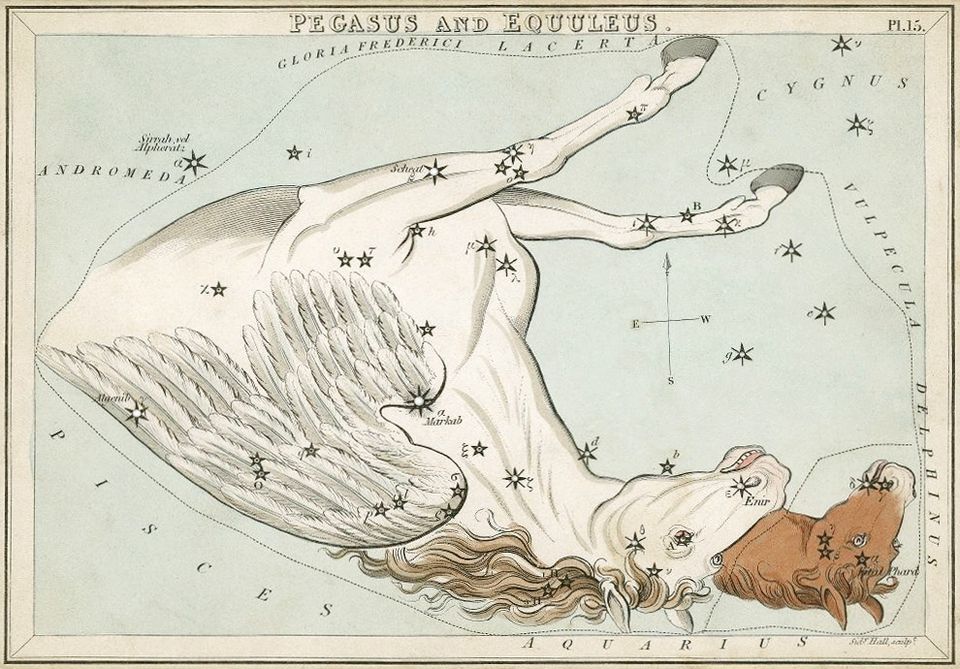
Markab is one of the four corners of the Great Square of Pegasus — one of the most conspicuous geometric figures in the autumn sky. The Square is not a constellation itself but a massive asterism, a visual landmark that ancient navigators and sky-watchers used to orient themselves across the northern sky. Markab marks the southwest corner; Scheat (Beta Pegasi) the northwest; Alpheratz (Alpha Andromedae, shared between the two constellations) the northeast; and Algenib (Gamma Pegasi) the southeast.
The Great Square is notable for what it does not contain: almost no stars within its boundaries visible to the naked eye. It is a field of apparent emptiness framed by bright corners. A window in the sky. The four stars mark the edges of a void.
The Hindu tradition understood Markab as the junction point — the pivot between the two Bhadrapadas. The Fore and the Latter Beautiful Feet. Markab is the bridge between them, the shared element, the star that belongs to both and therefore defines both.
The Chinese record:
In Chinese astronomical tradition, the asterism containing Markab was called Shi — associated with the emperor's temporary palaces and detached residences, with civil engineering and construction projects, and with the northern battlefield where the Emperor personally commanded. Allen records the sieu (lunar mansion) of this name as marked by this star.
The Chinese astrological reading of Shi adds a dimension that Western sources do not emphasize as explicitly: the person born under this sign is generally fortunate, experiences hardship in youth but gains fame in middle age, possesses an independent spirit, and has good financial luck — but may be prone to overspending, to relying on resources not yet secured. The Chinese tradition noticed the same double-edged quality: the capacity for attainment alongside the danger of overreaching.
Muddy Reception vs. Clear Reception
The star does not change. Only the quality of the receiver changes what arrives.
The Bellerophon story is the lower Markab expression. The person who has been given access to an extraordinary capacity — genuine capacity, earned through genuine effort — and who loses the distinction between access and ownership. The ambition that reaches not for the next legitimate challenge but for the destination that was never appropriate for them. Robson's classical account is frank: "Disappointed ambitions, accidents, sickness." The honors are achieved and then reversed. The trajectory that was climbing reaches a point where the trajectory changes. Not because the capacity was fake, but because the claim of ownership of the capacity was.
The traditional note about "danger from fevers, cuts, blows, stabs and fire" belongs here: the person operating from lower Markab who has overextended into territory they were not prepared for, who has ridden the horse to a height that the horse would only travel with a better rider. The danger arrives as a consequence of the overreach — not as random bad luck, but as the correction of a miscalculation.
The tradition's listings for Markab include: accidents, mental disturbances, peculiar life, domestic disharmony, many accidents, violent death. When the Saturn contact is active: "born in poverty, prison or asylum, hard life, few friends." The saddle without the horse is not a vehicle at all — it is just something you sit on.
The clearest Markab expression is the person who is the foundation. Not the brilliant individual but the reliable interface — the human instrument through which something exceptional passes into the world. Neil Armstrong going to the Moon was not the most decorated test pilot of his era; he was the steadiest. The mission required steadiness above all else. Markab's gift — the Saddle's gift — was exactly that.
The tradition notes Markab under "Riches" and "Honor" in its straightforward listings, and under "Diplomatic" and "Clever" (Uranus contact). The Jupiter-Venus nature of the star at its clearest: contented, philosophical, enjoying the legitimate fruits of the interface role, not reaching for what the interface was never meant to claim.
Brady's language for the highest Markab expression: the capacity to be the point of steadiness on a moving object — to hold the platform stable while the extraordinary thing moves beneath you and through you and accomplishes what ordinary effort could never accomplish.
Working With Markab
You do not need elaborate ritual. You need three things: your gaze, your intention, and something in the physical world that carries this star's resonance.
What would become possible if you stopped trying to own the capacity you've been given access to — and simply learned to hold the saddle steady?
Natal Conjunctions
Find your conjunctions →Energetic, active — and the tradition immediately adds: unlucky, subject to disappointment. Not because the energy is false but because the ambition tends to reach beyond what the current position can sustain. The identity itself carries the Markab tension: genuine capacity, genuine drive, and the built-in tendency to overestimate the gap between being the vehicle and being the destination. Preferment in religion, science, artistic matters, and public affairs when at higher expression. Accidents and sickness when the overreach occurs.
Paran Interpretations
Find your parans →Parans form when Markab and a planet simultaneously occupy the four angles at your birth location. The planet's angle determines the life period: Rising = youth, Culminating = prime, Setting = later years, Nadir = lifelong foundation.
Parans are timing signatures — they mark which life period Markab governs for you personally. The four angles below (Rising, Culminating, Setting, Nadir) correspond to youth, prime, later years, and your lifelong foundation. This requires your birth date and place to calculate.
Your Fixed Stars reading names the stars on your planets and in your parans, and what each one means for you.
Get Your Fixed Stars Reading — $44Frequently Asked Questions
Is Markab ruling your life?
Your Fixed Stars reading names the stars on your planets and in your parans, and what each one means for you.
Get Your Fixed Stars Reading — $44