Menkar in Astrology
Menkar is the archetype of the force from the deep that arrives before you are ready.
Not personal. Not aimed at you specifically. Enormous. Moving because it was called, or because something in the collective order was disturbed, or simply because its nature is to move toward what it detects. The nose of the creature: always pointing toward the thing it was sent for.
What Menkar grants: the ability to sense what is approaching from below. The capacity to work with overwhelming collective forces — to detect them, name them, chart their anatomy, and occasionally to be the vehicle through which they move into form. Brady's language: the cosmic rising of Menkar at birth implies "you have a very deep connection to the collective, giving you the gift of creating something on behalf of it." The gift is the deep connection itself — the access to what moves below the surface of ordinary awareness.
Mythology & History
Cetus and Andromeda:
The myth of Cetus is not really about the monster. The monster is instrumental — it is what happens when a specific violation of cosmic order occurs. Understanding Menkar requires understanding the chain of events that summoned the creature into existence.
Cassiopeia, queen of Ethiopia, made a boast. She declared that she — or her daughter Andromeda, depending on the version — was more beautiful than the Nereids, the sea nymphs who were daughters of the sea god Nereus and companions of Poseidon. She compared a mortal queen to divine beings whose beauty was part of their nature. She ranked herself above what was sacred.
The Nereids were furious. They complained to Poseidon. And Poseidon, in response to their outrage, sent Cetus — the sea monster, the beast from the deep — to ravage the coast of Ethiopia. The monster arrived and began its destruction. There was no stopping it by ordinary means.
King Cepheus, Cassiopeia's husband, consulted the oracle of Ammon and was told the only remedy: his daughter Andromeda had to be chained to a rock on the coast and offered to the monster as a sacrifice. She was not guilty of anything. She was the price of her mother's transgression. She was chained and left.
The myth would have ended there — in the consumption of the innocent by the monster sent to punish the proud — except that Perseus arrived. He was returning from his own impossible task: the beheading of Medusa. He saw Andromeda chained to the rock. He negotiated with her parents. And when Cetus arrived, Perseus showed it Medusa's head — the petrifying gaze — and the monster was turned to stone.
Cetus froze. The head that had been arriving for its prey became permanent, visible in the sky, in the position of pursuit.
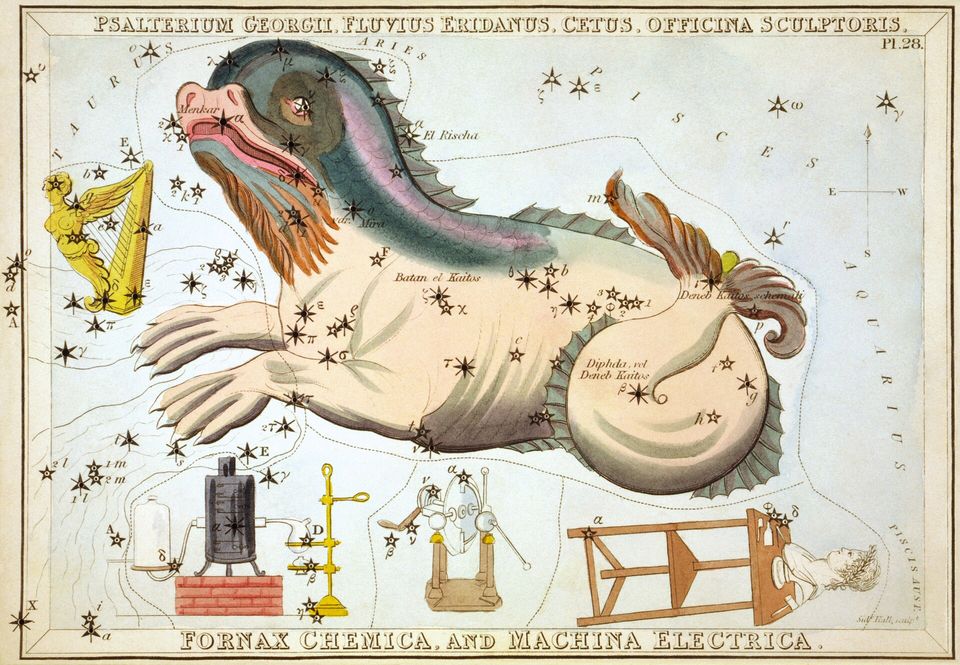
This is the myth Menkar carries. Not the creation story and not the resolution — the middle of the myth, the arrival. Menkar is the leading edge of the creature in motion. The nose and jaws approaching. The moment before the irreversible act.
What the Sea Monster represents:
Brady's reading of Cetus is the most important interpretive move for this star, and it requires taking the tradition beyond its classical framework.
The traditional account — Robson, the classical sources — treats Cetus as straightforwardly negative: the monster that brings disease, disgrace, ruin, injury from beasts. These readings are accurate descriptions of what happens when the Cetus energy operates unconsciously, without awareness of what it actually is.
What Cetus actually is, at the level of archetype, is the collective unconscious made visible. It is the vast force from the deep — not personal, not volitional, not chosen by anyone — that arrives when the proper boundaries between mortal and sacred have been violated. Cassiopeia's pride did not summon an ordinary enemy. It summoned something that came from beneath the surface of the world, that had no individual grievance, that was not acting from any personal motivation, that arrived because the cosmic order had been disturbed and a cosmic correction was needed.
Brady writes directly: "The unpleasant meaning of this star is justified if we think of this whale in the sky as representing the human unconscious or the collective unconscious which, like a beast from the deep, can erupt with moments of great collective insight, or bring chaos and mayhem."
The Menkar archetype is the experience of an overwhelming force that does not originate in individual psychology. Something coming from below — from the depths of the personal or collective unconscious — that arrives unbidden and is enormous and unstoppable. It is not always destructive. The collective unconscious that erupts can bring the great insight as readily as the catastrophe. But in either case the person under Menkar's influence is not dealing with an individual human force they can negotiate with. They are dealing with the deep.
Sigmund Freud had his Sun culminating with Menkar on the day he was born. His life's work was to map this exact territory — to find the edges of what arrived from the unconscious, to describe its forms, to make it available to human understanding. He did not destroy the monster. He drew its anatomy.
Adolf Hitler had his Mars culminating with Menkar. The collective force that his chart embodied and unleashed was the same energy: the unconscious depths of a wounded civilization, the thing that had been building beneath the surface, arriving through a specific vehicle with catastrophic results. The same archetype, different expression. The difference is not the star. The difference is the consciousness of the person through whom the force moves.
The Perseus connection — what stops the monster:
The detail that stops Cetus is worth attending. Perseus does not fight the monster with a weapon. He does not attack it directly. He shows it Medusa's head — the severed head of the one who petrifies with her gaze, wrapped in the bag so that Perseus himself is not destroyed by what he carries.
The indirect approach. The thing that was itself a monster, turned to purpose. The gaze that could not be faced directly, carried carefully, deployed at the right moment.
This is the myth's suggestion about what works with the Cetus force: not direct confrontation, not force against force, but the deployment of something that the force cannot withstand. What petrifies the monster is not superior strength. It is a specific quality of awareness — the gaze that cannot be looked at directly, shown to the thing that arrives without looking before it rushes.
The Menkar teaching, in full: something comes from the deep. You cannot stop it by fighting it. What you carry from your own confrontation with the terrible may be exactly what you need to show it.
Muddy Reception vs. Clear Reception
The star does not change. Only the quality of the receiver changes what arrives.
The traditional account is accurate and should not be minimized. Disgrace, ruin, calamity, much care and anxiety — these are real. The person operating from lower Menkar is overwhelmed by what arrives from the deep: by the unconscious forces in their own psychology, by the collective forces in the world around them, by circumstances that feel enormous and impersonal because they are enormous and impersonal. The tradition lists Menkar under: Active mind (Mercury), Trouble through writings, Many journeys, Domestic disharmony, Failure of crops, Fires, Violent death (Mars), Danger from thieves (Moon), Anxiety (Moon), Criminal/Murderous (Mars). These are the shadow expressions of the force that is larger than ordinary individual life.
The specific pattern worth naming: when the Menkar frequency operates at lower vibration, the person does not distinguish between the force arriving through them and the force arriving at them. They become the vehicle of the collective unconscious without any capacity to direct or moderate what moves through them. Hitler's chart is the clearest example: Mars culminating with Menkar, the force from the deep — rage, collective humiliation, the shadow of a civilization — moving through a specific individual who had no awareness of what was using him.
Freud is the exemplar Brady selects, and the selection is perfect. The Sun culminating with Menkar: the identity organized around the work of charting the unconscious, of making visible what operates below the surface, of giving the collective force a language and a map. The gift of the Menkar connection — the direct access to the depths — turned toward understanding rather than toward being overwhelmed.
At the clearest expression, the person who carries Menkar's frequency becomes the one who can hold the connection to the deep without being consumed by it. Not turning the monster to stone — that was Perseus's solution, which required Medusa's head and was final and catastrophic. But drawing the monster's anatomy, naming its parts, making it available to human awareness. The gift that comes from the deep can feed civilization — the Chinese understood this; their reading of the Menkar stars as the granary, the emergency provision, was not wrong.
Brady also notes the gift specifically: "giving you the capacity to create something on behalf of the collective." The writer who gives voice to what cannot otherwise be spoken. The artist who brings the depth to the surface. The healer who goes into the territory no one else will enter and returns with what is needed.
Working With Menkar
You do not need elaborate ritual. You need three things: your gaze, your intention, and something in the physical world that carries this star's resonance.
When the enormous force arrives — the thing that comes from deeper than your personal psychology, the force that feels collective and impersonal and overwhelming — what have you prepared to show it?
Natal Conjunctions
Find your conjunctions →Great trouble, sickness, throat ailments, legacies and inheritances attended by much evil, loss of money, failure of crops — the classical account is challenging. The identity itself organizes around the Menkar encounter with the overwhelming force. Vehlow's observation of epilepsy in several cases when the Sun was conjunct Menkar (noted in the traditional sources) points toward the same phenomenon: the force that can surge through the body without warning. At higher expression, the Sun through Menkar is the person whose very nature is to engage with what comes from the deep — the life organized around understanding and rendering visible what operates below ordinary awareness.
Paran Interpretations
Find your parans →Parans form when Menkar and a planet simultaneously occupy the four angles at your birth location. The planet's angle determines the life period: Rising = youth, Culminating = prime, Setting = later years, Nadir = lifelong foundation.
Parans are timing signatures — they mark which life period Menkar governs for you personally. The four angles below (Rising, Culminating, Setting, Nadir) correspond to youth, prime, later years, and your lifelong foundation. This requires your birth date and place to calculate.
Your Fixed Stars reading names the stars on your planets and in your parans, and what each one means for you.
Get Your Fixed Stars Reading — $44Frequently Asked Questions
Is Menkar ruling your life?
Your Fixed Stars reading names the stars on your planets and in your parans, and what each one means for you.
Get Your Fixed Stars Reading — $44