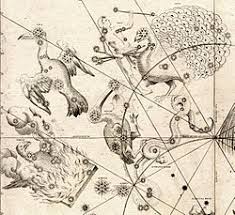
Peacock in Astrology
Peacock is a star of display and of watching, and in this star the two turn out to be the same thing. It has no old astrological lore of its own: it sits so far down the southern sky that it was never part of Ptolemy's catalogue, and the few old star books that mention its constellation say only that Pavo gives vanity and a love of display, a long life and sometimes fame. What astrologers read in it now comes from the bird itself, the peacock with its tail spread open and a hundred eyes painted across it.
Where Peacock touches a chart, it points to a gift that comes alive in front of other people: holding a room, putting a hard idea into words everyone can follow, standing up and speaking for people who cannot find the words. Recognition tends to come through what you show rather than what you hold back. The eyes in the tail are the other half of the gift. People with this star strong tend to read a room while they are performing in it, and to know exactly how they are landing.
Where it goes wrong is not hard to guess. A gift that only works in public leaves your confidence in other people's keeping, and display can slide into vanity or into a constant checking of how you look. The star works best when the showing serves something you actually care about, and when the watching is turned outward, on the people you are speaking to, rather than back on yourself.
Mythology & History
The peacock in the sky belongs to Hera, queen of the Greek gods, and its tail carries the eyes of a giant.
The giant was Argus, called Panoptes, the all-seeing, because his body was covered in a hundred eyes and some of them were always open. Zeus had fallen in love with a young woman named Io and, to hide her from his wife, turned her into a white heifer. Hera was not fooled. She asked for the heifer as a gift and set Argus to guard her day and night.
Zeus sent Hermes to set Io free. Hermes sat down beside the giant, played to him on the reed pipes and told him a long, slow story, until every one of the hundred eyes had closed. Then he killed him. In the version the Roman poet Ovid tells, Hera took the eyes of her faithful watchman and set them in the tail feathers of her own bird, which is why a peacock's tail is covered in eyes. Some old star books mix him up with Argos, the builder of the ship Argo, whose ship also lies in the southern sky.
The constellation itself is young. Pavo, the Peacock, is one of the southern figures drawn from the observations of the Dutch navigators Pieter Keyser and Frederick de Houtman on their voyage to the East Indies in the 1590s, and it first appeared on a celestial globe made by Petrus Plancius. Its brightest star had no name of its own until the late 1930s, when Britain's Nautical Almanac Office needed one for a new almanac made for air navigators and called it simply Peacock.
Peacock sits so far south that it never rises for anyone north of about 33 degrees of latitude, which leaves out all of Europe and most of North America. It belongs to the skies of the tropics and the southern hemisphere.
Working With Peacock
You do not need elaborate ritual. You need three things: your gaze, your intention, and something in the physical world that carries this star's resonance.
What within me still carries the frequency of Pavo unresolved — and what would clarity here change?
Paran Interpretations
Find your parans →Parans form when Peacock and a planet simultaneously occupy the four angles at your birth location. The planet's angle determines the life period: Rising = youth, Culminating = prime, Setting = later years, Nadir = lifelong foundation.
Parans are timing signatures — they mark which life period Peacock governs for you personally. The four angles below (Rising, Culminating, Setting, Nadir) correspond to youth, prime, later years, and your lifelong foundation. This requires your birth date and place to calculate.
Your Fixed Stars reading names the stars on your planets and in your parans, and what each one means for you.
Get Your Fixed Stars Reading — $44Is Peacock ruling your life?
Your Fixed Stars reading names the stars on your planets and in your parans, and what each one means for you.
Get Your Fixed Stars Reading — $44