Pollux in Astrology
Pollux is the archetype of divine force oriented by love across the boundary of difference.
The archetype has two faces, and the tradition has preserved both without smoothing them into one.
The first face: the pugilist. Unbeatable. Crafty, spirited, brave, audacious. The boxing champion who faced every opponent and walked away. This is Mars energy — the Mars of iron conviction, of knowing how to fight and being willing to, of the force that does not yield when something essential is at stake. Robson's reading is accurate at the lower frequency: subtle, cruel, rash, connected with poisons. These are real. They describe what happens to this archetype when the force has no worthy direction — when the greatest boxer in the world has no ring and no brother, only his own unspent force and nowhere to aim it.
Mythology & History
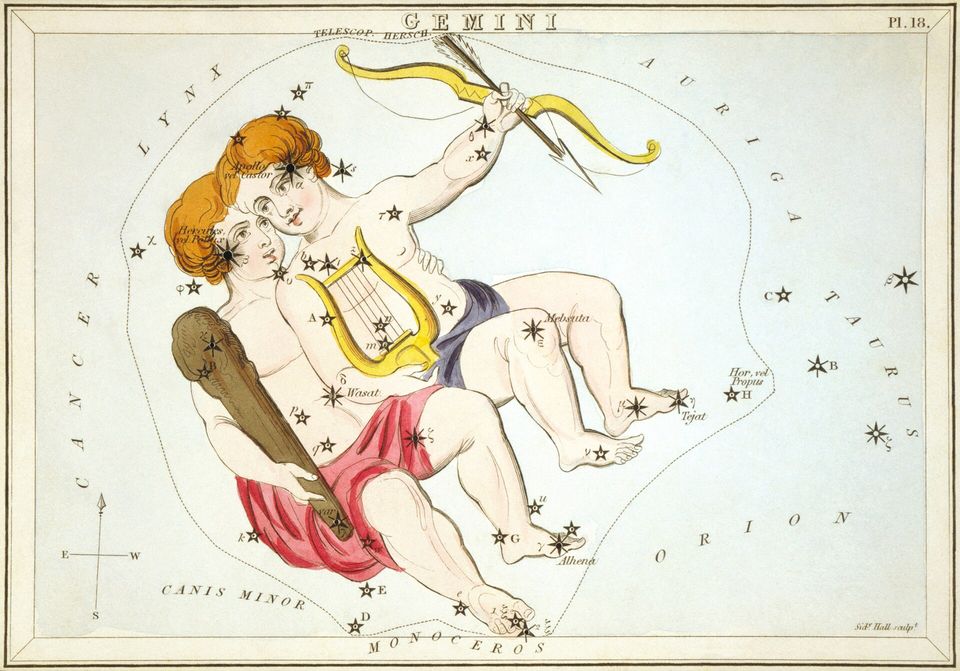
Castor and Pollux were twins — but not identical in the way that word implies.
Their mother was Leda, queen of Sparta, but they had different fathers. Pollux was the son of Zeus, who came to Leda in the form of a swan. He was therefore half-divine, carrying the seed of immortality. Castor was the son of Tyndareus, the mortal king of Sparta. He was fully human.
They grew up inseparable. Castor was famous for his skill with horses. Pollux was the greatest boxer who had ever lived — some accounts say he was simply unbeatable, that no mortal could stand against him. Together they sailed with the Argonauts. Together they raided cattle and fought wars. Two natures, one brotherhood.
Then Castor died.
The sources differ on how — in some accounts it was a cattle raid gone wrong; in others, a quarrel with cousins over women; in still others, a spear thrown in battle. The cause does not change what followed. Castor was mortal and so he could die, and he did. Pollux could not die — he was son of Zeus — and so he lived on, while his brother descended to the world below.
What Pollux did next is the center of this myth.
He begged Zeus. Not for power, not for wealth, not for victory in another contest. He asked to share his immortality — to give half of it away. The condition Zeus offered was this: the brothers would alternate. One day in Olympus among the gods. One day in Hades with the dead. Together they would cross the boundary that nothing else crosses, living on both sides of the divide between life and death.
Pollux chose his brother over his own permanence.
He chose the day in Hades as the price of the day in Olympus. He chose to descend, repeatedly, so that they would never be separated. He gave up the one thing that was his by birthright — divine, unearnable, unconditional — and distributed it between them like bread, so neither would eat alone.
Zeus moved both brothers into the sky as the constellation Gemini. Richard Hinckley Allen, drawing from the ancient record, notes that the two bright stars — Castor and Pollux — "probably bore the present title of the constellation long antecedent to the latter's formation." They were the constellation before the constellation existed. The partnership was older than the formal naming.
They are still alternating. One above, one below. Trading places for eternity.
Muddy Reception vs. Clear Reception
The star does not change. Only the quality of the receiver changes what arrives.
The Pollux force without consciousness is the champion who cannot stop fighting. The ring is empty but the fists are up. The native has genuine power — real courage, real willfulness, real capacity to cut through what others cannot — and no adequate container for it. The tradition is specific: subtle and crafty, audacious and rash, cruel. Not evil in the abstract sense. Cruel in the precise sense of force applied without attention to what it breaks.
The Heartless Judge is the Pollux who has the discernment of the gods and none of their mercy. The one who can see exactly what is wrong with everyone around them and says so, without considering that accurate judgment delivered without love is not justice — it is a form of violence wearing justice's face.
At the muddier end, the tradition records: unbalanced mind, domestic disharmony, anxiety, loss through land and property, trouble through the father, legal troubles, imprisonment for embezzlement. These are not arbitrary misfortunes — they are the natural consequences of enormous force moving without orientation, breaking through walls that were meant to hold, spending what belongs to others because the line between mine and ours has never been properly reckoned with.
The full archetype: the immortal who chose to descend.
This is a person who carries genuine power — real gifts, real force, real capacity to prevail — and has oriented all of it toward something they love more than their own continuity. Not martyrdom. Not self-erasure. Pollux did not dissolve into his brother — he remained himself, the son of Zeus, the greatest boxer who had ever lived, crossing the boundary with all his power intact. He simply chose where to point it.
The amber light of the K-class star: warmth that has been burning a long time, that does not blaze and exhaust itself but holds steady through the alternating days in the light and the dark. The exoplanet Thestias orbits this star. A world, carried. The star is not alone.
Working With Pollux
You do not need elaborate ritual. You need three things: your gaze, your intention, and something in the physical world that carries this star's resonance.
Fix your attention on the orange star — not the blaze of a young thing burning fast, but the amber warmth of something that has been holding its heat through alternating light and dark for longer than memory. The boxing champion who did not use his strength to exempt himself from what was difficult, but to go into the difficult place alongside the one who had to go.
What would you give up permanently so that what you love most would never face it alone?
Natal Conjunctions
Find your conjunctions →The identity carries Pollux's central paradox: genuine distinction, earned through will and wit — and a real exposure to being brought low. The tradition is unusually direct here: dignity through discretion, but danger of imprisonment concerning money or property entrusted to the native. The solar Pollux person rises through their own efforts and through a subtle, spirited nature. The shadow at the solar level is the Heartless Judge fully embodied: the person who has achieved real eminence and begins to confuse their own standards with universal law.
Paran Interpretations
Find your parans →Parans form when Pollux and a planet simultaneously occupy the four angles at your birth location. The planet's angle determines the life period: Rising = youth, Culminating = prime, Setting = later years, Nadir = lifelong foundation.
Parans are timing signatures — they mark which life period Pollux governs for you personally. The four angles below (Rising, Culminating, Setting, Nadir) correspond to youth, prime, later years, and your lifelong foundation. This requires your birth date and place to calculate.
Your Fixed Stars reading names the stars on your planets and in your parans, and what each one means for you.
Get Your Fixed Stars Reading — $44Frequently Asked Questions
Is Pollux ruling your life?
Your Fixed Stars reading names the stars on your planets and in your parans, and what each one means for you.
Get Your Fixed Stars Reading — $44