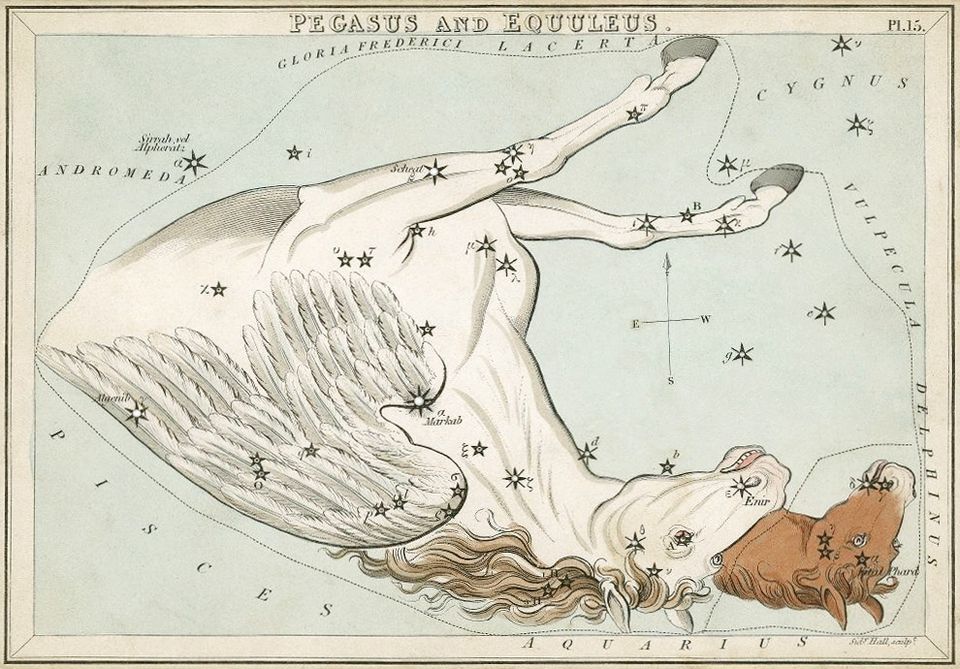
Scheat in Astrology
Scheat is the archetype of the shoulder that decides whether to keep carrying — and of the catastrophic and liberating consequences of that decision at each end of the consciousness spectrum.
The image in the myth is precise. Bellerophon reached the shoulder believing that what he had accomplished entitled him to what no mortal had been granted. The shoulder — the joint between human ambition and divine power — decided. Whether by divine intervention through the gadfly, or by Pegasus's own nature, the shoulder released. Bellerophon fell.
Pegasus continued to Olympus alone and took his place carrying Zeus's thunderbolts.
When Scheat Is Angular
Scheat carries additional weight when it falls on one of the chart angles, independent of any planet conjunction.
Trouble through old people, disgrace, trade losses, deceitful associates, rise followed by fall (Robson). The vocation carries the full arc publicly. The rise and fall of the Midheaven contact is Bellerophon's story in public life — the achievement that was genuine, and the overreach that followed it.
Mythology & History
Pegasus and the Blood of Medusa:
Pegasus was not born. Pegasus erupted.
When Perseus cut off the head of Medusa — the Gorgon whose gaze turned living things to stone, who had once been mortal and beautiful before Athena cursed her — the blood that fell from the severed neck entered the sea and the foam of the waves. From that blood and foam, Pegasus sprang: the winged horse, fully formed, already flying, born not of love or lust or divine will but of destruction's ending.
The direct lineage matters: Pegasus carries Medusa's blood. In the sky, Beta Persei — Algol, the Demon Star, the head of Medusa — and Scheat, the shoulder of Pegasus, are the two endpoints of the same mythological event. The destruction that produced the winged horse and the star that marks where the horse carried its rider are the two ends of the same line. This is not a comfortable inheritance. It is an honest one.
Medusa's blood also produced, in some versions of the myth, the giant Chrysaor, who sprang from the same wound. The destruction was generative in multiple directions. What was severed became, by the act of severing, something that could fly.
Bellerophon and the Chimera:
Pegasus passed through the possession of several figures in the mythology before Bellerophon. But the central myth — the one that defines the constellation and everything Scheat carries — is Bellerophon's.
Bellerophon was a hero, the son of Glaucus of Corinth, some accounts saying Poseidon was his true father. He was sent to kill the Chimera — the hybrid monster with a lion's head, a goat's body, and a serpent's tail, who breathed fire and devastated the lands of Lycia. The task was meant to be impossible: it was assigned by a king who expected Bellerophon to die attempting it.
Bellerophon tamed Pegasus with the aid of a golden bridle given to him by Athena or, in some versions, Poseidon. With Pegasus, he flew above the Chimera, raining arrows from above, killing it without being reached by the fire. Then Pegasus carried him against the Solymoi warriors, against the Amazons. He succeeded in everything.
Then, flush with victory, Bellerophon decided to ride Pegasus to Olympus. To join the gods.
He had killed the Chimera. He had defeated armies. He believed Pegasus was subject to his will. He believed what he had accomplished entitled him to what no mortal had been granted.
Zeus sent a gadfly. It stung Pegasus.
Pegasus reared. Bellerophon fell. He fell to earth, not to death — the fall left him lame and wandering, reproached by others, living out his remaining years in isolation. The ancient sources differ on whether he wandered the plains of Aleian, shunned by gods and humans, or died shortly after. What is consistent is what the fall did: it ended him as a figure in the world.
Pegasus continued. The horse completed the flight to Olympus alone. Zeus gave Pegasus a place in his stables, where the winged horse carried his thunderbolts. The horse that threw the hero continued serving the divine.
The Shoulder:
This is precisely where Scheat sits — on the shoulder of Pegasus. Not the wing that provided lift. Not the legs that carried the weight. The shoulder.
The shoulder is the joint at which the wing meets the body. In the moment that Bellerophon fell, it was the shoulder that moved — the joint that shifted when the gadfly stung and the horse reared. The shoulder is also the place a rider rests their trust. You cannot ride a winged horse by holding on to nothing. You hold at the mane, at the neck, at the shoulders.
Scheat marks the exact anatomical location of the decision. Whether Pegasus threw Bellerophon because Zeus ordered it through the gadfly, or because the horse had its own nature that would not ultimately carry a mortal to Olympus, the shoulder was the hinge. The joint released.
Muddy Reception vs. Clear Reception
The star does not change. Only the quality of the receiver changes what arrives.
The Robson tradition is blunt: extreme misfortune, murder, suicide, and drowning. These are not random. They are the specific forms that Bellerophon's overreach took when applied to different domains of life. The drowning is the water that overwhelms — the element of the unconscious, of what dissolves boundaries — when the rider refuses to release what they are carrying. The suicide is the ultimate expression of the shoulder-that-will-not-release: the decision to end the carrying rather than to set the burden down. The murder is the force that was meant to fight the Chimera applied without the horse's divine guidance, without the golden bridle, without the capacity for the elevation that made the flight possible.
At the lower end: the stubborn, combative nature the source tradition describes. The native who gains and loses friends through criticism. The changeable, unpredictable quality. The high enterprise that is not matched by the wisdom to know when to land.
There is also what the source tradition calls the tendency to fantasize — to live in the aspirational space of the Olympus ascent rather than in the actual terrain of the present. The rider who has already arrived at Olympus in their imagination while still on the ground.
The Great Mastery the source tradition occasionally names. The rider who has been through the fall — who carries the scar of Bellerophon's landing — and has learned from it. Who understands that Pegasus has a destination, and that the best riding involves listening for where the horse is going rather than imposing a destination that was never the horse's own.
At the clearest reception, Scheat is the star of knowing when release is the right action. The shoulder that lets go at the right moment — not because it has failed, but because holding on past the point of wisdom is itself the overreach. The one who has genuinely killed the Chimera knows the difference between the fight that is theirs and the flight to Olympus that belongs to the horse.
The 29° Pisces placement speaks here: this is the star at the end of everything, at the threshold before the beginning. The clearest reception of Scheat is the consciousness that stands at the final degree, having completed the entire zodiac's journey, and can genuinely say: I know what I earned. I know what was never mine to take. I can release both.
Working With Scheat
You do not need elaborate ritual. You need three things: your gaze, your intention, and something in the physical world that carries this star's resonance.
Fix your attention on the shoulder of the winged horse — the specific joint where the wing meets the body, where the rider's weight rests, where the decision is made.
What are you still carrying that the horse was never meant to take all the way to Olympus?
Natal Conjunctions
Find your conjunctions →The tradition records danger through water and engines, liability to accidents or drowning. At the higher expression: preferment in astrology, occult, and matters dealing with the public — success that follows disappointments. The identity carries the Bellerophon arc directly: the capacity for great achievement, the risk of the overreach that follows it. The clearest Scheat Sun has learned to distinguish achievement from entitlement.
Paran Interpretations
Find your parans →Parans form when Scheat and a planet simultaneously occupy the four angles at your birth location. The planet's angle determines the life period: Rising = youth, Culminating = prime, Setting = later years, Nadir = lifelong foundation.
Parans are timing signatures — they mark which life period Scheat governs for you personally. The four angles below (Rising, Culminating, Setting, Nadir) correspond to youth, prime, later years, and your lifelong foundation. This requires your birth date and place to calculate.
Your Fixed Stars reading names the stars on your planets and in your parans, and what each one means for you.
Get Your Fixed Stars Reading — $44Frequently Asked Questions
Is Scheat ruling your life?
Your Fixed Stars reading names the stars on your planets and in your parans, and what each one means for you.
Get Your Fixed Stars Reading — $44