Sirius in Astrology
Sirius is the archetype of blazing, devoted service that operates at the level of the supreme.
Not service from obligation or limitation. The star that outshines everything else in the sky is in the figure of the dog, the companion, the one who follows. This combination — the superlative brilliance in the role of faithful servant — is the essential paradox of Sirius. The greatest light does not stand alone. It serves.
The Sirius archetype governs those who carry extraordinary capacity and deploy it in devotion to something larger than themselves: a mission, a master, a cause, a people, a god. The military leader who serves their country with brilliance they could have spent elsewhere. The custodian who guards something irreplaceable with their life. The lawyer who fights for justice not because they must, but because they cannot not. The civil servant who runs toward the fire.
When Sirius Is Angular
Sirius carries additional weight when it falls on one of the chart angles, independent of any planet conjunction.
A splendid and illustrious life; glorious, mighty and commanding nature; fame, busy with many activities, bountiful resources, well known or feared in cities and regions. Prosperity from youth. The authority to insinuate power over people by high office or position of trust. Rising or culminating: unbounded good fortune, riches, happiness, ecclesiastical preferment, honor beyond the native's own expectations.
Mythology & History
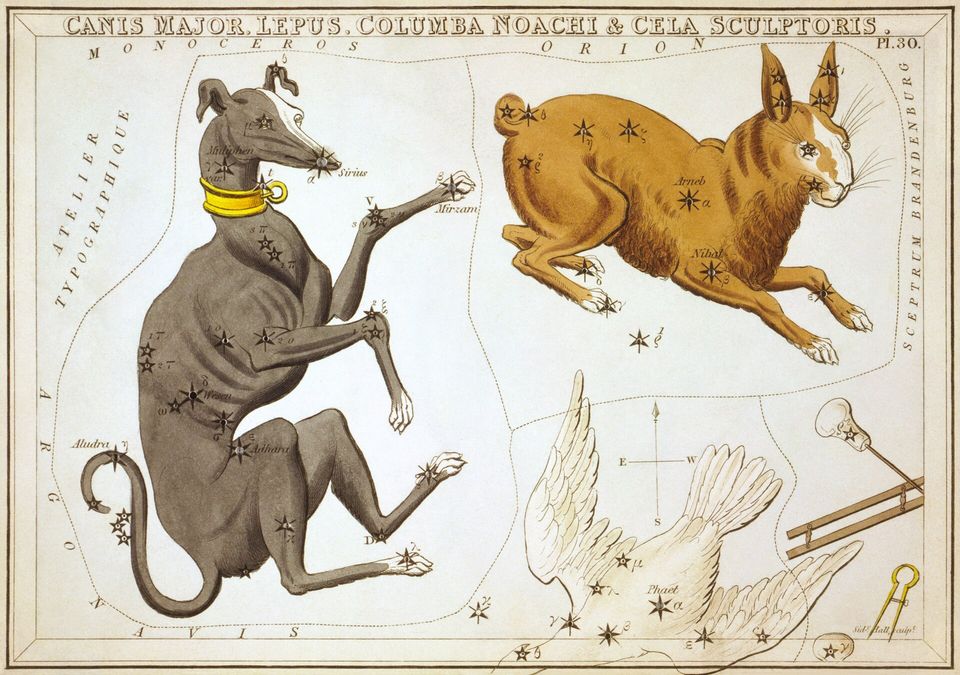
Canis Major and Orion:
In the most widely told version, Canis Major is Orion's hunting dog — the great hound that follows the hunter across the sky. Orion is the giant, the most recognisable constellation in the winter sky, with his belt and his club and his sword. At his heel follows the Greater Dog, and at the dog's heel follows the Lesser Dog. They hunt together in perpetual motion across the heavens.
Sirius, in this version, is the dog's eye — or by some accounts its nose, leading the hunt. The relationship is one of devotion, loyalty, and purposive pursuit. The dog does not hunt for itself. It follows the hunter, leading with its senses.
The myth of Orion is itself complex and contains multiple variants. In the most widely told version, Orion was the greatest hunter who had ever lived — son of Poseidon, beloved of the goddess Artemis (or Eos, depending on the tradition), killed by a scorpion sent either by the jealous god Ares or by Gaia herself because Orion had boasted he would kill every creature on earth. He was placed in the sky as a memorial to his greatness and his tragedy. His dog followed.
In another tradition, the dog is specifically Laelaps — a magical hound gifted by Zeus to Europa, then passed through several hands (Minos, Procris, Cephalus), notable because Laelaps was a dog fated never to miss its quarry. When Laelaps was set on the Teumessian Fox — a fox fated never to be caught — the logical paradox this created was so irresolvable that Zeus turned both animals to stone and set them in the sky. The dog that could not fail, and the prey that could not be caught, frozen in the moment before resolution.
In a third tradition noted by Robson and the mythographers, Canis Major was the dog set by Jupiter to guard Europa, whom he had stolen and conveyed to Crete. The guardian dog, placed at the threshold of what was most prized.
All three traditions circle the same constellation of meanings: devoted pursuit, faithful following, the one who leads with its senses, the one who guards what cannot be replaced.
Sopdet — The Egyptian Star:
This is a mythological tradition entirely separate from the Greek, and it may be the older layer of meaning embedded in this star.
In Egyptian theology, Sopdet (Sothis) was a goddess depicted as a woman wearing a crown with a tall white star above it, or as a cow bearing that same star between her horns. She was the personification of the star itself. Her heliacal rising — the first predawn appearance of Sirius after its annual period of invisibility, when it rose just before the sun — announced the beginning of the Egyptian new year, the inundation of the Nile, and the season of fertility.
The Nile's flooding was not merely an agricultural event. It was the renewal of the land, the reconstitution of Egypt itself, the moment when the river gave back the life that the summer had taken. Sopdet's appearance triggered that renewal. She was the herald of everything that would be needed to live.
Over time the mythological layers accumulated. Sopdet was identified with Isis, the great goddess of magic and restoration. The connection was not merely astronomical — it was theological. Isis, in the central myth of Egyptian religion, gathered the scattered pieces of her murdered husband Osiris and reconstituted him sufficiently to conceive their son Horus. The star that rose annually to announce the Nile's restoration was naturally given to the goddess whose defining act was restoration.
By the Ptolemaic period, the alignment between Sirius and Isis was explicit. Temple architectures at Dendera and elsewhere were oriented so that on the day of Sirius's heliacal rising, the star's light would travel down the temple's axis and illuminate the inner sanctuary. This is the archaeological record of a practice that linked the star's first appearance with the goddess's sacred presence. The star was her signal: she had returned, and the flood would follow.
The Sothic Calendar — one of the most sophisticated ancient calendar systems — used the cycle of Sirius's heliacal rising as its foundation. One Sothic cycle is approximately 1,460 years, the period required for the heliacal rising of Sirius to return to alignment with the Egyptian civil calendar. Egyptian chronologists used this to anchor their historical dating.
Muddy Reception vs. Clear Reception
The star does not change. Only the quality of the receiver changes what arrives.
The Sirius intensity burns without direction. The ardor — which at its best is devoted and purposive — attaches to grievances, to ambitions that serve only the self, to objects of worship that do not deserve it. The scorching quality of the dog days becomes literal: something is burning, and what is burning is relationships, opportunities, the trust of those who came close enough to feel the heat.
There is a particular Sirius shadow the tradition names consistently: resentment. The capacity for passionate devotion is exactly equal in potential force to the capacity for passionate grievance. The one who loved most absolutely also suffers most absolutely when the devotion is not returned. The wounds are not quiet. The Heavenly Wolf raids when it cannot hunt.
At the muddier end there is also the danger of misaimed service — enormous energy placed in faithful execution of something corrupt or wrong. The loyal soldier who does not ask what he is fighting for. The devoted custodian who guards a system that should not be guarded. The hound who pursues the wrong quarry with perfect efficiency.
The blazing runs clean. The devoted service is aimed at something worth serving, with full knowledge that this is a choice — that the capacity here is superlative, and that its direction matters enormously.
The Sirius person at their clearest does not make a display of their devotion. It simply becomes unmistakable because of what it produces. The herald who appears precisely when needed, every time. The guardian who has never once failed the thing they guard. The one whose ardor becomes a kind of solar wind — everyone in proximity is warmed by it, not burned.
At the clearest reception, the hidden companion becomes an asset rather than a secret. The Pup — the collapsed, dense, invisible partner that Sirius carries in its orbit — is the person's knowledge of their own darkness, their own capacity for resentment and burning, held close and known, used to calibrate the aim rather than denied.
Sopdet rising at dawn: the darkness has passed, the invisibility is over, and the one who serves is here again, exactly on time, with everything the land requires.
Working With Sirius
You do not need elaborate ritual. You need three things: your gaze, your intention, and something in the physical world that carries this star's resonance.
Fix your attention on the hound in full stride at the heel of the great hunter — moving forward without hesitation, leading with its senses, blazing.
Stone: Beryl — traditionally connected to clarity of vision and the goodwill of spirits · Herbs: Savin, mugwort, dragonwort
What is genuinely worthy of everything I carry?
Natal Conjunctions
Find your conjunctions →Success in business, occupation connected with martial affairs, domestic harmony. Kingly preferment if rising or culminating. The identity itself carries Sirius's blazing quality — a natural authority that is hard to ignore, a capacity to attract high honors and preferment, sometimes beyond what the native consciously expects or seeks. The Sun-Sirius native tends to receive positions of responsibility because they radiate a kind of reliable, burning competence that those with power find both useful and impressive.
Paran Interpretations
Find your parans →Parans form when Sirius and a planet simultaneously occupy the four angles at your birth location. The planet's angle determines the life period: Rising = youth, Culminating = prime, Setting = later years, Nadir = lifelong foundation.
Parans are timing signatures — they mark which life period Sirius governs for you personally. The four angles below (Rising, Culminating, Setting, Nadir) correspond to youth, prime, later years, and your lifelong foundation. This requires your birth date and place to calculate.
Your Fixed Stars reading names the stars on your planets and in your parans, and what each one means for you.
Get Your Fixed Stars Reading — $44Frequently Asked Questions
Is Sirius ruling your life?
Your Fixed Stars reading names the stars on your planets and in your parans, and what each one means for you.
Get Your Fixed Stars Reading — $44