Spica in Astrology
Spica is the archetype of the divine servant who chose to remain.
Not forced into service — capable of departing (the wings) but choosing to stay. Carrying the civilisation-gift (the sheaf) with divine patience. Witnessing the full range of human failure without abandoning the post. Making what wholeness is possible from incomplete material. Offering in the open hand without demanding recognition for the offering.
What Spica grants: the capacity to bring the gifts of heaven into earthly practicality. Not mystical without skill. Not skilled without soul. Both. The thing Tvashtar makes is divine in conception AND it functions. The wheat sheaf is both beautiful and edible.
Mythology & History
Astraea:
In the beginning the gods lived among human beings. The world was in its Golden Age — humanity was young and still innocent, and the divine and mortal walked together without separation.
One by one, as the ages declined — Gold to Silver to Bronze — the gods grew disgusted with what human beings were becoming and left. They ascended to Olympus and wherever gods go when they can no longer bear to witness what is happening below.
Astraea, goddess of justice and innocence, stayed.
She remained through the Silver Age as warfare emerged. She endured through the Bronze Age as greed hardened into institution. She stayed longer than any other immortal — not because she was blind to what was happening, but because leaving before the time was not something she was willing to do. The ancient writers say she wept. She witnessed and wept and stayed.
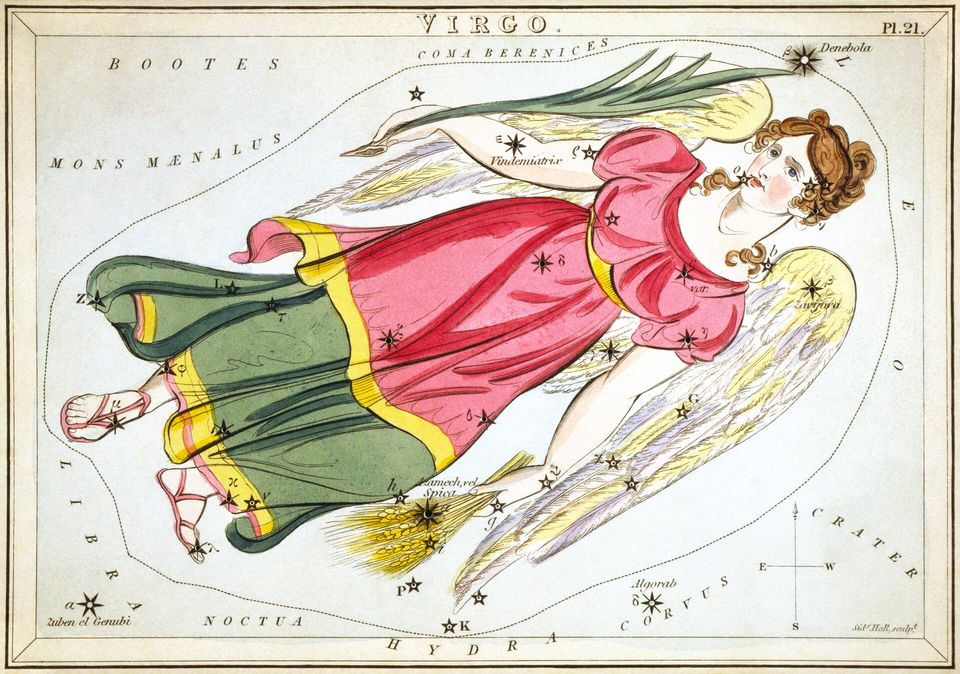
Only in the Iron Age — when bloodshed had become ordinary, when injustice had become the architecture of daily life — did Astraea finally depart. She did not leave in anger. She ascended to become the constellation Virgo in the sky. She is still there. Still holding her scales — which became the adjacent constellation Libra. Still watching.
Not gone. Transmuted.
The one who stayed longest became the star most associated with gifts.
Demeter:
The wheat sheaf Virgo holds is also Demeter's — the goddess of grain, of the harvest, of the patient knowledge of what the earth will yield.
Demeter's central myth is not about abundance. It is about loss.
Her daughter Persephone is taken by Hades to the underworld. Demeter's grief is absolute — she withdraws her gifts, nothing grows, the earth becomes barren, humanity starves. The gods must negotiate. Persephone can return, but she has eaten pomegranate seeds below and must descend again every year.
Demeter accepts this. Not easily. But she accepts the terms and the wheat grows again.
The sheaf in Virgo's hand is the thing that comes back every year despite the loss. The gift that grief could not permanently withhold. Something descends. Something returns. The wheat grows.
Isis:
By the Old Kingdom, Egyptian temple architects were aligning sacred structures to Spica's dawn rising — a practice that would continue for millennia. The appearance of Spica at dawn heralded the Nile's annual flood and the renewal of the land.
Later tradition layered a mythological identity onto this astronomical event: Spica rising was said to announce the return of Isis — the goddess who reassembles what has been dismantled. Her husband Osiris is murdered and scattered in pieces across Egypt. She searches. She finds each piece. She reconstructs. Not perfectly — one piece is never recovered — but enough. She makes what wholeness is possible from incomplete material.
The star's rising heralded renewal. The goddess it was given to was the one who knew how to bring things back.
Muddy Reception vs. Clear Reception
The star does not change. Only the quality of the receiver changes what arrives.
The perfectionism of the lower Spica frequency is not chaotic — it is meticulous. The hand that holds the sheaf begins counting the grains, rearranging them, unable to present the offering because one grain is out of place. The gift is held back not from laziness but from excessive care. Or it is given compulsively, from duty rather than love, draining the giver without replenishing them. The divine servant who no longer knows they are divine. The question who am I to be this brilliant? answered with silence and with work that is brilliant but joyless.
The wings are remembered. The work is offered not because it must be but because this is what this being came to do. The craft is extraordinary and worn lightly — the Spica person at their clearest seems almost unaware of how rare what they do is, because their attention is entirely on the making, not on themselves making it. They stay not because they cannot leave but because staying is what they choose. Astraea watching from the sky — still holding the scales, still present, not gone but transmuted into something that serves from a greater vantage.
Working With Spica
You do not need elaborate ritual. You need three things: your gaze, your intention, and something in the physical world that carries this star's resonance.
Fix your attention on the wheat sheaf held in the open hand. Not the field where it grew. The completed offering. The thing that took a season of patient cultivation and is now ready.
Stone: Emerald — traditionally engraved with the bird or merchant image · Herbs: Sage, trefoil, periwinkle, mugwort, mandrake
What am I willing to refine, without guarantee of recognition, for the sake of the thing itself?
Natal Conjunctions
Find your conjunctions →Great and lasting preferment, eminent dignity, immense wealth. Favorable for public and legal affairs. The identity carries Spica's gift — a quality of refinement that opens doors which remain closed to others. Church and state preferment when culminating.
Paran Interpretations
Find your parans →Parans form when Spica and a planet simultaneously occupy the four angles at your birth location. The planet's angle determines the life period: Rising = youth, Culminating = prime, Setting = later years, Nadir = lifelong foundation.
Parans are timing signatures — they mark which life period Spica governs for you personally. The four angles below (Rising, Culminating, Setting, Nadir) correspond to youth, prime, later years, and your lifelong foundation. This requires your birth date and place to calculate.
Your Fixed Stars reading names the stars on your planets and in your parans, and what each one means for you.
Get Your Fixed Stars Reading — $44Frequently Asked Questions
Is Spica ruling your life?
Your Fixed Stars reading names the stars on your planets and in your parans, and what each one means for you.
Get Your Fixed Stars Reading — $44