Vega in Astrology
Vega is the archetype of the gift that must not become the source of identity.
The gift is real. Manilius describes the Lyra constellation-influence as drawing forests and rocks, leading the stars, making off with the vast orb of the revolving sky. The sources consistently describe extraordinary artistic power, public appeal, the capacity to move and charm, the magnetism that causes attention to gather without apparent effort. The star is the reference point by which the brightness of everything else is measured. This is not a small gift.
But the Orpheus myth draws the precise line. Orpheus received the greatest gift and used it for everything that mattered: he reached the gods of the dead with it, he moved the forces that govern finality itself, he negotiated Eurydice's release. And then at the last step — when the gift had done everything it could do — he turned back to verify that it had worked. He looked, not forward into the light, but backward at what he had come for.
Mythology & History
Orpheus:
The myth this star transmits is one of the oldest in the Western tradition, and it hinges on a single moment that cannot be undone.
Orpheus was the greatest musician who had ever lived — or, in some versions of the myth, the greatest musician who would ever live. He was the son of the Muse Calliope. The god Apollo gave him the lyre, or, in another strand of the tradition recorded by Hyginus, Mercury made the first lyre from a tortoise shell cast up by the Nile, struck the dried sinews and heard music in them, fashioned the instrument, and gave it to Orpheus. By whatever origin, Orpheus received the lyre and what he did with it was not merely pleasing: it was world-altering. He played and the rocks moved toward him. The rivers changed their courses to draw near. The wild animals lay down at his feet, their nature suspended by the beauty of what they heard. Trees uprooted themselves to follow him. The ancient sources, including Manilius writing in the first century AD, are unanimous: Orpheus reached everything that could hear, which was everything, and what he reached was altered.
He loved a woman named Eurydice, and they were married. On the day of the wedding feast, Eurydice was fleeing from a man named Aristaeus who had tried to assault her, and in her flight she stepped on a serpent in the grass. She died of the bite. She descended to the underworld.
Orpheus, in his grief, did what no living being was supposed to do: he went after her. He descended to the kingdom of the dead, playing as he went. And the myth is specific about what happened when the music entered that place: Tantalus stopped reaching for the water that always receded. Ixion's wheel stopped turning. The Furies — who had never wept — wept. Hades himself, with his queen Persephone, was moved. The god of the dead agreed to release Eurydice on one condition. Orpheus must walk ahead of her back to the world of the living. He must not look back. Until both of them had crossed the threshold into sunlight, he must not turn to see her.
He walked. She followed. They were almost out. In some tellings he was one step from the light. In others he could see it beginning at the end of the passage. And then — at the last possible moment — he turned.
The versions differ on why. In Virgil's Georgics, it is madness, a sudden overwhelming love, a seizure of the very emotion that had brought him so far: furor, the Latin word for both passion and insanity. In Ovid's Metamorphoses, he turned because he feared she was no longer there. In some tellings he simply could not contain what he felt. Whatever the reason, the result was absolute: the moment his eyes found her, Eurydice was drawn back. She had no reproach for him — in Ovid she says only "farewell" before she is taken. One word. Then the silence.
Orpheus attempted to return below a second time. The ferryman Charon would not carry him. He was turned back. He sat on the bank for seven days. Then he wandered. He played still, but his music had changed, and now it drew only grief toward him. He would not love again. The tradition records that he refused all other loves, which in some accounts enraged the Maenads, the women of the Dionysian rites, who eventually tore him apart while in their sacred frenzy.
His body was scattered. His head, still singing, floated down the river Hebrus. His lyre floated beside it. Both reached the island of Lesbos. The Muses gathered what they could find of him and buried it at the foot of Mount Olympus.
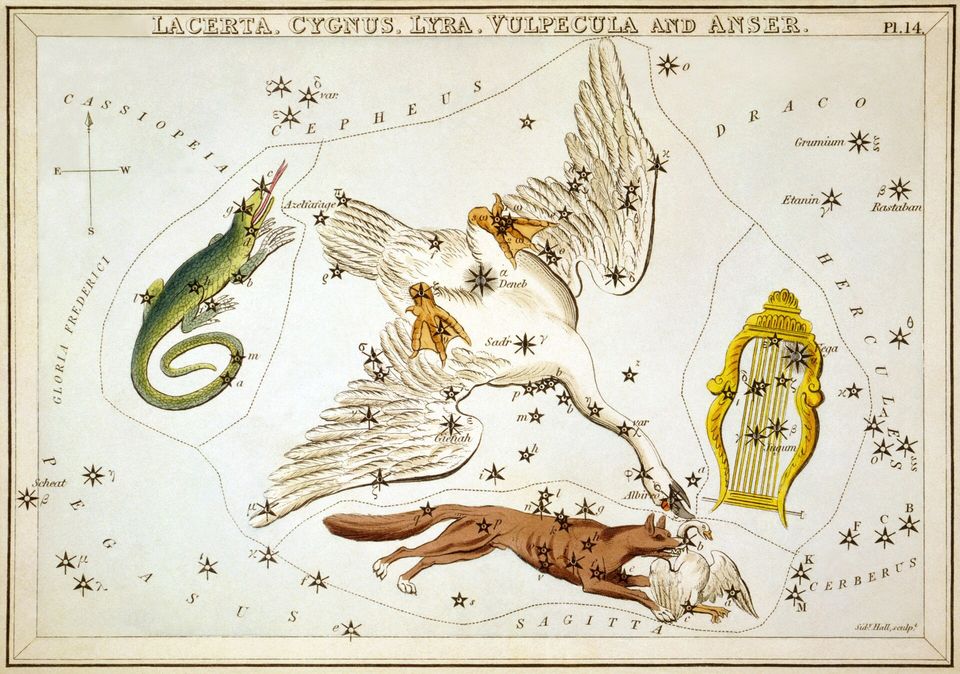
Then Jupiter, at the request of Apollo and the Muses, placed the lyre in the sky.
This is the lyre Vega is the brightest point of. Not the lyre in its joyful first form — the instrument that moved rocks and suspended time. This is the lyre after the looking back. The lyre after the loss. The lyre placed in the sky as a memorial to the greatest music that ever was, and to the moment that cost it everything.
Zhinu — the Weaving Maiden:
In the Chinese sky, this region of the heavens carries a different story, though it shares with the Orpheus myth a river, a separation, and love that can only reach across an uncrossable distance.
Vega, together with the nearby stars Epsilon and Zeta Lyrae, forms the Chinese asterism Zhinü — the Spinning Damsel, or the Weaving Sister. In the most widely told version of the Qixi story — the Night of Sevens, the Chinese Valentine's Day, celebrated on the seventh day of the seventh month — Zhinü is the daughter of the Jade Emperor, the weaver of clouds. She fell in love with a mortal cowherd, Niulang (represented by the star Altair and its flanking stars across the Milky Way), and the two married and were happy. But she had abandoned her heavenly work for love, and the Jade Emperor — or in some versions the Queen Mother of the West — drew the Milky Way across the sky between them as an impassable river.
Once a year only — on the seventh day of the seventh lunar month — the magpies of the world take pity on the lovers and form a bridge across the Milky Way from their outstretched wings, and the two can cross to meet each other. For one night the separation lifts. Then it resumes.
The Milky Way itself, visible as the bright band of stars that separates Vega from Altair in the summer sky, is the river between them. The bridge forms and dissolves and forms again.
Abhijit — the Victorious One:
In the Vedic tradition, Vega is identified with the nakshatra Abhijit, meaning "the Victorious One" — a name from the Sanskrit root for conquest or attainment. According to sources compiled by Allen, the nakshatra was associated with especially auspicious outcomes: under its influence, according to one tradition, the gods had vanquished the Asuras, the Hindu divinities of opposition and chaos. Because of this association with divine victory, Abhijit was included in some lists of the lunar nakshatras and omitted from others — Allen notes it was "the doubtful one of that country's lunar stations." Its association with Lord Brahma, the creator, and with the most fortunate outcomes is preserved in classical Vedic sources. The Akkadian title Dayan-same (Judge of Heaven) given to Vega in the Babylonian tradition carries a similar weight: this is a star associated with the highest position, the supreme seat, the crowning of victory. Whether through the Sanskrit naming or the Babylonian, the tradition agrees: when Vega was the pole star, it was the judge and the summit of the sky. The memory of that position survived even after precession had carried it elsewhere.
Muddy Reception vs. Clear Reception
The star does not change. Only the quality of the receiver changes what arrives.
The Vega energy without consciousness is the performance of the gift rather than the gift itself. The musician who is watching himself play. The artist whose attention is on the audience's response rather than on the music. The person who moves from relationship to relationship, from project to project, from achievement to achievement, seeking the confirmation that the gift is real — which the gift never quite gives, because confirmation is not what it offers.
At the muddier end there is also what the tradition names as changeability: the instability that underlies the brilliant surface. The person who can charm everything and commit to nothing, because commitment requires looking forward and this archetype's particular failure is to look back at what was, to check, to verify, to try to hold what cannot be held. Orpheus could not trust the music; he had to see. At the lower end, the Vega native cannot trust the gift either. It must be demonstrated again, confirmed again, praised again.
The criminal/murderous general attribution in the tradition — the tradition notes Vega (General) under that heading — is best understood in the context of the full archetype: the one with the capacity to charm everything can also use that capacity to deceive and manipulate. The lyre that moved the Furies moved them because it was genuine. The same instrument wielded for self-interest is the instrument of the deceiver. The gift is not selective about who wields it or toward what end.
The full Orpheus energy before the looking back. The music that moved the stones. The art that reached the underworld. The frequency that had the capacity to change what cannot be changed — received and deployed in full commitment, looking forward, trusting the gift.
At the clearest reception the Vega native is so absorbed in the act of making that the question of how they appear while making it does not arise. The reference-point quality — the standard against which everything else is measured — is worn without self-consciousness, because the measuring is happening through them rather than by them.
The Abhijit quality surfaces here: the Victorious One. Not victory over others, but the victory of having given the gift completely — of having walked the passage without looking back, of having trusted the music all the way to the light.
The former pole star, the Judge of Heaven — not currently at the summit, but carrying the frequency of having once held the highest seat. The precession will come around again. In approximately 11,500 years, Vega will return to be the pole star. This star does not hurry. It holds what it is.
Working With Vega
You do not need elaborate ritual. You need three things: your gaze, your intention, and something in the physical world that carries this star's resonance.
Fix your attention on the lyre — not the player, not the audience, not the reaction to the music, but the instrument itself. The thing that was made from what the sea cast up. The tension of the strings. The note that waits in the string until someone plays it.
Stone: Chrysolite — traditionally associated with clarity, with purification of the mind, with the removal of illusion and confusion. The stone appropriate to a star whose shadow is the looking back, the anxious verification, the inability to trust the gift. · Herbs: Succory (chicory) and fumitory — plants historically associated with purification and with the clearing of what clouds the mind.
What am I willing to walk all the way through, without looking back to see if the gift is following?
Natal Conjunctions
Find your conjunctions →Critical, abrupt, reserved; influential position, fleeting honors, insincere friends; danger of becoming obscure despite initial public prominence. The Vega Sun carries the archetype's central tension most nakedly: the gift produces influence and public position, but the shadow equally present — the note of obscurity alongside the brightness, the insincere friends around the person the public finds compelling. The tradition is unusually complex here, holding honor and its loss in the same breath. Unpopular in the tradition, which stands in paradoxical tension with the influence and preferment also attributed: the Vega Sun can be publicly prominent and privately difficult to sustain.
Paran Interpretations
Find your parans →Parans form when Vega and a planet simultaneously occupy the four angles at your birth location. The planet's angle determines the life period: Rising = youth, Culminating = prime, Setting = later years, Nadir = lifelong foundation.
Parans are timing signatures — they mark which life period Vega governs for you personally. The four angles below (Rising, Culminating, Setting, Nadir) correspond to youth, prime, later years, and your lifelong foundation. This requires your birth date and place to calculate.
Your Fixed Stars reading names the stars on your planets and in your parans, and what each one means for you.
Get Your Fixed Stars Reading — $44Frequently Asked Questions
Is Vega ruling your life?
Your Fixed Stars reading names the stars on your planets and in your parans, and what each one means for you.
Get Your Fixed Stars Reading — $44