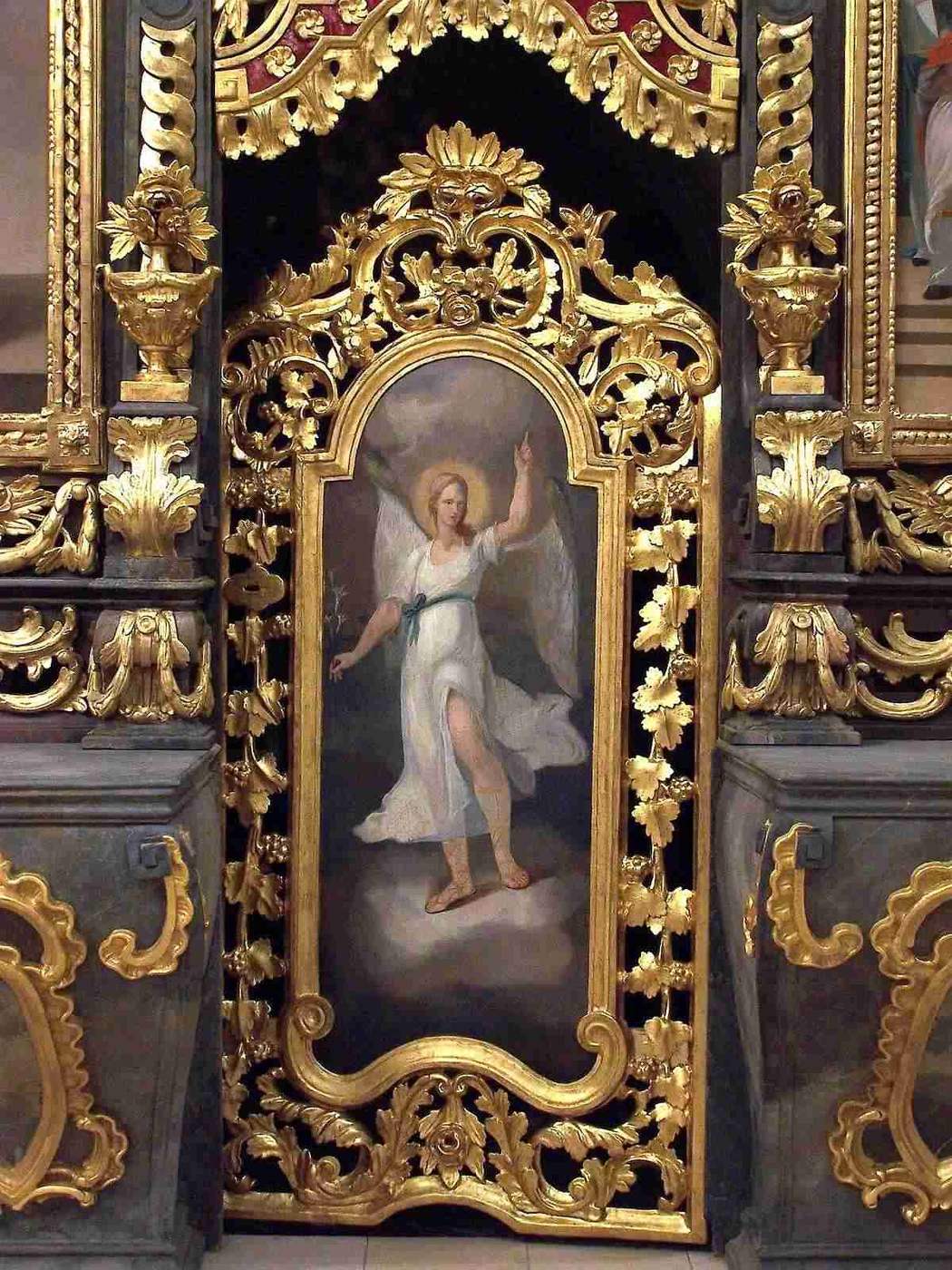
At first light, an open casement window faces east over a stone courtyard. Cool dawn air moves across the wooden sill and stirs the leaves of a white lily in a clay jar. Before the street wakes with carts and voices, a single clear breeze fills the empty room.
Archangel Gabriel is the herald who steps across that threshold in Judaism, Christianity, and Islam. His Hebrew name is Gavri'el, meaning Strength of God or Mighty One of God. In Arabic he is Jibril, the Trustworthy Spirit. Across scripture and sacred art, his horn, white lily, and stillness before speech show how an unseen word lands in a human life without shattering the vessel.
The signal that crosses the door
Most people picture a messenger as a runner with a letter in a satchel. That misses how messages move between unseen order and daily speech.
Tom Kenyon and the Hathors describe deep-space waves as messengers that sweep through our solar system and strike old habits until locked doors fly open. Nothing stays sealed once a true wave hits it. At that hour, a person faces a choice point between repeating an old loop or stepping into a new form.
Physics tells a similar story about how possibility becomes fact. John Archibald Wheeler summed up his view of the cosmos in three words: it from bit. Every physical thing, he proposed, answers a chain of yes-or-no questions posed to an open field. As Jennifer L. Nielsen writes in her study of Wheeler's idea, reality takes shape through questions and entangled exchange, never dead blocks pushed around in space.
A message from beyond is a question knocking on a door. How the room answers decides what enters the world.
Amit Goswami uses Gabriel to explain how revelation works. In The Visionary Window, Goswami describes angels as contexts in the subtle realm that lend a pattern to a prepared mind. When Muhammad sat alone in the cave, Goswami writes, Gabriel lent him a mind beyond his schooling, and the encounter changed history.
The mute priest and the open room
This is the story kept in the Book of Daniel, the Gospel of Luke, and early accounts of Mount Hira.
By the River Ulai, Daniel saw a vision of horns and falling kingdoms, and his strength left him. He fell face-down in terror. Then a figure touched him, lifted him upright, and spoke plainly so the prophet understood what the vision meant for coming ages.
Centuries later, Gabriel stood beside the altar in Jerusalem. The priest Zechariah was burning incense while the crowd prayed outside. Gabriel told him that his wife Elizabeth would bear a son named John. Zechariah doubted and asked for proof because they were old. Gabriel named himself and sealed the priest's mouth. Zechariah walked out unable to speak, and stayed mute until the boy was born.
Six months later, the messenger entered a house in Nazareth. He greeted Mary and told her she would conceive a child. Mary did not scoff or ask for a sign. She asked a plain question: how can this be? Gabriel explained how the power would overshadow her, and she answered: let it be to me according to your word. Then the angel departed.
In Islamic tradition, Jibril came to Muhammad in Cave Hira above Mecca. Three times the spirit pressed him and gave one command: Iqra, meaning Read or Recite. Out of that night came the verses of the Quran, delivered across twenty-three years.
Two halves of the horn
Put Zechariah beside Mary, and Gabriel's rule locks into place.
First, a signal lands only in a vessel that stops arguing with it. Zechariah met an impossible word with dry arithmetic, so his mouth was closed until the child arrived. Chatter blocks new growth. Mary asked one question about how the work would happen, and then agreed. Wonder leaves the door open. Cynicism locks it from within.
Second, silence and announcement are two halves of one horn. What is spoken before its season scatters in the wind. What is held inside the mind or womb gathers weight until its hour comes.
Anne Tucker shows how this works in human breath. In one message, the angels say that when people gather love inside the heart, angels trumpet that signal out to the world. In another, the Mother of Creation, whom Tucker calls Isla, says angels arrive in a breath of freshness when someone feels unready to move, bringing a shade of light they had not seen.
Trumpet, lily, and bare floor
Look at an Annunciation painting or a carved church portal. Three objects beside Gabriel show how speech and receptivity balance each other.
At his lips or in his hand rests the brass horn. Unlike a whisper behind curtains, a horn turns breath into sound that crosses a valley. Its job is never to entertain. Its job is to wake a sleeping room so truth no longer stays buried in private notes.
In his other hand sits a white Madonna lily, often rising out of a water jar between the angel and the listener. Sound without pure motive turns into noise and spectacle. The lily grows from dark soil into open air without strain. It marks intent free from trickery, ready to hold seed without forcing the hour.
At the bottom of those paintings, Gabriel's wings sweep down toward stone or wooden floorboards. He does not hover far off in clouds. In Tucker's talks, calling Archangel Gabriel shapes the angelic field into a messenger inside daily life. The word lands where someone washes cups and sweeps the floor.
Where silence meets sound
In human life, Gabriel governs the seam between holding back and speaking out.
Think of a seed under winter soil. If you dig it up every week to prove it grows, it dies. If you bury it under concrete where rain and air never reach, it rots.
Zechariah learned the first half in nine months of silence. When his tongue opened on the day his son was named, the words poured out with force because they had ripened in the dark. Mary lived the second half in one sentence of consent.
Every creative threshold follows that sequence. First comes listening in the back room or cave. Next comes a plain question that tests how the pattern wants to move. Only then does the horn lift to the lips.
How the herald moves in the sky
Archangel Gabriel is honored across living faiths, with no planet or asteroid carrying his name in astronomy. Linking him to Uranus, Chiron, or modern birth chart placements is a modern overlay, not part of Jewish, Christian, or Islamic scripture. Readers who draw that comparison usually look at Mercury, the Moon, and Uranus.
Mercury rules voice, writing, breath, and translation. When Mercury meets the Moon, feeling finds exact words so what lived inside the chest enters a room clearly. When Mercury stands still near a station or retrograde at birth, a person often mirrors Zechariah's silence. They refine speech slowly until every word carries weight.
Uranus marks the sudden horn blast. When Uranus touches natal Mercury or the Moon, old roles go mute overnight and an unexpected calling asks for air.
Modern chart readers also check the third, fifth, and tenth houses when birth time is known. The third house tracks speech and study. The fifth house guards conception, risk, and what is born from joy. The tenth house shows where a word steps into daylight. Chiron marks bruises around being heard, while the Lunar Nodes point toward whether a person clings to silence or risks speaking a new chapter aloud.
Tuning the receiver
Turn toward Archangel Gabriel when an old chapter has ended and a new work waits to be named, or when doubt keeps shouting down a clear signal.
Come at dawn or in the first still hour before news and messages fill the room. Sit upright on a chair beside an open window with a blank page and a pen on the sill, plus a small glass of water for the lily jar.
Close your mouth and breathe in gently through your nose. Feel the breath sink below the navel. In Gabriel's pattern, conception begins low in the body before any word reaches the throat.
Ask one simple question out loud, the way Mary asked how. Do not ask for a five-year map. Ask only what step wants to take form today. Then stop talking and wait two minutes while you watch the water grow still.
If a word or image comes, speak it once in a firm voice. Let your breath carry one open tone, like a horn clearing rust from brass.
Seal the morning practice with one clear physical gesture. Write down the single true line you heard on the page in front of you, fold the sheet once, and shut the window latch firmly so the room keeps what arrived. Drink a sip of water and step into your day.
What people ask about Gabriel
What does the name Gabriel mean?
In Hebrew, Gavri'el means Strength of God or Mighty One of God. Across Jewish, Christian, and Islamic scripture, he is the herald who translates visions and delivers announcements at turning points.
What is Gabriel known for in the Bible and the Quran?
In Daniel he lifts the fainting prophet and explains visions of coming eras. In Luke he announces the births of John the Baptist to Zechariah and Jesus to Mary. In Islam, Jibril reveals the Quran to Muhammad in Cave Hira.
Why is Gabriel shown with a trumpet and a white lily?
The trumpet stands for announcement that wakes a sleeping room and breaks denial. The lily stands for pure intent and receptivity, showing that new life takes root without force.
Is Archangel Gabriel tied to a planet or zodiac sign?
Gabriel is a sacred figure in living faiths, with no planet or asteroid bearing his name. In modern chart comparisons, his themes align with Mercury for voice, the Moon for receptivity, and Uranus for sudden awakenings.
How can someone work with the Gabriel archetype?
Take five minutes beside an open dawn window before checking messages, ask one plain question about a waiting beginning, and shut the latch after writing one line so the word takes root without interference.
The archetype of the horn
Archangel Gabriel is the breath that turns hidden pattern into living speech.