At dusk, a heavy stone city gate swings shut with the clack of an iron latch. Beyond the wall, wind sweeps across open fields. Inside the courtyard, a single lantern holds its flame out of the gust, and two neighbors can hear each other speak without shouting.
Archangel Michael stands at that threshold across Jewish, Christian, and Islamic traditions. His Hebrew name is Mikha'el. That name is a question, never a boast of rank. It asks, Who is like God? Through his story, his blade, and his scales, tradition maps how a person holds firm ground without turning into a tyrant.
The force that keeps an edge
Every living thing needs a border. A cell stays alive because a membrane lets water in and keeps poison out. Without that border, the cell spills into the sea and vanishes.
Consciousness works the same way. When panic sweeps a room, thoughts blur until no one knows what belongs to them and what belongs to the storm. Michael restores the edge. He separates what is true from what is loud.
A sentinel at a city gate is no warlord hunting enemies. He keeps two things from bleeding into one muddle: what belongs to God and what belongs to human panic.
In the Kryon talks, Lee Carroll corrects the old paintings of heavenly armies. Angels do not stand in ranks under a general. Michael is no lone commander above the rest. In Kryon's teaching, Michael is a group consciousness heard as one voice because it carries one service. Like the heart inside a body, it speaks for the whole without ranking above the lungs or the hands.
The dragon and the dust
This is the story kept in the Book of Daniel, the First Book of Enoch, the Epistle of Jude, and the Book of Revelation.
When empires rose and fell in Babylon, Daniel stood by the river and saw powers clash in the dark. He fell face-down upon the ground. A messenger came and told him that the prince of Persia had held the way for twenty-one days. Then Michael, the chief prince, came to stand beside him.
In the First Book of Enoch, Michael is called the merciful watcher, set over patience and human virtue. Centuries later, the letter of Jude remembers a strange scene. Michael stood over the body of Moses and faced the adversary. They disputed for that dust. Yet Michael did not hurl a curse or an insult. He spoke one sentence: The Lord rebuke you.
Then in the Book of Revelation, war broke out in heaven. Michael and his angels fought the dragon, and the dragon fought back. The serpent found no place left in heaven and was cast down to the earth.
In Islamic tradition, he is honored as Mika'il beside Jibril. There he brings rain to dry fields and food to living creatures. Across all three faiths, the same figure stands in storm and harvest alike.
The law of the blade
Set those old passages side by side, and two rules of the threshold stand out.
First, a true cut divides without hatred. In Jude, Michael holds strength enough to cast down a dragon. Yet over the body of Moses he refuses to trade insults. Once a defender begins to scream or mock, he steps into the enemy's camp. Anger blurs the edge. Restraint keeps it sharp.
Second, what has no edge dissolves into noise. Water needs a riverbank to flow. A string must be drawn tight to hold a note. When someone gives up every border to please a crowd, their own signal disappears into static.
Anne Tucker, in her talks with the angelic realm, describes angels as the orchestration of time. They are an essence spread everywhere, she says. When someone calls Archangel Michael by name, that vast field gathers into one form. The question inside his name acts as a tuning fork. Who is like God? Nobody is. Because no person owns the source, no bully and no panicked crowd holds final rule over you.
Sword, scales, and blue water
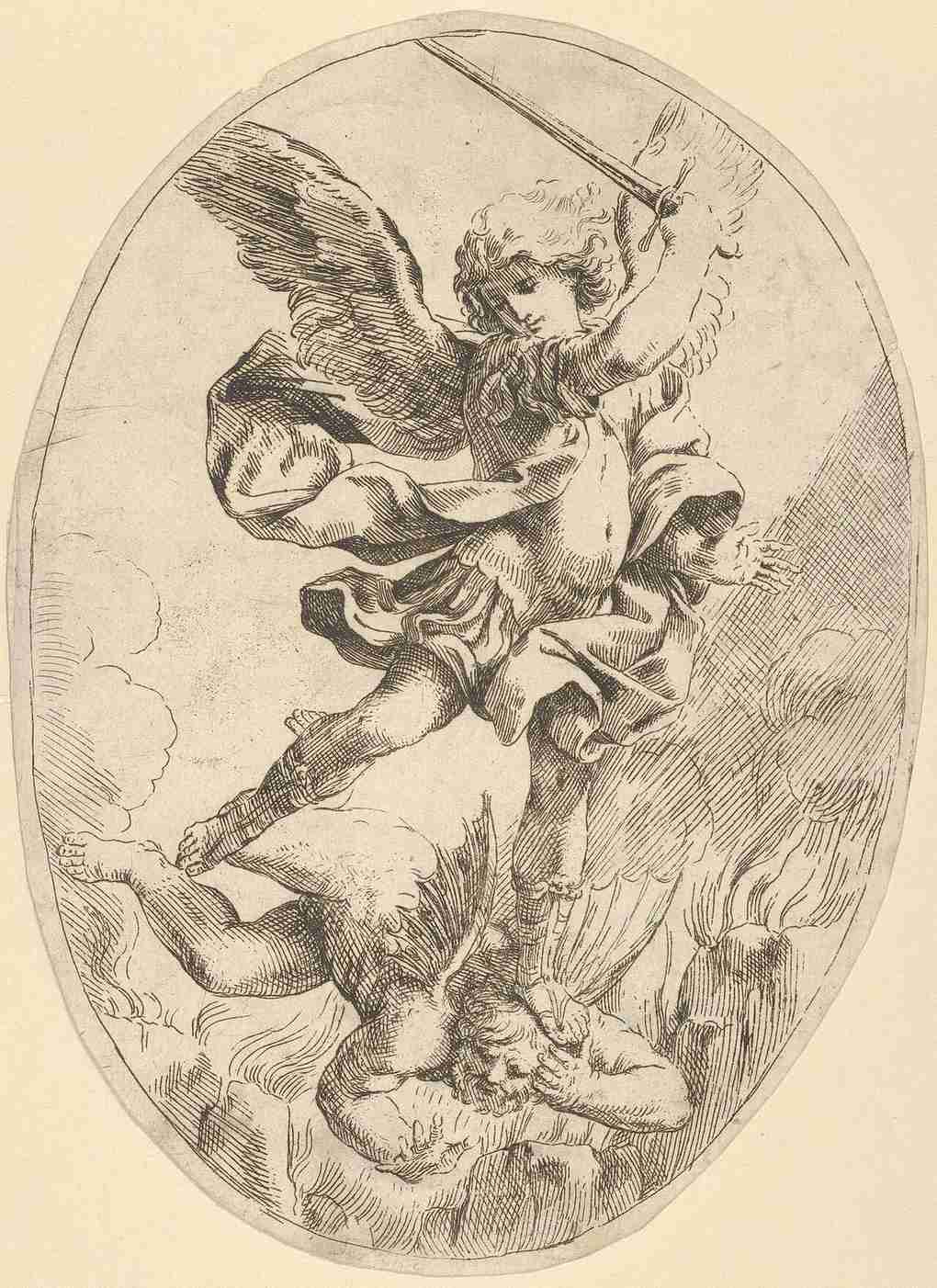
Look at Guido Reni's painting of Archangel Michael. Every detail in the frame points to restraint under pressure.
In his right hand is the sword. It does not swing wildly at neighbors. A blade is a tool of distinction. It parts two things that were tangled together, such as an old vow and a present duty. Tom Kenyon and the Hathors describe angels as fields of intention sent on one purpose. A sword of fire is attention that holds its line once the truth is seen.
In his left hand, medieval painters often set balance scales. Scales exist to test the sword. Without scales, a blade turns cruel and hacks at whatever moves. The scales ask one question before the strike: is the weight true? Power answers to proportion.
Under his feet lies the dragon, held down by one heel, not hacked to pieces. Chaotic force is not erased from the cosmos. It is put beneath the foot, in its proper place.
In Kenyon's note from Fiji, he recalls one sentence from Michael about why humans long for deep water. You are from a place where beings swim in blue love, the angel told him. Sapphire belongs to Michael because blue is the color of open sky and distance. It sees clearly without scorching what it touches.
The two pillars of the gate
Michael never stands alone in older maps. He is half of a circuit.
Session 74 of The Law of One dialogues explains how a seeker orders a space before prayer. The teaching calls two names from the Tree of Life. One is Ve Geburah, linked to Michael, to Mars, and to outward force. The other is Ve Gedulah, linked to Auriel, or Uriel, to Jupiter, and to the receptive pole.
Outward force alone turns brittle. Receptive holding alone collapses under pressure. Michael holds the line so the vessel inside stays open without breaking. Together, the two forces form an upright gate.
Rock and tide
People did not build Michael's shrines in soft valleys. Across Europe, his chapels rose on jagged islands and sea cliffs where stone meets ocean.
Mont-Saint-Michel rises out of shifting sands in Normandy. Atlantic tides cut it off from shore twice a day. Skellig Michael climbs straight out of water off Ireland, seven hundred feet of rock battered by gales.
Those sites mirror his work. They sit on the seam between earth and sea. Twice a day the tide rushes in and pulls back, leaving the bare stone wet and shining. Climbing those steps meant leaving the town's noise behind and standing where sky, stone, and water keep clear borders.
Where the sentinel walks the sky
Archangel Michael is a spiritual figure across Judaism, Christianity, and Islam, with no planet or asteroid carrying his name. Pairing him with Western planets, Chiron, or the Lunar Nodes is a modern lens, not part of ancient scripture. Readers who use that comparison often look at Mars, Saturn, Pluto, and the Nodes.
Look first at Mars and Saturn when they meet. Mars is the blade, the spark moving outward. Saturn is the wall, the limit that teaches timing and restraint. Together they form the craft of defending what matters without wasting force in useless fights.
Look next at the Sun and Pluto. Where those two align, a person meets power that cannot be bribed. The test echoes Michael's name: can you hold strength without mistaking yourself for God?
Chiron and Black Moon Lilith mark sore spots around truth and speech. Chiron shows where a voice was shouted down early, leaving someone silent or guarded. Lilith shows where someone refuses to bend to lies. The South Node shows habits of merging with a crowd to dodge conflict. The North Node points toward standing firm when truth asks for it.
Standing at the threshold
Turn to Archangel Michael when the noise around you grows louder than your own voice, or when you carry a weight that belongs to someone else. You need no robes or speeches. You need an upright spine and a clear line.
Stand or sit with your feet apart and your back straight. Look at one point across the room so your eyes stop darting.
Name aloud what belongs to you today, and name what does not. Keep each sentence short. Do not blame anyone while you speak. You are only sorting two piles on a table.
Raise your right hand to chest height, palm flat like a blade turned toward the floor. Breathe in slowly for four counts, filling your ribs. As you breathe out, drop your hand in one stroke toward the ground, drawing a line between your feet and the room.
Then hold both hands level in front of you, palms up, like pans of a scale. Ask silently what weight you need to set down before nightfall. Wait until one answer surfaces.
End the practice with one ordinary act at your own door. Walk over to the doorway, test that the latch sits shut, and set your keys neatly on the hook or table inside the threshold. Speak the question once under your breath: Who is like God? Step back into the room with your hands free.
Questions asked about Michael
What does the name Michael mean?
In Hebrew, Mikha'el means Who is like God? It is a question, not a title of pride. It reminds every defender that strength serves a higher order and never belongs to vanity.
Why does Archangel Michael hold both a sword and scales?
The sword stands for clear division between truth and confusion. The scales stand for fair weight and proportion. Together they show that power must measure before it cuts.
Where does Michael appear in scripture?
He appears in Daniel as the guardian prince who brings aid in dark times. In Jude he refuses to insult an adversary over the body of Moses, in Revelation he casts down the dragon, and in Islam Mika'il brings rain and food.
Is Archangel Michael a planet in astrology?
He is a spiritual figure in living faiths, with no planet or asteroid bearing his name. In modern chart comparisons, readers link his themes with Mars, Saturn, Pluto, Chiron, Black Moon Lilith, and the Lunar Nodes.
How do you work with Archangel Michael respectfully?
Stand upright, sort what is yours from what belongs to others, and speak with restraint. End the practice by latching your doorway, setting your keys neatly inside the threshold, and returning the outcome to the source.
The archetype of the line
Archangel Michael is the stroke at the threshold, the question that keeps power humble.