Beside a dusty milestone outside the city gate, a wild herb bush catches the midday sun. Two travelers pause in the gravel to tighten their sandal straps and share a leather water flask before taking the next hill. The road ahead stretches for miles, yet neither walks it alone.
Archangel Raphael is that companion in Jewish, Christian, and Western esoteric traditions. His Hebrew name is Refa'el, meaning God Mends or God Restores. He does not arrive on lightning. He puts on dusty sandals, takes a staff, and walks beside a traveler under a mortal name. His story and emblems show how fear turns into clear sight along a real road, without promising magical cures.
The walker in disguise
Most people imagine restoration as a bolt from above that erases trouble behind locked doors. The old records teach the reverse.
A bruised limb or an isolated household rarely heals behind a bolted door. Strength returns through daily motion, fresh air, and faithful company. A traveler learns the trail by setting foot on real gravel, never by staring at a wall indoors.
Ancient storytellers gave that restoring motion sandals, a walking staff, and a dog at the traveler's heels.
The road to Ecbatana
This is the story told in the Book of Tobit, alongside lines in the First Book of Enoch.
In Nineveh lived Tobit, an old man who lost his sight while burying the dead and sat poor in his courtyard. Far east in Ecbatana lived a young woman named Sarah. Seven times she married, and seven times the demon Asmodeus killed her bridegroom on the wedding night. In the same hour, Tobit and Sarah prayed to die, each thinking no one heard.
Heaven sent Raphael. He did not appear in fire. He took the form of a kinsman named Azariah, met Tobit's son Tobias in the street, and hired on for daily wages as a guide for the road east. A small dog trotted behind them out of the gate.
They camped at dusk beside the Tigris River. When Tobias washed his feet, a huge fish leaped from the water and tried to swallow his foot. Tobias cried out. Azariah did not strike the beast. He told the boy to seize the fish by the gills and pull it onto the bank. Then he showed Tobias how to save three parts: the heart, the liver, and the gall.
When they reached Ecbatana, Tobias married Sarah. On the wedding night, following Azariah's word, he laid the fish's heart and liver on hot coals. The smoke drove Asmodeus far away into Egypt, and the couple lived.
Azariah collected the family silver owed from old debts, and they walked home to Nineveh. There, Tobias rubbed the fish gall across his father's eyes. A white film peeled away like scales, and Tobit saw his son standing in the yard. Only when the family tried to pay Azariah half their wealth did he drop his disguise. I am Raphael, he told them, one of the seven angels before the glory of the Holy One. Then he vanished.
What the road reveals
Follow that road from Nineveh to Ecbatana, and two plain truths stand out.
First, wholeness cannot drop onto a locked room. It enters through motion and company. Raphael walked at Tobias's pace for weeks, letting a frightened boy grip the fish with his own hands. A guide who does the work for you leaves you helpless when the road turns dark again.
Second, what rushes at you in the dark carries what your eyes are missing. The fish tried to swallow Tobias whole. Yet inside that fish lay the smoke that cleared Sarah's house and the gall that lifted Tobit's blindness. Avoidance keeps a wound sealed. Contact turns terror into clear perception.
In a talk with Pam Gregory, Anne Tucker cites Kelly Kolodney on Archangel Raphael speaking about humanity entering a new cycle of change. Isla, the Mother of Creation, adds a clear rule in Tucker's recordings. Restoration takes energy, Isla says, and nothing outside can steal or break off a piece of your soul. Every thread still lives inside the whole.
Staff, fish, and twin serpents
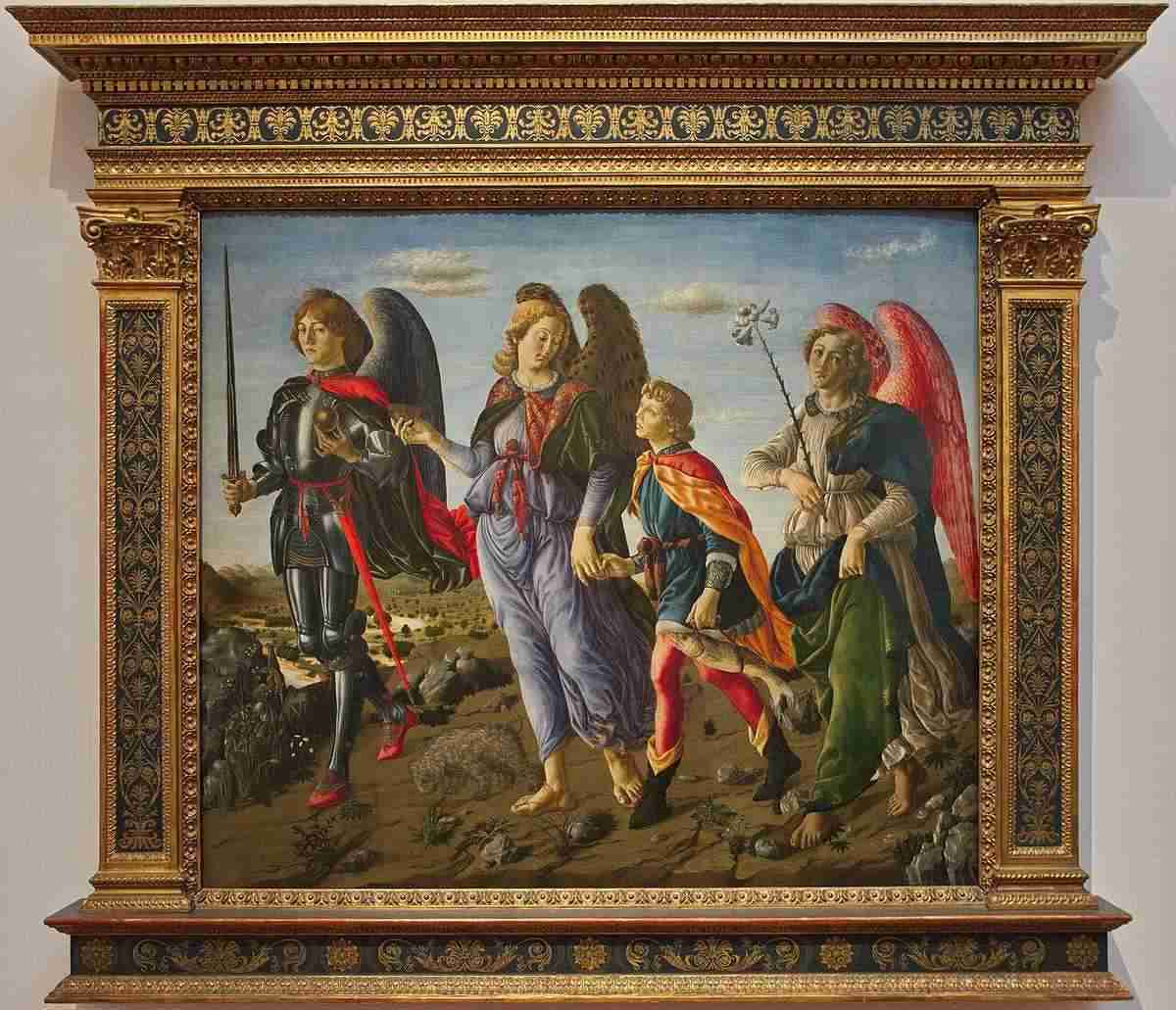
Stand before Francesco Botticini's painting of Tobias and the angel in Florence, or look at traveler carvings of Raphael. Every detail beside them speaks of travel, not comfort.
At his side rests the walking staff, cloak, and water gourd. Unlike Michael's blade or Gabriel's horn, Raphael carries gear for gravel miles. A staff gives three points of contact with the earth when footing slips. The dog beside his ankles marks loyal instinct following the trail before the mind reads the map.
In Tobias's grip gleams the fish from the river. River water stands for what swirls beneath conscious thought. Gripping the fish by its gills means facing sudden dread without running upstream. Held in daylight, raw fear separates into heart, liver, and gall, each serving a step on the way home.
Later artists placed the winged caduceus in Raphael's hand, a rod with two serpents rising toward wings. Remember what that rod is. Before hospitals borrowed a single-serpent staff, the twin-serpent wand belonged to messengers and travelers who crossed borders to make peace. Two currents wind around one spine and meet in balance at the top. It is an emblem of proportion, never a promise of physical cure or a substitute for doctors.
Two currents on one spine
Tom Kenyon and the Hathors map that twin-current rod inside the body.
In his sound work, Kenyon offers a track titled Sounds of Raphael, meant to be heard with attention resting at the center of the head near the pineal gland. Alongside it, the Hathors teach a three-minute method using the pranic tube. That channel runs down the center of the body from the crown and the Ba point above the head to the base of the spine and into the earth.
You draw earth energy up from below and solar energy down from above. Both currents meet inside an octahedron at the center of the head. When the two currents cross inside that shape, turbulence levels out across mind and body. That is Raphael's caduceus in practice: earth below, sky above, two spirals on one axis.
Maia Nartoomid writes in her study of the Mazzaroth that archangels move across streams of time to mend separation and restore balance between the pillars of the temple. Opposing forces mend when they share one center.
Where the companion crosses the sky
Archangel Raphael is a sacred figure in living faiths, with no planet or asteroid carrying his name in natal tables. Pairing him with Western planets, Chiron, or houses is a modern overlay, not part of the Book of Tobit. Readers who use that comparison often look at Mercury, Chiron, Venus, and the sixth and twelfth houses.
Mercury is the walker on the road, linking Nineveh to Ecbatana and mind to body through plain speech. When Mercury meets Venus, words bring fairness into tense rooms without hiding truth.
Chiron marks the wound that cleverness cannot fix alone. Where Chiron touches Mercury or the Sun, a person knows how it feels to walk blind or carry family grief. That bruise becomes the lantern they hold for the next traveler.
Check the sixth and twelfth houses when birth time is known. The sixth house governs daily habits, craft, small animals, and humble work. The twelfth house holds unseen waters where fears swim and unseen companions walk beside you. Jupiter touching Mercury opens the long road abroad, reminding a traveler that one night in Nineveh is not the whole map.
Walking with the unseen companion
Turn toward Archangel Raphael when you feel scattered across too many rooms, or when fear leaps out whenever you approach a crossing. Make no medical demands and expect no instant lightning. Treat the work as a walk down a real road.
Set a bowl of water on a table before you, or step outside where your shoes touch dirt or stone. Sit or stand upright so your spine forms one staff from your seat to your crown.
Recall Kenyon's central channel. Feel a thread running from six inches above your head through your chest into the floor. Breathe in slowly. Picture a green current rising from the earth to meet a gold current descending from the sun at the center of your head. Let them cross without force.
Now name one Tigris fish you have been dodging this week. Perhaps it is an unopened letter or a talk you dread. Picture gripping it by the gills in daylight. Name one small part to handle today. Do not try to walk to Ecbatana before noon. Walk only the next mile.
If you use sound, hum one tone on the out-breath until your jaw softens.
End the practice by setting your pack down for the evening. Walk to your entryway, place your walking shoes neatly side by side beside the door, and share or eat a piece of plain bread at the kitchen table. Leave the road outside until morning, and let Azariah step back into the crowd.
Common questions on Raphael
What does the name Raphael mean?
In Hebrew, Refa'el means God Mends or God Restores. Across Jewish, Christian, and Western esoteric traditions, he is the guide of travelers and companion during hard crossings.
What happens in Raphael's story in the Book of Tobit?
Disguised as Azariah, Raphael guides Tobias and his dog to Ecbatana. He teaches the boy to seize a fish, frees Sarah from torment, recovers family silver, and clears Tobit's eyes with fish gall before revealing his name.
Why is Raphael shown with a staff, a fish, and a caduceus?
The staff, sandals, and dog mark travel on earth. The fish stands for facing fear until it yields clarity. The twin-serpent caduceus shows two forces balanced around one spine, serving as an emblem of harmony, never clinical medicine.
Is Archangel Raphael a planet in astrology?
Raphael is a revered spiritual messenger in living faiths, with no planet or asteroid bearing his name. In modern chart comparisons, readers link his themes with Mercury as the guide, Chiron as the wounded mentor, and the sixth and twelfth houses.
How do you work with Archangel Raphael?
Walk one stretch of road at a time instead of panicking over the whole distance. Center your breath along the spine, face one avoided task in daylight, and set your walking shoes neatly by the door when finished.
The archetype of the road
Archangel Raphael is the companion who walks at your pace until scattered pieces find one road.