At sunset, a fresh blank page lies beside a glass inkwell on a wooden desk. Yesterday's tally sheet sits folded inside a drawer, its columns of old debts closed for the night. Amber evening light crosses the open paper without leaving a smudge.
Archangel Zadkiel carries that release in Jewish lore, Kabbalah, and modern ray teachings. His Hebrew name is Tzadkiel, meaning Righteousness of God or Benevolence of God. On the Tree of Life, he keeps Chesed, the sphere of mercy and loving-kindness. His mercy breaks old loops, and his violet fire warms dense memory until a person can lay down a grudge without hiding the truth.
Why old loops refuse to break on their own
Most habits act like stones rolling downhill. Once a grudge starts moving down a bloodline or a town, each year adds weight and speed. Fighting a grudge with another grudge only feeds the slope.
Physics met a surprise when it looked inside the atom. In his book Physics of the Soul, Amit Goswami explains the quantum leap. An electron around a nucleus never slides smoothly from a high ring to a low ring. It vanishes from one orbit and appears in the next without crossing the space between.
Goswami calls this a jump without steps between. Habitual thought runs along fixed tracks, repeating yesterday's math forever. Real change breaks the track and leaps to another plane of meaning.
Light shows the same edge in color. At one end of the rainbow sits red, built from long waves with low energy. At the far rim sits violet, built from the shortest waves and highest energy our eyes see before light turns unseen. Old teachers placed mercy at that high rim because mercy takes more strength than revenge.
In Jewish thought, repairing a fractured world happens through real acts of mercy and kindness, never through keeping an endless ledger of slights.
The blade on Mount Moriah
This is the story kept in Genesis and told in Jewish Midrash lore.
Abraham led his son Isaac up the rocky slope of Mount Moriah. The boy carried split wood on his shoulders while his father carried fire and a knife. Isaac asked where the lamb for the offering was. Abraham answered only that God would provide the lamb.
At the top, Abraham built an altar of field stones. He laid the wood in order and bound his son on top. Then he reached out his hand and lifted the knife.
Rabbinic Midrash names Archangel Zadkiel as the angel who came in that last breath. As the blade hovered over Isaac, a voice cried Abraham's name twice, and Zadkiel caught the falling arm. Do not lay your hand on the boy, the voice commanded, and do no harm to him.
Abraham lowered the knife and turned around. Caught by its horns in a thicket stood a ram. He untied Isaac, set the ram upon the stones, and walked down the hill with his son alive beside him. From that hour, the line broke free from child sacrifice, and Zadkiel stood as keeper of mercy.
Staying the blade and holding heat in the cup
Look at Mount Moriah, and two laws of Zadkiel stand clear.
First, a caught blade frees two generations at once. Had the knife fallen, Isaac would have died on the stone and Abraham would have carried madness down the mountain. Stopping an old debt mid-swing breaks the bond for everyone yet to come.
Second, real change needs both heat and a vessel. You cannot wish rage into peace by forcing a fake smile. In his notes on inner change, Tom Kenyon writes that real shift needs three things: heavy lead ready to turn, a subtle vessel strong enough to hold the heat, and power from a higher octave.
Kenyon saw this color during his sound work after the Fukushima crisis in 2013. As he sang tones over the coast, white light pouring into the field shifted into a violet flame aimed at changing heavy conditions. Mercy is strong heat held inside a calm vessel.
Amethyst stone, chalice, and violet flame
Three traditional emblems gather around Zadkiel in Kabbalah and ray lore.
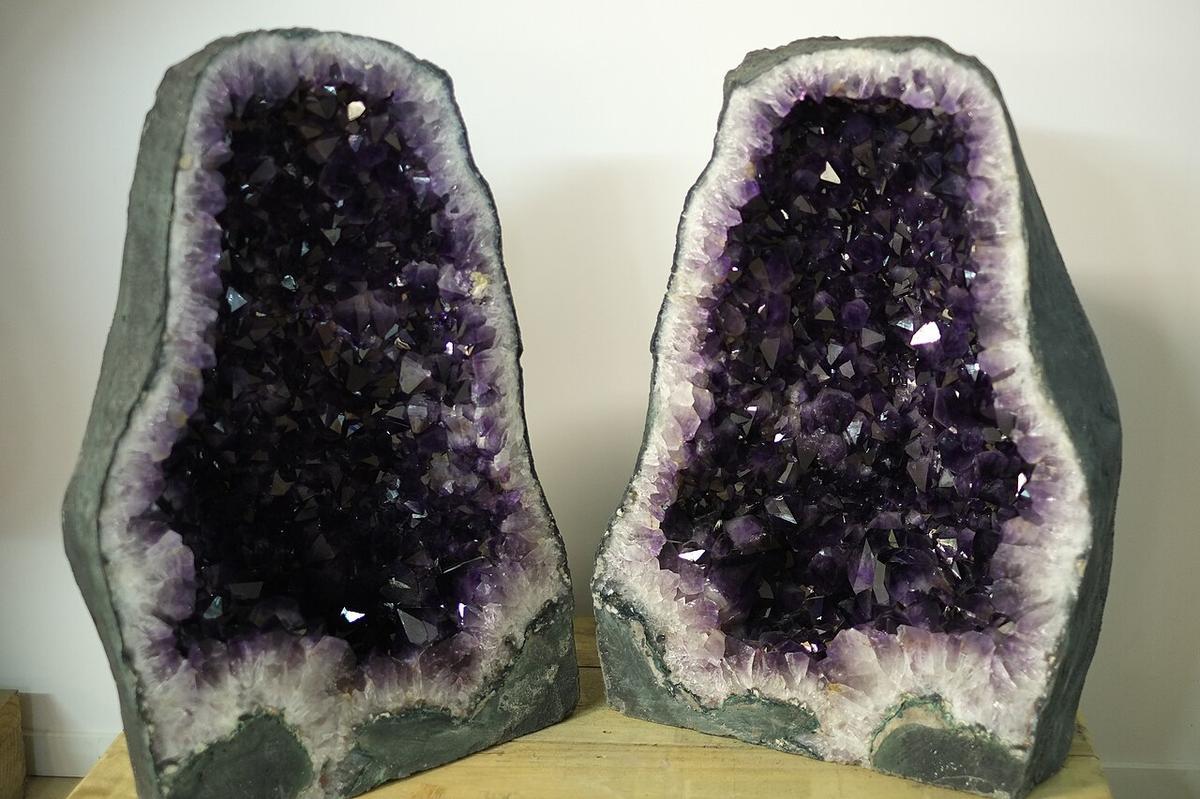
An amethyst crystal, purple quartz formed inside hollow geodes, anchors his calm sight. Its Greek root warns against drunkenness. Travelers held the stone as a sign of sobriety and a clear head. When grief or rage tries to cloud your choices, amethyst brings the mind back to clear balance.
Beside the crystal rests a chalice. Unlike Michael's sword that cuts outward, a cup receives what pours into it. A chalice holds bitter memory without spilling poison on the table, giving old lead time to turn into gold.
Rising above both is the violet flame itself. Maia Nartoomid writes in her Mazzaroth and Osiris texts that a violet ray enters the center when split parts are ready to rise into a new octave. She links Sagittarius to transmutation as its keynote, lifting heavy instinct toward bright mind.
Mercy and severity on one tree
On the Kabbalistic Tree of Life, Chesed sits on the right pillar across from Geburah on the left pillar. Geburah is strict judgment, the blade that measures every fault to the grain. Chesed is Zadkiel's seat, the open hand that grants room to start again.
Judgment alone freezes the world in yesterday's court. Mercy alone without sight leaves no door shut against harm. Together, severity draws the border while mercy keeps the prison from turning eternal.
In Why Lightworkers are Built to Transmute Suffering, Anne Tucker shares Isla's view that forgiveness is a tool built straight into the human frame. Ordinary forgiving still holds the grudge while setting it down. Higher forgiveness lifts awareness into the seat of a watcher above the fight. From that height, old friction stops copying itself into tomorrow.
Lee Carroll's Kryon talks echo that release. When people stop dragging past guilt into every room, their inner record grows lighter, and rival traditions begin seeing one another through mercy. The Law of One dialogues add that true change lifts daily life into awareness of one Creator, guarding the seeker on the path of service.
Where Zadkiel moves in the birth sky
Archangel Zadkiel is a sacred figure in Jewish and esoteric lore, with no planet or asteroid bearing his name. Pairing him with outer planets, Chiron, or modern birth charts is a modern lens, not part of ancient Midrash. Readers who draw that comparison often look at Jupiter, Saturn, Pluto, and Uranus.
Jupiter has ruled Chesed, the sphere of mercy and growth, since Renaissance Kabbalah mapped planets onto the Tree. Where Jupiter touches the Sun or Moon, broad sight refuses to let old walls keep the last word.
Saturn and Pluto mark heavy debts and family patterns asking for change. Saturn tracks every vow and result across decades. Pluto strips away rot until only durable truth stays standing. When Jupiter meets Saturn or Pluto, a person learns to carry hard history without turning cruel.
Uranus brings Goswami's sudden jump, snapping stale habits in one flash of insight. Chiron shows the old ache that tempts someone to keep score forever. The South Node holds past loops ready for release, while Lilith refuses to stay bound to old shame.
Stepping out of yesterday's courtroom
Turn toward Archangel Zadkiel when old resentment keeps replaying a dead fight, or when family grief feels too dense to carry into a new season. Hold one grudge in violet light until its grip loosens.
Sit upright in a still room with no slouching cushions behind your back. If you own an amethyst stone, hold it in your left palm. If not, cup both hands loosely on your lap like a bowl.
Name one old verdict or grudge you still enforce against yourself or a neighbor. Speak it aloud in one short sentence with no excuses. Picture that memory sitting inside your cupped palms as dark smoke.
Breathe in through your nose for four counts. As you breathe out, picture violet light rising from your chest into your palms, passing through the dark smoke like sun through morning mist. Recall Tom Kenyon's work on ancestors: send mercy to the lines behind you so the chain stops in your hands.
Rest for one minute as the watcher above the court, letting Anne Tucker's shift take hold. Refuse to swing the knife again.
End the practice by closing yesterday's books. If you wrote down the old grievance on a slip of paper, fold that balance sheet shut and tuck it away out of sight. Name one plain chore waiting in the house, stand up from your chair, and step out into the evening unburdened.
Questions people bring to Zadkiel
What does the name Zadkiel mean?
In Hebrew, Tzadkiel means Righteousness of God or Benevolence of God. Across Jewish mysticism and Western angel lore, he stands as the archangel of mercy, forgiveness, and inner purification.
Where does Zadkiel appear in traditional lore?
Rabbinic Midrash names Zadkiel as the angel who stayed Abraham's raised knife over Isaac on Mount Moriah and pointed to the ram in the thicket. Kabbalah places him over Chesed, the sphere of loving-kindness on the Tree of Life.
What do amethyst and the violet flame mean for Zadkiel?
Amethyst stands for clear sobriety in strong feeling, drawn from its Greek root warning against drunkenness. The violet flame marks the high edge of visible light that turns heavy grief and habit into free energy.
Is Archangel Zadkiel a planet in astrology?
Zadkiel is a spiritual figure in living faiths, with no planet or asteroid carrying his name. In modern chart comparisons, readers link his themes with Jupiter as Chesed's ruler of mercy, beside Saturn, Pluto, Uranus, Chiron, and the Lunar Nodes.
How do you practice forgiveness with Zadkiel?
Sit upright, name one grudge plainly, cup it in your hands as an offering to violet light, and step into the watcher seat where old loops stop repeating. End by folding away yesterday's balance sheet, naming one plain chore, and stepping out into your evening unburdened.
The stayed knife and the open cup
Archangel Zadkiel is the hand that catches the blade in midair, turning yesterday's debt into tomorrow's freedom.