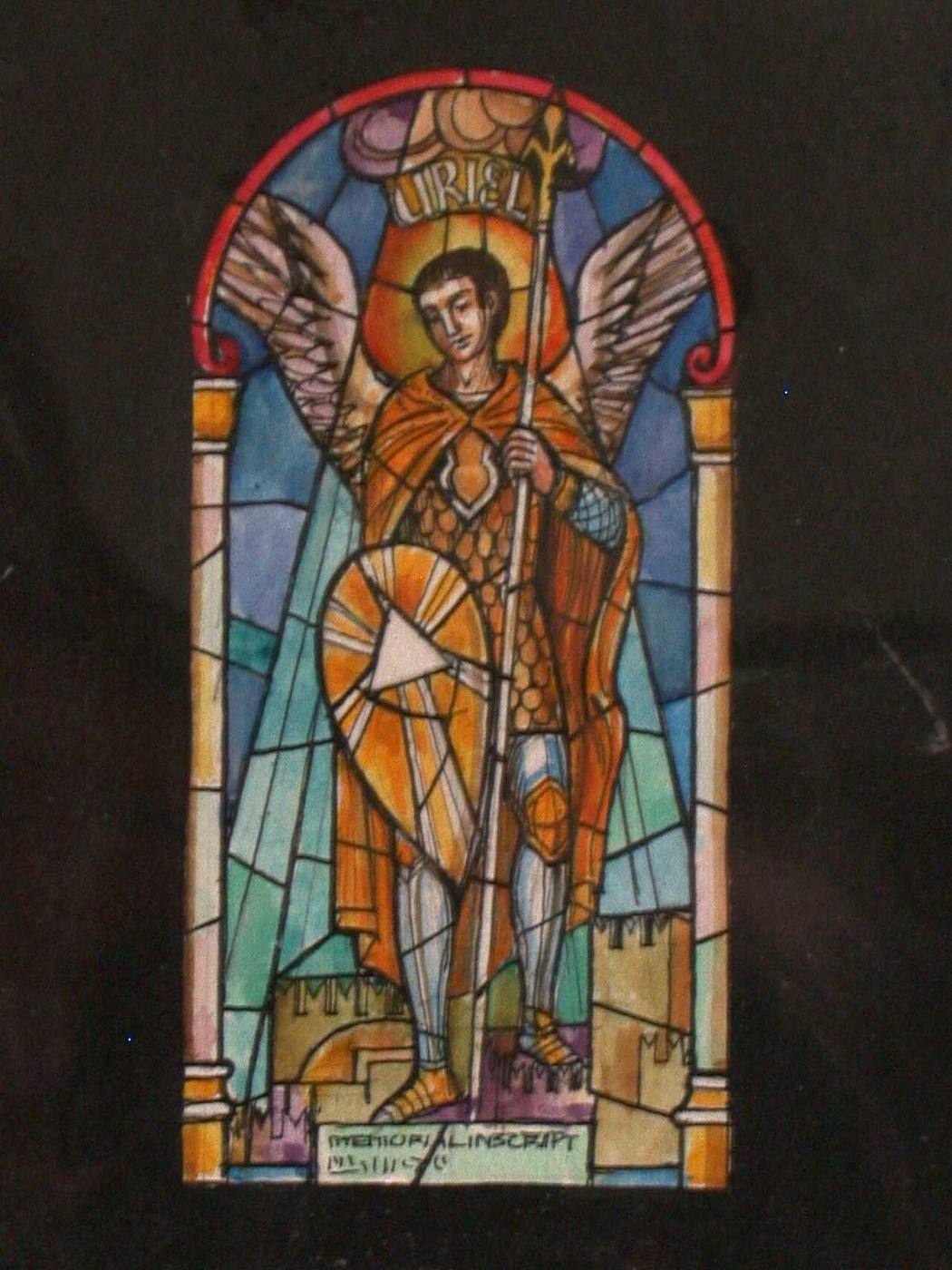
On a winter evening, a brass lantern is lit inside a cold hallway. Its yellow wick reaches only as far as the threshold stone and the lowest stair, leaving the dark garden outside unseen. Overhead, the winter constellations turn slowly past the high window at their own pace.
Archangel Uriel keeps that flame and measure in Jewish apocalyptic texts, Christian liturgy, and Hermetic tradition. His Hebrew name is Uri'el, meaning Light of God or Flame of God. He does not hand panicked minds a magic key to tomorrow. He stands beside a grieving thinker in the dark and pairs a palm-held lamp with the clockwork of the heavens.
The fire that keeps measure
When life around a person falls into ruins, the mind demands to know why it happened and what comes next. When no answer arrives, thought spins in tighter circles until exhaustion sets in.
Uriel meets that storm with scale and proportion. He asks the mind to see the difference between a cup and an ocean.
A traveler walking a mountain trail in winter carries a small lantern, never a searchlight strong enough to brighten the whole valley. That small pool of light shows the next stone step beneath your boots, and nothing past the bend. In the same way, a clay jar dropped on stone breaks once and does not leap back into a whole cup. Yesterday never walks back through the door.
Two thousand years earlier, Uriel stood over the ashes of Babylon and taught Ezra the same lesson with fire, wind, and yesterday.
The three riddles and the twelve gates
This is the record in the Second Book of Esdras, also called Fourth Ezra, alongside the First Book of Enoch.
In Babylon, Ezra sat brokenhearted among the ruins of his city. He looked at the world and cried out to heaven with a burning question: why do cruel rulers sit in ease while the faithful suffer and die?
Archangel Uriel came to answer him in the night. He did not scold Ezra or offer easy slogans. Instead, Uriel set three tests between them. Weigh for me the weight of a fire, he said. Measure for me a blast of wind. Call back for me the day that has already passed.
Ezra stared and answered that no mortal on earth could do even one of those things. Then Uriel asked how a mind that cannot measure the flame, wind, and hours right before it expects to measure the plan of the Most High. A small vessel cannot hold the sea. A human eye sees one thread of a loom stretching across ages.
Turn to the First Book of Enoch, chapters seventy-two through eighty-two, and the other half of Uriel appears. There Uriel leads Enoch to the rim of the sky and shows him the astronomical gates of heaven. Six gates stand in the east and six in the west, where the sun rises and sets across the year. Uriel shows him the chambers of the moon, the exact count of days binding solar and lunar calendars, the storehouses of winds, and the courses of stars.
In Babylon, Uriel stops a mind from demanding too much. At the gates of Enoch, he shows that the sky is not chaos. It is geometry and faithful clockwork.
The law of the cup
Put Second Esdras beside First Enoch, and two laws of Uriel's wisdom come clear.
First, a mind breaks when it tries to pour the ocean into a cup. Suffering climbs when we demand certainty about the next century before we take one measured step tonight. You are not asked to carry the cosmos. You are asked to carry the lamp in your hand.
Second, mystery at the edge of sight does not mean disorder at the root of things. The angel who told Ezra he could not weigh a flame taught Enoch the math of the solstices and the moon. What looks tangled from three inches away runs on exact measure from the rim of the sky.
In one of Anne Tucker's talks with the angelic realm, when she first asked the angels for their names, the very first name they gave her was Uriel. Soon after, they asked her to stop asking for separate names and know them as one essence, like cells inside one body. Their language, they told her, is wind and buoyant sea, not bone and speech. Their wings are breath, opening daily to bring in the dawn and renew the earth with morning light.
Open palm, scroll, and sky gate
Look at the stained-glass drawings of Uriel made by Edward Burne-Jones and William Morris, or older emblems of the north quarter. Every detail in his hands marks both inquiry and human limits.
Resting on his open palm or inside a ruby-gold lantern glows a small flame. It is no lightning bolt hurled from a cloud, and no sword swung in battle. A flame in an open palm cannot coerce anyone. Close your fist, and the fire goes out. Its light reaches only two paces of stone before your shoes.
Beside the lamp hangs an unrolled scroll, paired with dividers or a planetary sphere. The scroll shows that light welcomes hard questions. Uriel invites Ezra to think to the rim of what thinking holds, and then step into wonder.
Around his shoulders fall robes of deep crimson and gold. Gold marks tested wisdom, forged inside hard seasons instead of borrowed from slogans. Crimson grounds worry down into the belly, reminding the thinker that they stand on earth.
Maia Nartoomid writes in her study of the Mazzaroth that archangels move across different streams of time while the Archangels of Sagittarius guard the twelve sky gates. They keep order between Earth and the star wheels. Wisdom and timing belong together.
The hearth inside the wall
Carla Rueckert's Session 74 transcript in The Law of One names two pillars from the Tree of Life used when a seeker clears a space. One pillar is Ve Geburah, linked to Archangel Michael, Mars, and outward strength. Across from it stands Ve Gedulah, linked in those dialogues to Auriel, or Uriel, to Jupiter, and to the receptive pole holding breadth and mercy.
See how the circuit completes itself. Michael draws the line in the storm so chaos stays outside the door. Uriel lights the lamp inside the room so the mind does not starve in the dark. One is the wall. The other is the hearth. Neither stands without its partner.
How the astronomer moves in the sky
Archangel Uriel is an honored figure in living faiths, with no planet or asteroid bearing his name. Pairing him with Western planets, Chiron, or natal houses is a modern overlay, not part of Second Esdras or First Enoch. Readers who use that comparison often look at Saturn, Jupiter, Mercury, and the Sun.
Saturn is the master of the twelve gates and passing years. Wherever Saturn sits in a chart, a person learns that time cannot be rushed or bribed. Mastery grows through winter seasons. When Mercury meets Saturn, thought drops shallow shortcuts. That mind asks Ezra's questions, tests claims against experience, and matures into calm counsel.
Jupiter supplies the sky of Ve Gedulah, the breadth that refuses to shrink life to fear. Sun and Chiron contacts mark people who walked through unanswered grief early and learned to hold a lantern for neighbors in the dark.
Modern chart readers also check the third and ninth houses when birth time is known. The third house maps daily notes and steps. The ninth house maps philosophy, horizons, and the sky clock. Earth signs like Virgo and Capricorn bring measure. Fire signs like Leo and Sagittarius carry the palm flame.
Holding the small lamp
Turn toward Archangel Uriel when worry tries to weigh tomorrow's fire before dawn. You need no robes or charts. You need paper, a pen, and five minutes of stillness.
Sit upright in a room beside one candle or lamp. Place both hands open on your thighs, palms facing upward like two pools of light.
Draw one line down the middle of the page. On the left side, write actions inside your reach this week: one call, one repair, one bill. Keep the list short.
On the right side, write questions that belong to Ezra's riddles: what the economy will do, how strangers will judge you, or why a loss happened. Look at that column and speak Uriel's three tests aloud: I cannot weigh fire, I cannot measure wind, and I cannot call back yesterday.
Let your breath slow until your shoulders drop. Look at the candle, and take in enough light for the left column. Tomorrow belongs to the twelve gates.
End the practice before worry turns the flame too bright. Turn the brass lantern wick low or blow out your desk candle, and write one plain ground step for tomorrow morning at the bottom of your left column. Speak aloud the hour and the day of the week, close your notebook, and leave the night sky to keep its own clock.
Questions people bring to Uriel
What does the name Uriel mean?
In Hebrew, Uri'el means Light of God or Flame of God. Across Jewish apocalyptic texts, Christian devotion, and Hermetic thought, he stands as the angel of wisdom, proportion, and sacred astronomy.
Where does Uriel appear in ancient texts?
He appears in the Second Book of Esdras answering the prophet Ezra with three riddles about fire, wind, and yesterday. He also guides Enoch in the First Book of Enoch through the twelve gates of the sun, moon, winds, and stars.
Why is Uriel shown holding a flame in his open hand?
A flame in an open palm sheds light on the next step without blinding or forcing anyone. Paired with a scroll, it shows that wisdom welcomes sincere inquiry while honoring mortal limits.
Is Archangel Uriel a planet or zodiac sign in astrology?
Uriel is a spiritual figure in living traditions, with no planet or asteroid bearing his name. In modern chart comparisons, readers link his qualities with Saturn for time and structure, Jupiter for breadth, Mercury for rigorous thought, and the ninth house.
How can someone work with the Uriel archetype?
Sort what sits inside your hands today from what belongs to the wider horizon. Observe natural cycles like sunrise or moon phases, and close your work by turning the lamp wick low and writing one plain step for tomorrow.
The archetype of the lamp
Archangel Uriel is the small lamp in the palm, bright enough for one step while the heavens keep the hours.