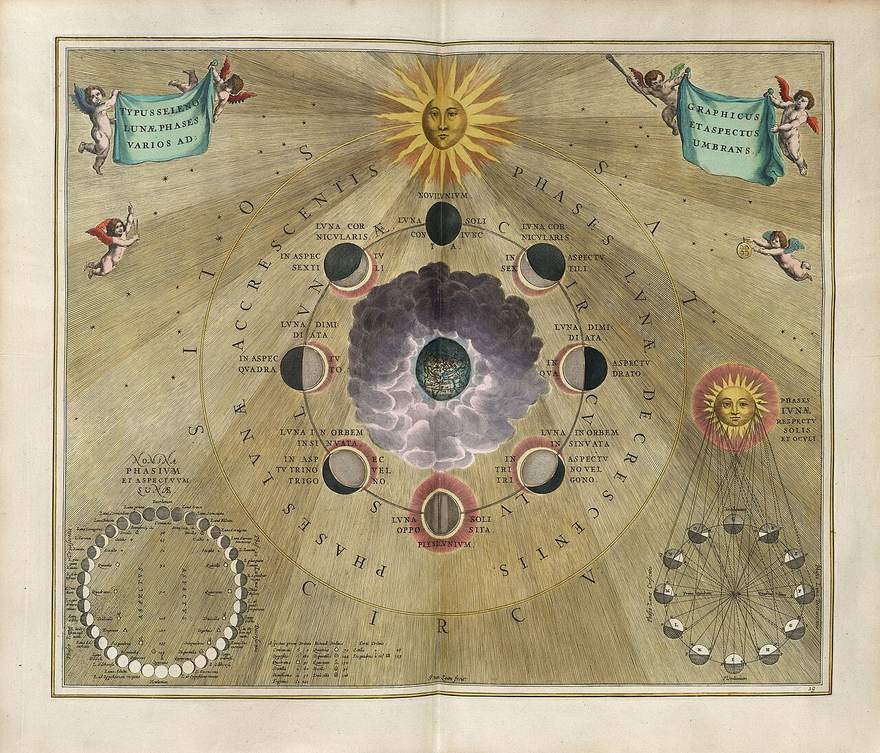
Moonlight lays a silver track across a still river bend lined with tall reeds. Frogs call from the mud bank while cool night air settles over the damp leaves. Looking up from the water's edge, your eyes open wide to stars that afternoon glare hid completely.
Mayari and Apolaki are the sister and brother who rule night and day in Tagalog and Kapampangan lore. Apolaki is the warrior lord of the sun. Mayari is the queen of the moon, known as Bulan across southern islands. Beside them stand Tala of the evening star and Hanan of the dawn. Together they show how fierce drive learns measure, and how wounded sight lights the dark.
Two ways of looking at one world
Science has found a clear mirror for this sky pair inside light and human sight.
Human eyes hold two distinct systems for reading the world. Bright daylight uses cones at the center of the retina to lock onto sharp edges and color, like a hunter tracking a single target. Dim night light wakes rods around the outer rim of the eye. Those rods surrender sharp color so you can spot movement and starlight across the whole dark bank at once. Noon focus cannot replace night watch.
Physics adds a second mirror in Carlo Rovelli's Helgoland. Rovelli watched Anton Zeilinger split a laser beam down two paths on a table. Block one path with your hand, and half the light drops away. The bright interference pattern vanishes. Only when both paths stay open do the waves meet and build the full design. One single glare leaves half the sky blind.
How the moon lost an eye
This is the story told across Luzon when elders speak of the sun and moon.
Bathala made heaven and earth, and then passed beyond the world. He named no child to sit alone upon his throne. Two siblings stood beneath the empty seat. Apolaki carried the blaze of the sun and the pride of a war chief. He stepped forward and claimed the whole sky as his own.
Mayari stepped beside him with the light of the moon. She refused to vanish behind her brother's shadow. She asked for an equal share of command over heaven and earth.
Neither yielded. Words turned into blows across the clouds. Apolaki swung his weapon and struck Mayari across the face, blinding one of her eyes.
When the dust cleared, Apolaki saw what his fury had caused his sister. Remorse broke through his pride. He laid down his claim to rule all hours without rest. He asked Mayari to forgive him and share the throne in equal turns.
From that day forward, Apolaki rules the day with fierce warmth. At dusk he steps down so Mayari can rise and govern the night. Her light is softer than his because she sees through one eye, yet travelers walk safely under her silver road.
Why noon heat yields half the sky
Two clear laws sit inside this truce between sun and moon.
First, unchecked force blinds the very kinship it needs. Apolaki wanted total victory, yet winning meant hurting the sister who balanced his world. Tom Kenyon writes in his notes on Egyptian alchemy that solar heat without a lunar partner turns harsh. Strength matures only when it knows where to step back.
Second, softer light reveals paths that noon glare hides. Under blazing sun, a sailor cannot see guiding stars. When Mayari takes the night watch with her one eye, constellations step out of the dark. What looked like loss became the exact filter that lets night eyes read the sea.
The eye, the star and the dawn horizon
Together, the four Luzon sky figures divide the full circle of twenty-four hours.
Apolaki holds the spear and the noon sun. He stands for action, courage, and focus when a task must be built in daylight. He teaches that heat works best within twelve hours.
Mayari carries the wounded eye and the silver disk. She does not hide her scar or try to burn as bright as noon. Her one eye narrows the blast so moonlight stays cool and safe for sleepers and crops.
Tala shines beside them as the evening and morning star. Fisherfolk watched Tala over dark waves to steer outriggers home before squalls hit. Hanan opens the eastern gate before sunrise, softening the edge between sleep and labor.
Light and dark polarity work like a prism, splitting one white beam into colors that meet again in unity. Luzon's sky siblings map that prism across day, dusk, night, and dawn, handing the wheel onward without dropping the world.
Sun, moon and nodes in the sky
Reading Luzon's four sky figures through a Western birth chart is a modern comparison, not an indigenous Philippine tradition. People who explore that link often look at the Sun, Moon, Mars, Venus, Mercury, and the Lunar Nodes.
The Sun and Mars carry Apolaki's heat and pride of command. When Mars presses hard on the Moon or Sun, a person feels the urge to win every room until life forces a pause. The Moon holds Mayari's watchful eye, memory, and rhythm of ebb and flow.
Venus mirrors Tala, lighting dusk and dawn so love and direction stay clear when shadows grow long. Mercury echoes Hanan, moving swiftly across the border between night dream and morning speech.
Look at the Lunar Nodes where the moon's path crosses the sun's path. Eclipses happen only at those two crossing points. In modern chart reading, strong Sun, Moon, or Node ties point toward equal turns between bold action and patient listening.
Setting down the spear at dusk
Mayari and Apolaki belong to living Philippine memory and folk wisdom. Mark this practice at the exact hinge where day hands the sky to night.
Come at dusk, twenty minutes before orange light fades from the west, or at dawn when Tala still glows in the east. Set a small silver coin or a piece of smooth wood on a table near the window.
Sit on a low wooden stool or the edge of a bench near the glass, keeping your spine long and your ankles uncrossed. Rest your right hand palm down on your knee for Apolaki's daylight work. Turn your left hand palm up on your other knee for Mayari's night watch. Feel the difference between the hand that grips and the hand that receives.
Breathe in through your nose for four counts and out for six. Name one battle or worry from the day that you are ready to lay down for twelve hours. Watch the sky change color without trying to hold the sun in place. If you see a star near the horizon, greet Tala by name and let your jaw soften.
Mark the close of daylight clearly before rising. Dim or turn down any bright lamp in the room, then touch the silver coin or smooth wood on the table to honor the night watch. Step back from the window and let the evening begin in unhurried stillness.
Questions people ask about Mayari and Apolaki
Who are Mayari and Apolaki in Philippine mythology?
Mayari is the Tagalog and Kapampangan goddess of the moon, and Apolaki is the god of the sun and war. Together with star goddess Tala and dawn goddess Hanan, they share rule over the sky after Bathala.
Why does Mayari only have one eye?
In Luzon myth, Apolaki struck Mayari's face during a fight over who would rule the heavens after Bathala left. Blinding one eye shocked Apolaki into remorse, and he agreed to share the sky equally so her softer light could guide the night.
What do Tala and Hanan stand for?
Tala is the bright star of morning and evening who guided pre-colonial sailors and farmers across dark hours. Hanan is the goddess of dawn who opens each new day with fresh air and light.
Why is moonlight gentler than sunlight in the myth?
Because Mayari shines through a single eye, her silver light never scorches crops or blinds sleepers. It allows stars to appear and gives night travelers clear sight across dark water.
How can someone reflect on Mayari and Apolaki today?
People mark their balance at dusk and dawn by laying down daytime strain, stepping back from harsh arguments, and honoring rest as equal to hard work.
The equal turn of Mayari and Apolaki
Mayari and Apolaki are the twin lights of one sky, the courage that lays down its spear so another kind of sight can shine.