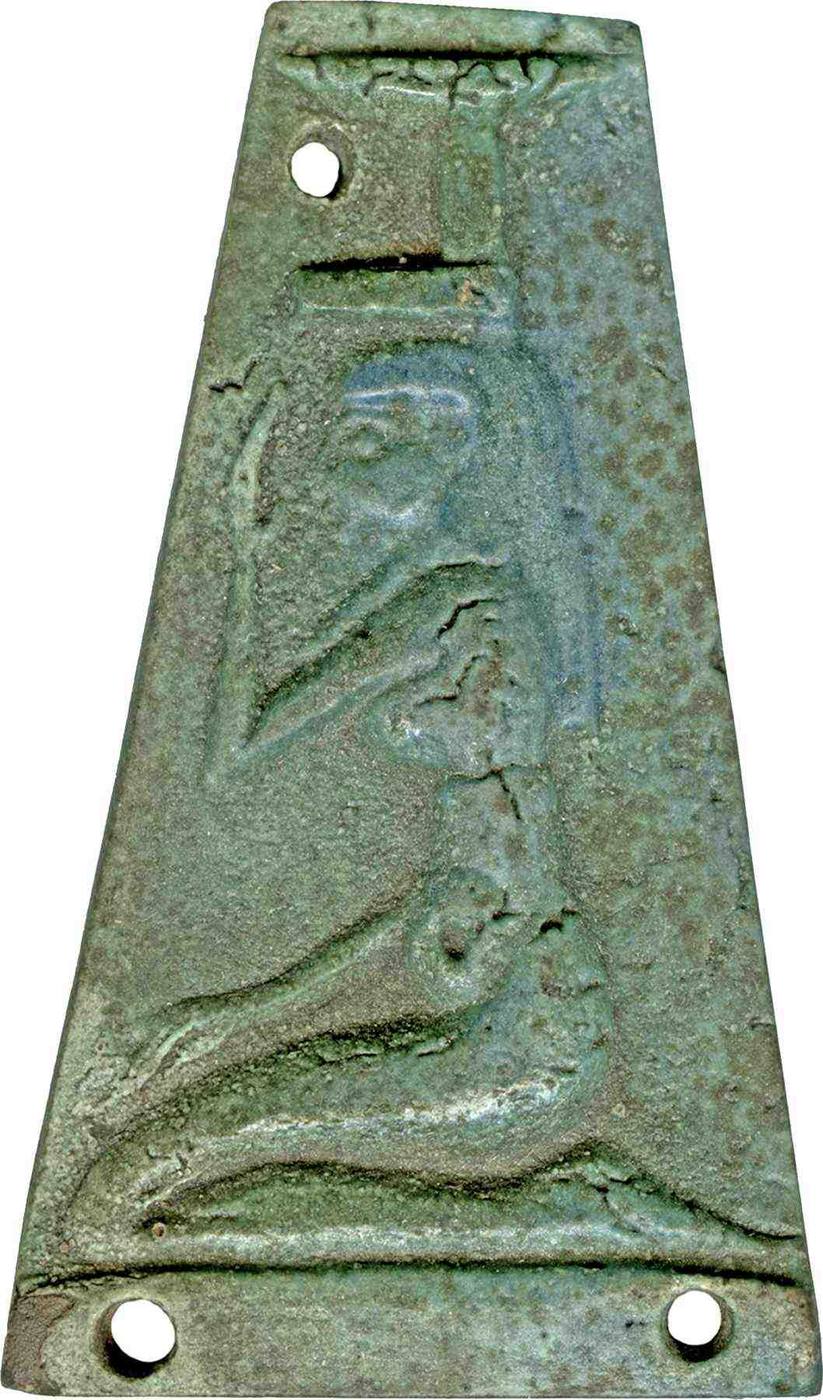
Between daylight and full night lies a strip of blue air when color leaves the banks and lamps are not yet lit. A woman stands in linen at the head of a resting form with one hand lifted over the brow, saying nothing while dusk deepens.
Nephthys is the twilight goddess of ancient Egypt, called Nebet-Het, Lady of the Temple Enclosure. Where her twin sister Isis governs the open throne and magic spoken aloud, Nephthys holds the room behind the court. She is the friend of the dead, the second mourning kite and the keeper of hidden gestation. She shelters what has passed out of sight until form is ready to rise. And Egypt built a craft of linen, silence and station to hold that passage.
What is folded out of daylight
A thing leaves the light, and we say that it is gone.
In Wholeness and the Implicate Order, physicist David Bohm argues that surfaces hide a deeper storehouse. He compares reality to a jar filled with syrup and fitted with a turning paddle. Place one drop of ink inside and spin the handle. The droplet stretches into a thin thread until the fluid turns grey. Nothing looks distinct anymore, yet every bit of that ink stays intact inside the jar. Turn the paddle back the other way. The droplet gathers out of the cloud sharp and whole again.
Bohm called that hidden layer the implicate order, meaning folded inward.
The Law of One, channeled by Carla Rueckert for L/L Research, points to a similar design inside the mind. In Session 79 the voice called Ra tells of a time when the conscious mind and the unconscious lay open to each other. Then the Logos drew a Veil between them. With the Veil came mystery, and shadow, and choice.
Nephthys is Egypt's face for that Veil and that folded room. She holds what cannot yet stand in the glare of noon.
The sister who walked out of Set's house
This story lives in the Pyramid Texts, the Songs of Isis and Nephthys, and the account by Plutarch.
In the five extra days Thoth won from the moon outside the year, Nut bore five children. Osiris came first, then Horus the Elder, then Set, then Isis, and last Nephthys at the far edge of the calendar.
She wedded Set, lord of storms and barren sand. His land grew little, and no child came to his house. Seeking life, Nephthys crossed over in darkness to Osiris, and from that meeting Anubis was born. Fearing Set's fury, she hid the infant in marsh reeds along the Nile. Isis found him there and raised him beside her own house.
When Set struck Osiris down, sealed him in a cedar chest, and tore his body into fourteen pieces across Egypt, Nephthys did not hide behind Set's wall. She left her husband's house and joined Isis in the reeds.
Both sisters took the shape of kites, hawks that circle over marshes and cry above water. Together they searched canal and sandbank until every limb was gathered. Inside the booth of balm, Isis took her station at the feet, and Nephthys stood at the head. She spread her wings around the skull and sang the lament that called the breath of Osiris back from the deep.
For three thousand years after that night, every funeral bed in Egypt placed two women at its ends. One stood for Isis at the feet, and one stood for Nephthys at the head.
Laws inside the mourning room
Two laws govern that room.
First, what slips behind the veil is folded, not lost. Nephthys stood beside Osiris when no throne remained and no crown could be worn. By staying inside the room, she held the outline intact until life gathered back into it. Look at winter roots under frozen mud. No green leaf shows above ground, yet the oak rests folded inside the soil.
Second, what is hidden has its own hour. Nephthys never drags Osiris back to his throne too soon. She stands at the head of the bed and keeps the place. A seed dug up to be looked at will die, and left alone it comes up by itself.
The White Queen and the eye of the storm
Maia Nartoomid, taught by Thoth, knows Nephthys as the White Queen, who carries the Pure Path of Grace. It is the grace of the Adaru-Rishis, and Adaru, as Thoth defines it, is the rending of the veil. With it Thoth gives a practice for letting go. Touch each middle finger lightly to each thumb, draw the light from the crown into the brow until it is a white sphere, and blow out slowly three times through pursed lips. Then bring the light down as rays through the body, through the feet, into the earth.
I-La, the Mother of Creation, whom Anne Tucker channels, names the one thing that bars the door. She calls it inconsolable resistance, the gaze held on what has departed. When it is let go, the new thing rises from the ashes.
Then there is the room itself. The Hathors, through Tom Kenyon, call it the void point. Its marks are darkness and silence, and everything that can be is folded in it, like the oak in the acorn. When storms turn outside, they say, there is a still point at the center, and it must be found within.
Reading the basket, the veil and the wings
Every sign she carries belongs to that room.
First is her crown, a basket resting atop the floor plan of a temple enclosure. Her name Nebet-Het means Lady of that enclosed house. Isis wears the stepped throne meant for daylight rule. Nephthys wears the inner room and the basket that holds what is unfinished.
Second is the linen veil and headband worn across her brow in reliefs. Cloth keeps the glare from a form that is still knitting together in the shade.
Third are her outstretched kite wings painted across coffins and plaques. Unlike stone walls, wings shelter a body without crushing it. They move air gently across the brow when breath grows thin.
Fourth is her station at the head of the bier. Isis works at the feet, where motion and return begin. Nephthys guards the head, where memory, silence and release settle first.
The twilight circuit of the four siblings
Nephthys completes the four-part loop of the children of Nut.
Set breaks form apart with sudden force. Osiris bears the breaking and sinks into the unseen seed. Isis goes out into daylight to gather the parts and bring forth Horus. Nephthys bridges both sides. She leaves the house of Set, gives Anubis into safe keeping, and guards the head of the bed beside Isis until restoration ends.
Without Nephthys the parts are found, and there is no room to lay them in.
Nephthys among the outer planets
The links are modern. Nephthys answers to the waning Moon, Neptune and Pluto, above all in the twelfth house of a birth chart. The waning Moon thins to a last silver edge before dawn, and then goes dark. Neptune softens lines into mist, tears and mercy. Pluto strips away what has finished its course so only the seed stays.
Watch transits of Neptune or Pluto across the Moon, Venus or the twelfth house cusp. Those seasons rarely reward loud action or hasty vows. They ask for what she did: to stand at the head and leave the veil drawn until life stirs beneath it.
How to interface with Nephthys
Interface with Nephthys when something is passing out of sight and its place must be kept. Her enclosure shelters passage until morning returns.
Come at twilight, when room corners soften and outdoor lamps begin to glow. Sit in a dim room with a folded cloth of cotton resting on your lap, beside a glass of cool water.
Keep your spine tall and soften your shoulders. Touch the tip of each middle finger lightly to each thumb, following Nartoomid's posture for release. Let your eyelids drop halfway or close so glare steps back behind a veil.
Picture a room walled from noise outside. Name the one thing that has gone behind the veil. Keep your place at its head, as Nephthys kept hers at the head of the bier.
Take three slow breaths in through your nose and blow out through pursed lips, as Nartoomid teaches. With the third, give up every impulse to hold on. The still point is there, in the middle of the storm.
Close the circuit before standing. Open your eyes to room light. Fold the cloth twice and set it aside. Turn both palms up, and bring the light down through the body, through the feet, into the earth. Drink the water, wash your hands at the sink, and step into the evening without carrying the dark room on your shoulders.
Questions people ask about Nephthys
Who is Nephthys in Egyptian mythology?
Nephthys, called Nebet-Het in Egypt, is the twin sister of Isis, former wife of Set, mother of Anubis, and guardian of twilight and mourning. She helped Isis gather Osiris and stands at the head of the funerary bed.
What does the name Nebet-Het mean?
Nebet-Het means Lady of the Temple Enclosure. Her crown shows a basket atop the sign for a walled sanctuary, marking her as keeper of the private chamber.
Why did Nephthys leave Set to help Isis?
When Set murdered Osiris, Nephthys refused to join the betrayal. She left the house of Set, joined Isis as a mourning kite, and guarded Osiris until renewal began.
What is the difference between Isis and Nephthys?
Isis governs daylight emergence, the throne and healing magic at the foot of the bier. Nephthys governs the shadowed house, silence and witness at the head of the bier.
How do you work with Nephthys?
At dusk, seated, with a folded cloth and three slow breaths. Keep the place of what has passed, force nothing, and close with the cloth put away, light and water.
The shelter behind the wall
Nephthys is the compassionate witness in the veiled room, keeping every hidden fragment safe until its hour to return.
The free birth chart shows where the Moon, Neptune and Pluto stand in your own sky, and, with a birth time, which of them keep the twelfth house.