Late afternoon light slides across a temple lotus pond in the west, turning the still water the color of crushed rubies and copper. Red lotus petals open above dark mud, catching the last warmth of the sun without dazzling the eye. Across the water, slow evening bells answer the fading sky.
Amitabha is the Buddha of that western light in living Mahayana and Vajrayana Buddhism. In China he is Amituo Fo. In Japan he is Amida. In Tibet his name is Opame, which means Boundless Light. He sits at the head of the Lotus Family. The Pure Land scriptures name him guide of Sukhavati, the Land of Bliss. He is no stern judge counting debts at a gate. His awareness is a field with no borders. His seat, his color, and his forty-eight vows form a tool that turns frantic grasping into clear sight.
Watching the setting sun over western water
In the Contemplation Sutra, a distressed queen named Vaidehi asks Shakyamuni Buddha how an ordinary person can see a realm free of fear. The Buddha does not hand her an abstract lecture. He tells her to sit facing west and watch the setting sun hang like a glowing drum above clear water.
Sunset slows a racing mind down because the day's work is already spent. The harsh glare of noon softens into warm crimson. Light and the eye that meets it belong to one open field.
Buddhist teaching maps this space of light across three modes called bodies. Dharmakaya is boundless awareness beyond any shape or border. Nirmanakaya is the living teacher who walks on earth in time. Between them shines Sambhogakaya, a luminous field of pure potential where Buddhas and bodhisattvas remain open to every heart that turns toward them.
Amitabha shines in that Sambhogakaya field of light and sound. When a mind stops straining and faces that western glow, resonance happens at once.
Dharmakara and the forty-eight vows
This is the story kept in the Larger Sukhavativyuha Sutra, read in temples across India, China, Korea, and Japan.
Long ages ago, in a world older than ours, a king heard a Buddha named Lokeshvararaja teach the Dharma. Compassion struck the king so hard that he left his throne. He gave up his crown and palace, shaved his head, and took the name Dharmakara as a monk.
Dharmakara knelt before his teacher and asked to see every Buddha realm in being. Lokeshvararaja opened twenty-one billion worlds to his eyes. For five long kalpas, Dharmakara watched what made each realm bright or warped. He saw worlds where fear locked beings behind walls. He saw worlds where pride shut out help.
Then Dharmakara stood before Lokeshvararaja and spoke forty-eight vows. He vowed that when he reached full awakening, his western land would hold no dark traps and no wasted pain. He vowed that its trees, streams, and birds would sound the Dharma as they moved. In his eighteenth vow, he gave a clear promise. Any being who turned toward that land with trust and called his name even ten times would find an open door at death.
Dharmakara kept his vows through ages beyond count. He gave freely and held nothing back. At last the vows ripened. Ten kalpas ago, the texts say, he woke as Amitabha, the Buddha of Infinite Light. His Land of Bliss shone open in the west.
In Tibetan and East Asian shrines alike, his tale joins that of Avalokiteshvara. When Avalokiteshvara wept over world pain until his head broke into eleven shards, Amitabha gathered all the shards back. He set eleven heads and a thousand seeing hands on the bodhisattva. Light does not rescue from far off. It rebuilds the hand that serves on earth.
Laws inside the Western Pure Land
Dharmakara's forty-eight vows point to two working principles of light and attention.
The first principle is that light pours outward before effort arrives. Most striving works like climbing wet stone with sore hands. You measure every inch and fear a slip. Pure Land teaching names the opposite current Other Power in Japanese tradition. The sun does not wait for grass to earn its warmth. Light already fills space. The sole shift needed is turning your face toward it.
The second principle is that grasping narrows sight while open attention sees every detail. In Buddhist lore, red is the color of desire and strong craving. Wild desire clutches one thing and goes blind to the whole room. When that same heat opens its hand, it turns into discriminating wisdom. You still feel the brightness of each hour, yet you let each shape rise and pass like dusk over water.
Amit Goswami describes the Tibetan practice of Amitabha in Physics of the Soul. Devotees call on Amitabha while holding Sukhavati in mind throughout the day, until the prayer runs by itself under thought. When striving ends, awareness stays awake through change and meets the Clear Light without fear.
The peacock, the lotus and the open palms of Amitabha
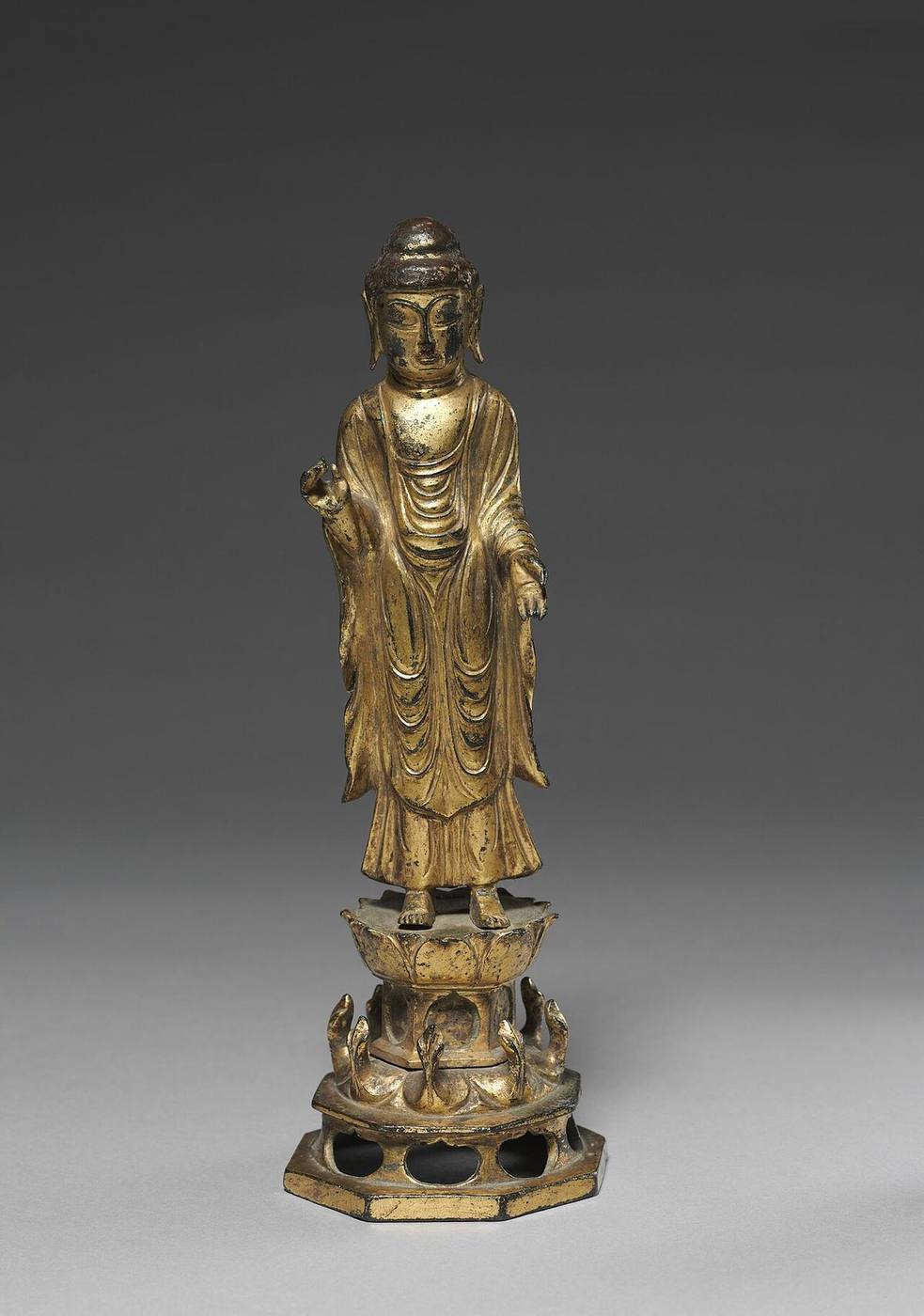
Stand before an altar bronze from Silla Korea or a painted scroll from Tibet. Each color and creature around his seat shows how that practice works.
Look first at his color. In Himalayan art, Amitabha glows deep sunset red. Sunset marks the close of daytime work, when tools rest and the eye turns west. Red here is never cold. It holds warmth, love, and fierce energy freed from blind craving.
Look under his seat. Amitabha sits on a throne held up by peacocks. Folk tales in India said peacocks eat harsh herbs and bitter plants without harm and turn poison into bright tail feathers. Each eye-spot on a peacock fan glows with shifting blue and gold without needing flat paint. In the same way, Amitabha's seat takes the sting of clinging and opens it into wide vision where nothing is locked in a box.
Above the peacocks blooms a red lotus. It rises out of dark pond mud with spotless petals. Amitabha sits on that flower in full meditation seat. His eyes stay half open, looking neither high into clouds nor shut in sleep.
Look at his hands. In Tibetan scrolls, both palms rest upward in his lap in meditation posture. They hold a begging bowl filled with spiritual nectar. In Korean and Japanese statues, he often stands with one hand raised in fearlessness and one lowered in welcome. One palm says have no fear. The other reaches down to meet the caller halfway.
Amitabha and Amitayus as one circuit
Buddhist lineages pair Amitabha with a twin form named Amitayus. Amitabha means Infinite Light. Amitayus means Infinite Life.
Tom Kenyon shows how these two brothers form one current in his Orcas Island notes and his essay on the Wind Horse. He names Amitabha as the Infinite Light of bodhicitta, the awakened mind that lets a person see hidden patterns clearly. Amitayus is how that light steps down into living breath and earthly vigor.
Kenyon pairs them as enlightened mind and enlightened action on earth. Light stays vague if it never touches breath. Life grows weary if it forgets its root in light. In his practice, attention rests along the spine behind the navel at Ming Ma, or Snow Mountain, where breath and warmth meet.
Beside Amitabha on Sukhavati altars stand two helpers. To his left stands Avalokiteshvara with the lotus of mercy. To his right stands Mahasthamaprapta with the vajra of awakened strength. Light at the center, mercy on one side, clear power on the other. Together they keep the circuit whole.
Where Amitabha shines in a birth chart
Amitabha is a Buddha of living Asian faith, not a star in a sky table. Traditional Chinese astronomy charts time through twenty-eight lunar mansions, the polar enclosure, and the twelve-year cycle of Jupiter. Modern Western astrology adds outer planets discovered far later, such as Neptune in 1846, and uses them to map subtle patterns in a natal wheel.
Look first at the Sun and Neptune in a modern Western chart. When the Sun touches Neptune by conjunction, trine, or square, personal will keeps meeting something larger than pride can steer. Early years may bring fog or false hopes. Once grasping drops, that same tie can open wide artistic sight and open mercy.
Look next at Venus and Jupiter, and at Pisces and Sagittarius. Venus reflects what the heart longs to keep. Jupiter reflects how far the sky opens once fear shrinks. Placements in Pisces or the twelfth house often feel drawn toward calm dusk and service. Placements in Sagittarius or the ninth house often seek a far shore of meaning past daily chores.
Look last at the South Node. In modern chart reading, the South Node points to habits carried past the point of use. Facing Amitabha mirrors opening a tired fist at the end of a long day so fresh light can enter.
Turning toward the western window at dusk
Approach Amitabha with respect, whether you bow at a temple shrine or sit at home outside the faith. Millions across Asia honor him as a living Buddha.
Come at sunset, when western light turns warm and work ends. Face west toward a window, or set a red candle beside a string of wooden prayer beads on a fresh white cloth.
Sit tall with your spine straight and eyes half open. Hold the beads lightly in your lap, or rest your left hand under your right with thumbs touching lightly to form a ring. Notice if your ribs or jaw still grip the day's tasks.
Sound his name aloud or in mind at a slow pace, counting one bead for each breath. In Chinese shrines, devotees chant Namo Amituofo, bowing to the Buddha of Infinite Light. In Japan they chant Namu Amida Butsu. In Tibet they sound Om Ami Dewa Hri. Picture sunset red light filling the room with no strain from you. Remember Goswami's observation in Physics of the Soul: you do not push the light to shine. You stop blocking the window.
If your breath grows deep, move attention to the spine behind the navel as Kenyon teaches. Let each outbreath soften any knot in the belly. On the seventeenth day of the eleventh lunar month, East Asian temples celebrate Amitabha's day with lanterns, chanting, and plant meals.
When you finish, gather the counting beads gently inside one closed palm and rest your hands in your lap. Bow your head slightly toward the western window, latch the pane or draw the curtain softly against night air, and carry that unhurried warmth into your evening.
Questions people ask about Amitabha
Who is Amitabha in Buddhist tradition?
Amitabha is the Buddha of Infinite Light, central guide of Pure Land Buddhism and head of the Lotus Family in Vajrayana. In China he is called Amituo Fo, in Japan Amida, and in Tibet Opame.
What is the Western Pure Land of Sukhavati?
Sukhavati is the Land of Bliss in the west born from Dharmakara's forty-eight vows. In Buddhist teaching it is an open field of practice free from traps where sincere callers can awaken without turning back.
Why is Amitabha painted red and seated on peacocks?
Sunset red stands for warm devotion and discriminating wisdom, the freed form of blind craving. Peacocks hold his throne because Indian lore says they eat poison without harm and grow bright plumes, showing desire turned into insight.
How are Amitabha and Amitayus connected?
They are twin forms of one Buddha. Amitabha stands for Infinite Light and awakened sight, while Amitayus stands for Infinite Life and that light flowing into breath and days.
How do Buddhists practice with Amitabha?
Devotees chant his name, such as Namo Amituofo or Om Ami Dewa Hri, face west at sunset, picture Sukhavati's red light, and practice letting go of frantic effort.
The sunset door of Amitabha
Amitabha is the boundless light at day's end, the open palm that turns grasping into clear sight.