At the sandalwood threshold of a Himalayan shrine room, a small jade bell hangs beside the doorway, catching the first breeze from the street. Before a visitor even sets a bag down, one light gust rings the bell clear and sharp, waking the whole hallway at once.
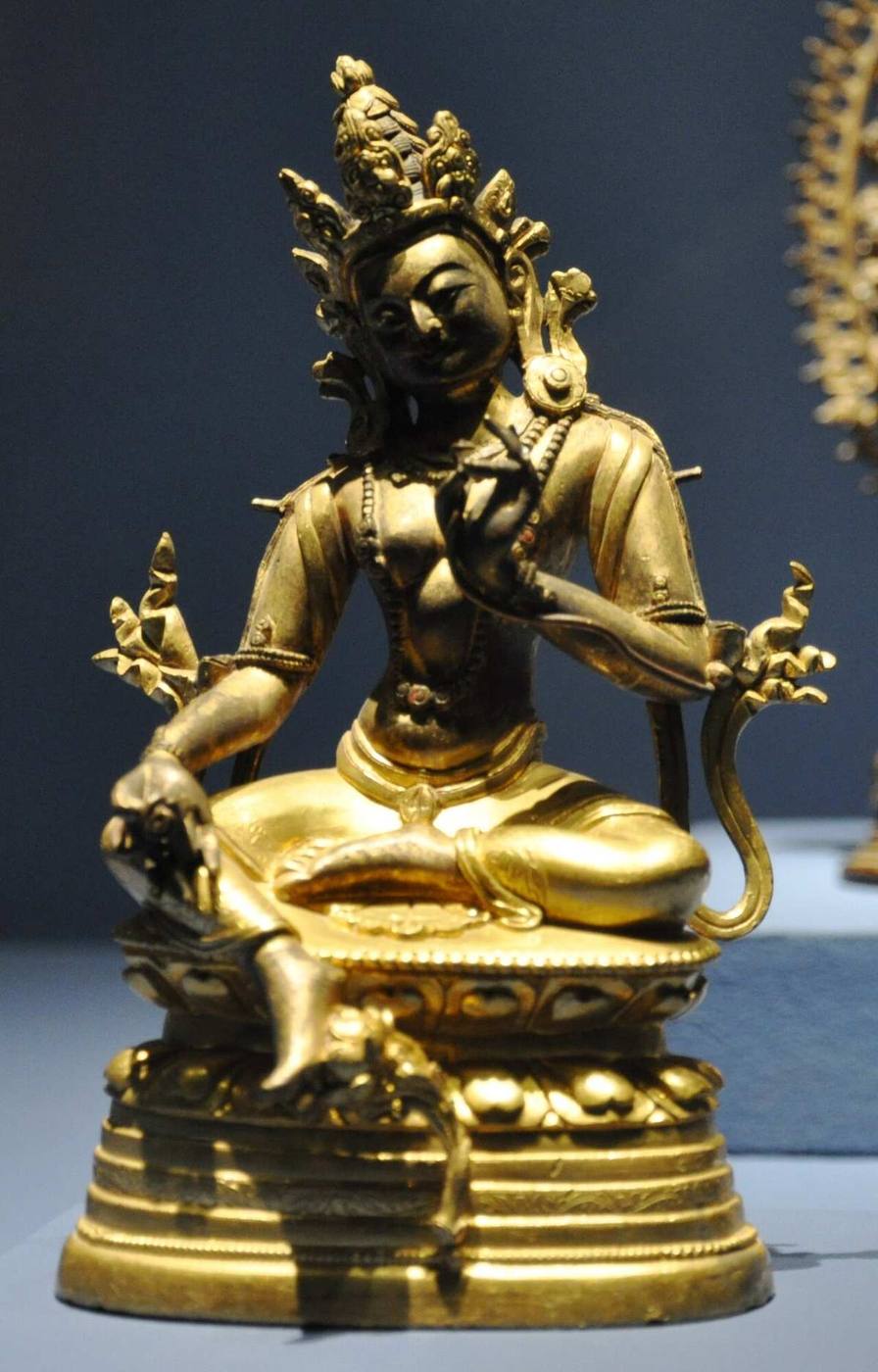
Green Tara is the female Buddha of swift mercy in Tibetan and Himalayan Buddhism. Her Sanskrit name is Syamatara. Tibetans call her Droljang, which means Green Savioress. Living monasteries and home altars honor her as the Mother of All Buddhas. Unlike figures locked inside deep stillness, Green Tara sits with one foot already stepping down off her lotus seat. Her emerald hue, her outstretched leg, her blue lotus stem, and her ten-syllable chant form a spring set for instant help.
The green ray and the sudden step
Most people treat kindness as a soft mood felt while sitting still. Yet kindness locked inside a room never lifts a fallen cart from the mud.
In Session 42 of The Law of One dialogues, the speakers discuss the green ray, the heart center of unconditional love. Asked if spiritual care should skip real aid and offer only lofty lessons, the reply is no. When a person is hungry, the right response is giving food. At the same time, the session warns that green-ray care alone stumbles into blind martyrdom until it walks with fifth-density wisdom. Love must move with open eyes.
Tibetan teachers point to that same instant shift from thought into deed. When a child trips on gravel, a mother does not sit down to draft a plan first. Her foot moves before doubt can form a sentence. In Vajrayana Buddhism, Tara belongs to the Karma Family of active wind, where wisdom becomes immediate help without hesitation.
Anne Tucker points to that nerve in her talk Your Release Creates a Ripple. When old shells drop away, she says, growth asks for fearlessness. You trust what rises from the heart before logic maps every mile. Lee Carroll speaks in his 2017 Salt Lake City message of compassionate action as the new path past old fear.
Green Tara is that living energy in motion, clear sight stepping straight into touch.
Yeshe Dawa and the tear of Avalokiteshvara
Two origin tales live side by side in Tibetan Tara lineages, recorded by historian Taranatha and sung in temple chants.
The first tale goes back ages ago to a world called Manifold Light. A young princess named Yeshe Dawa, whose name means Wisdom Moon, brought gifts to the Buddha of that age every day for a million years until she reached deep insight.
The monks of that realm saw her merit and offered advice. Because she had earned so much good, they said, she should pray to be reborn in a male body next time so she could reach full Buddhahood.
Yeshe Dawa looked at them without anger and spoke plainly. Here there is no man and no woman, no self, no person, and no such label. Small minds cling to male and female shapes and call that truth. She stood before the Buddha and made a vow. Many seek awakening in male form, she said, while few serve beings in a woman's body. So until the world of pain is empty, I will work in female form. Age after age she kept that vow until she shone as Tara, the Savioress who ferries beings past fear.
The second tale begins with Avalokiteshvara, the Bodhisattva of Mercy. For ages he labored to free beings from blind pain. One day he looked down from his peak and saw that as fast as he helped crowds toward peace, countless more fell back into rage and grief.
Sorrow pierced him. Two tears fell from his eyes and pooled in the valley below, forming a lake. Out of that water a lotus rose and opened. Inside the flower sat Tara. From one tear stepped Green Tara, swift and ready to answer each cry. From the other tear shone White Tara, calm as a full moon, watching over fragile life.
Laws held in the stepping foot of Green Tara
Those two origin stories show two clear principles of awake compassion.
First, awakening never waits for approval from stale bias. Yeshe Dawa did not waste lifetimes arguing with monks over rank. She looked straight at mind itself, saw no gender inside pure sight, and stepped into service on the spot. In Buddhist Karma-family lore, wind moves wherever a door opens. Waiting for applause freezes the wheel.
Second, insight stays half baked until one foot hits the earth. Mercy tucked up on a silk cushion turns brittle or timid. When Avalokiteshvara wept, his grief did not stay salt water on his face. It bloomed into a lotus with legs built to stand. Real care steps down from the cushion into daily life instead of hoarding peace inside a cave.
Reading Green Tara as a working instrument
Look at a Tibetan scroll or a Nepalese bronze of Green Tara. Each hand sign, petal, and posture on her figure shows how swift help moves.
Start with her legs. Her left leg stays folded inward across the lotus seat, heel drawn near her center. That folded leg anchors stillness, the root that holds firm. Her right leg reaches out and down, foot resting on a small lotus bud past the main seat. She sits yet stays poised to rise in half a breath. You cannot run well without one foot down. You cannot help while both feet stay tucked under your robe.
Look next at her hands. Her right palm rests open on her right knee, fingers pointing to earth in the sign of open giving. She offers shelter and timely help without hiding behind tests. Her left hand lifts before her heart, thumb and ring finger touching in the refuge sign of the Three Jewels.
Between those two fingers rises the stem of a blue utpala, a night-blooming water lily. Beside her left shoulder, that single stem bears three flowers at once: a closed bud, a half-open bloom, and a full blossom. They stand for Buddhas of past, present, and future, linking memory, this breath, and what comes next into one stem.
Look at her color. Forest green belongs to the Karma Family of Amoghasiddhi, whose element is wind and whose work is swift action. Wind cannot be locked in a box. It cools heat, clears smoke, and spreads seeds over high ridges.
Around her in old paintings sit the Eight Great Fears, drawn from the Praises to the Twenty-One Taras. Eight outer perils threaten roads: lions, wild elephants, wildfire, snakes, bandits, iron chains, floods, and dark spirits. Tibetan teachers match those eight to knots inside the mind: pride, fog, rage, envy, false views, greed, clinging, and doubt. Green Tara meets both kinds of storm with one fearless step.
Green Tara and White Tara in one tear
In Himalayan shrines, Green Tara and White Tara stand as twin forms of one caring pulse, like wind and still water.
Green Tara carries the speed of wind. She moves at the exact instant a rope frays or a hiker loses the trail. White Tara carries the calm of a mountain lake under moonlight, guarding focus so wisdom has years enough to ripen. Neither replaces the other. A life with only green speed burns through its stores without rest. A life with only white stillness watches the flood rise from the porch.
Her mantra links those two sides in ten short syllables: Om Tare Tuttare Ture Svaha. Tare frees from outer peril and panic. Tuttare frees from inner fear and fog. Ture opens swift clarity for helpful action. Svaha plants that vow in the ground.
Green Tara in the birth chart
Green Tara is a living Buddha of Tibetan faith, honored on the eighth lunar day of each Tibetan month outside horoscope tables. Traditional Asian calendars follow the Moon's phases, the twenty-eight lunar mansions, and the twelve-year cycle of Jupiter. Modern Western astrology adds outer planets such as Uranus, Neptune, and Pluto. Still, a modern Western birth chart uses a few classical placements that mirror swift action and warm care.
Look first at Mercury and Mars together. Mercury carries quick thought, wind, and nimble speech. Mars gives the nerve to step off the bench instead of talking all afternoon. When Mercury links smoothly with Mars, thought turns into useful motion fast. Under strain, that same tie can snap sharp words unless guided by heart care.
Look next at the Moon and Venus, and at Gemini, Virgo, and Aries. Gemini and Virgo belong to wind and craft, sorting a tangled room in ten minutes. Aries brings the spark that moves first while crowds freeze. Moon beside Venus reflects whether the heart opens with ease or hides behind old bruises.
Look last at the tenth house and sixth house when birth time is known. Placements there often show how care leaves private thought and enters daily work and public courage.
Stepping across the threshold with Green Tara
Meet Green Tara with respect, whether you bow before a Tibetan shrine or sit calmly at home outside the faith. Millions across the Himalayas and the world honor her as a living refuge.
Come in early morning, when fresh air crosses the trees and the day's chores have not piled up. Crack a window if weather allows so air moves in the room. Set a green leaf and a small jade or brass bell on a fresh cloth before you.
Sit tall near the edge of a firm chair. Keep your left foot drawn back close to the seat, and place your right foot one inch ahead with the sole flat on the floor, mirroring her stepping pose. Feel the shift from leaning back to being ready to move.
Bring attention to the center of your chest, the green-ray heart center, without forcing your ribs tight. Name one concrete act of help or courage you have put off out of fear. Keep it plain and real.
Sound her ten-syllable mantra softly or in silence: Om Tare Tuttare Ture Svaha. Let each breath pass like wind through an open door. Do not strain for visions. You do not need to crawl out of fear inch by slow inch when the next kind deed stands right in front of you.
On the eighth lunar day of each Tibetan month, devotees gather to chant the Praises to the Twenty-One Taras and offer lamps, flowers, and fresh water.
End the sitting with a single clear tone. Ring the small bell once, or touch a piece of turquoise or green stone on the cloth as a mark of completion. Draw your forward foot back beside the other, stand up from the chair, and carry out the single step you named while the morning is fresh.
Questions people ask about Green Tara
Who is Green Tara in Tibetan Buddhism?
Green Tara, called Droljang in Tibetan and Syamatara in Sanskrit, is a fully awakened female Buddha of swift mercy and protection. She belongs to the Karma Family and is honored as the Mother of All Buddhas.
Why is Green Tara's right leg stepping off the lotus?
Her left leg stays folded in meditation to anchor stillness, while her right foot steps onto a smaller lotus to show readiness for fast action. She never waits in isolation when help is needed.
What does the Green Tara mantra mean?
Her mantra is Om Tare Tuttare Ture Svaha. Tradition reads Tare as rescue from outer dangers, Tuttare as freedom from inner fears, and Ture as swift clarity leading straight into kind action.
What are the eight fears linked with Green Tara?
Traditional texts name eight outer dangers: lions, elephants, fire, snakes, thieves, chains, floods, and spirits. Tibetan teachers match them to eight inner knots: pride, fog, rage, envy, false views, greed, clinging, and doubt.
How is Green Tara different from White Tara?
Both rose from Avalokiteshvara's compassionate tears, yet they move at opposite speeds. Green Tara acts swiftly like wind in urgent moments, while White Tara sits in full lotus stillness to guard calm presence.
The swift wind of Green Tara
Green Tara is the green step off the throne, the wind that moves before fear finishes talking.