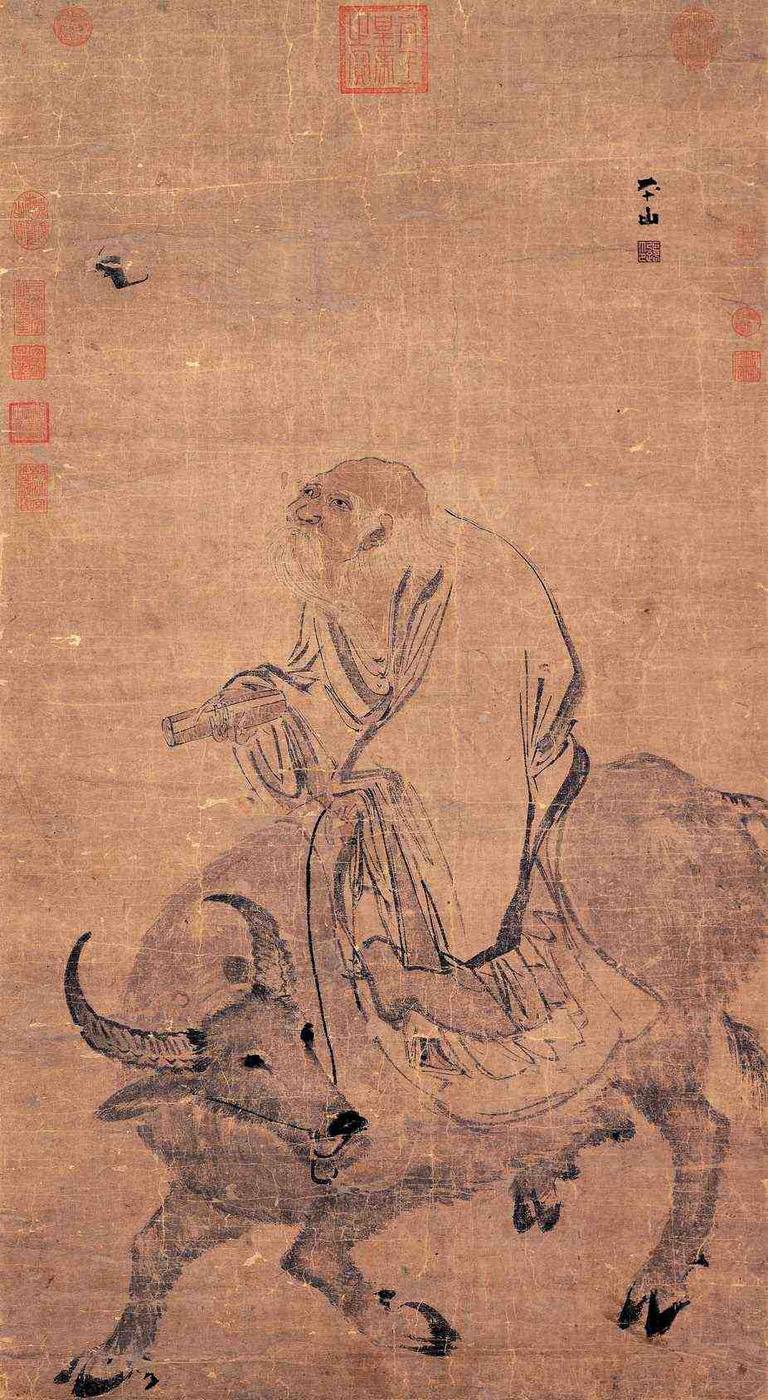
At the stone gate of Hangu Pass, dust settles from the flanks of a gray water buffalo while desert wind blows through the archway. Beside a rough wooden desk, an old archivist dips a brush into black ink and writes five thousand characters across bound bamboo strips. When the last stroke dries, he ties the bundle with hemp cord and rides west past the frontier stones.
Across China and the wider world, an old man rides sideways on a water buffalo toward western mountains. His name is Laozi, which means Old Master, born Li Er in traditional accounts. In Daoist temples, he is honored as Taishang Laojun, the Supreme Elder Lord, one of the Three Pure Ones who embody the living Dao.
Laozi is the teacher of wu wei, action without strain against the grain of reality. He stands at the root of living Daoism. His book of five thousand words, the Daodejing, works like an acoustic tuning fork. Every paradox inside it strips away excess effort so awareness flows with the tide of things.
Flowing along the grain of the river
We tend to picture the world as solid blocks stacked side by side. A chair sits over here, a cloud floats over there, and a person pushes against both.
Ancient Chinese thinkers saw a fluid world closer to a mountain river. Every eddy and whirlpool inside a stream looks like its own round shape for an hour, yet each spin is made of the same moving water passing through one current. Chinese artisans used the word li for that natural grain found inside carved jade, marbled ink, and oak wood. Li shapes bone, water, and leaf from inside without forcing them.
In the Daodejing, Laozi speaks of that current right at the start: the Dao that can be spoken is not the eternal Dao. Later verses describe how the great Way flows everywhere, to the left and to the right, feeding ten thousand beings without trying to own or boss them.
Laozi did not invent that current. He mapped how to stop blocking it.
The departure at Hangu Pass
Han historian Sima Qian recorded the farewell at the mountain gate in his Shiji, and Daoist halls have kept the memory alive for two thousand years.
In the waning days of the Zhou dynasty, Li Er served as keeper of the royal archives. Year after year he watched scholars argue over empty titles while rulers turned ancient rites into hollow display. The form remained, yet the spirit had drained out of the room.
At last the old archivist packed no chest of gold. He mounted a green water buffalo and rode slowly toward the western frontier, leaving the capital behind.
When he reached Hangu Pass, the last mountain gate before the desert, the gatekeeper Yinxi recognized him. Yinxi knelt in the dust and barred the road with prayer. You are going away into stillness, the keeper said, and no one will find your trail again. Before you cross the border, write down what you know so the world does not lose it.
Laozi halted the beast. He sat down beside the stone gate and wrote five thousand characters on bamboo slips, dividing them into two parts: the Way and its Virtue. When the ink dried, he placed the bundle in Yinxi's hands, mounted the ox again, and rode into the western hills. Nobody saw where he went.
Later Daoist storytellers passed down a second tale about silence along a riverbank. Laozi used to walk beside the water at dawn without a word alongside an old friend. One morning the friend brought a guest, warning him not to speak along the bank. As the sun rose red and bright over the mist, the guest gasped out loud: what a beautiful sunrise. Neither Laozi nor his friend said a word. When they returned to the gate, Laozi pulled his friend aside and said: do not bring that man to walk with us again, for he talks too much.
What the buffalo and the gate encode
Those five thousand characters at the gate hold two working laws of unforced action.
One law is that emptiness makes every useful vessel work. In the eleventh verse of the Daodejing, Laozi points out that thirty spokes meet in a hub, yet the empty space between them is what lets the wheel turn. Pots are shaped from clay, yet the hollow inside holds the soup. Walls with windows and doors make a house, yet the empty space inside is where a family lives.
Musicians know that same rule in the living pause between notes that gives a song its breath. Without the gap, sound turns into noise. Without an open hub, thirty spokes lock fast and refuse to roll.
A second law is that rushing and clutching break what they mean to hold. Another verse in the Daodejing puts it plainly: rushing into action, you fail, and trying to grasp things, you lose them.
Tom Kenyon quotes the Daoist text Wen-Tzu attributed to Laozi's lineage. Human beings are tranquil by birth, the passage reads, and that is their celestial nature. When senses meet outer things, desire stirs and knowledge moves outward. If knowledge chases externals and never returns home, the celestial design vanishes.
Wu wei repairs that drift through nondoing, watching thoughts pass without chasing or fighting them. Out of a still mind, the right step arrives on time.
Reading the ox, the wood and the stream
Stand before Ming painter Zhang Lu's scroll of Laozi riding his ox, and read the emblems of the Daodejing in order. Each image works like a lever on attention.
Look first at the ox. A conqueror rides a warhorse with spurs and iron bit. Laozi sits sideways on a heavy water buffalo, holding no whip. You cannot rush a buffalo up a mountain trail. You match your seat to its gait and let its weight carry you across mud.
Look next at pu, the uncarved block of wood. Before a carpenter saws a pine trunk into bowls, tables, and pegs, the timber holds every possible shape inside its grain. Once carved into a spoon, it can never become a beam. Wu wei begins by resting in that uncarved wholeness before rushing to label yourself.
Look at water. Laozi praises water above iron or gold because water gathers in the low ditches that proud people despise. It wraps around boulders without arguing, waits behind dams until its weight rises, and wears granite smooth over centuries. Softness outlasts stiffness because it never snaps.
Look finally at the bellows of a forge. Empty, it looks weak and flat. Pull the handle, and air rushes out without running dry. A vessel that refuses to hoard keeps its flow alive.
Dragon points and the Celestial Gate
Daoist alchemy turned Laozi's philosophy into direct body technology. Tom Kenyon describes that craft in his essays on Daoist meditation.
From the Dao, he writes, streams an eternal current of life force called chi. Stars and distant quasars pour out one kind of chi, while mountain ridges and clear rivers gather another. Where two streams cross, or where heavenly chi from the sky meets earthly chi along a valley floor, chi concentrates into what Daoist sages called a Dragon Point. Old masters built their huts beside those crossings so practice moved with the current instead of rowing upstream.
Inside the human body, Kenyon notes, the same crossings exist. One major hub sits about an inch behind the bridge of the nose, a small space roughly one inch square. Daoists call it the Celestial Gate, or Heaven's Gate. Here subtle sky chi meets heavier earth chi inside the head.
To open that circuit, Kenyon describes a seal of posture. Rest the tip of the tongue gently against the roof of the mouth behind the front teeth. That small touch closes the Microcosmic Orbit, linking the front and back channels along the spine. Then let soft attention rest at the Celestial Gate without straining to block thoughts. When attention sits lightly at the gate, thoughts slow down on their own. Spaces open between them, breath grows shallow and calm, and in that pause between breaths, contact with the Dao takes place.
Laozi and the birth chart
Laozi belongs to Daoist philosophy and temple devotion, while ancient Chinese sky watchers read the heavens through the twenty-eight lunar mansions, the polar enclosure, and the twelve-year cycle of Jupiter. Modern Western astrology added outer planets far later, such as Neptune in 1846, and reads them as mirrors of tide and release.
In a modern Western natal wheel, a few placements echo Laozi's unforced current.
Look first at Neptune. Neptune rules the river, the tide, and the edge where stiff plans dissolve back into sea. Where Neptune touches the Sun, Moon, or Ascendant, brute force often backfires fast. Those placements work best through wu wei, reading timing instead of hammering closed doors.
Look next at the Moon and Saturn together. The Moon feels the shifting current of the hour. Saturn builds the thirty spokes and the clay walls of the pot. Without Saturn's rim, the wheel collapses. Without the Moon's empty center, the wheel freezes in the mud.
Look also at Taurus, Cancer, and Pisces, and at the fourth and twelfth houses when a birth time is known. Taurus holds the patient ox walking at its own pace. Cancer holds the hollow valley and home vessel. Pisces and the twelfth house open the western pass where old titles drop away.
Resting attention at the Celestial Gate
Meet Laozi with respect for the Daoist temples and lineages that preserve the Daodejing. Come to him when effort turns brittle, when overthinking knots a choice, or when you feel worn down from pushing uphill.
Come at dawn, or beside moving water if you live near a stream. If you are indoors, set a small copy of the Daodejing or a plain notebook flat on a wooden table before you.
Sit upright in a chair or on a cushion, like Laozi seated evenly upon the ox. Let your shoulders drop away from your ears. Rest both hands lightly on your thighs.
Place the tip of your tongue gently against the roof of your mouth, right behind the upper teeth, closing the Microcosmic Orbit as Kenyon teaches. Notice your breath without changing its speed.
Bring light awareness to the Celestial Gate, an inch-wide space behind the bridge of your nose. Do not fight stray thoughts or try to blank your mind. Let thoughts pass like travelers walking past Hangu Pass while your attention stays seated by the gate.
Think of a river winding smoothly around boulders without fighting them. Ask where in your week you are straining against the grain of things instead of reading the turn of the water. Listen for the pause between thoughts, where open space enters the noise.
Stay with that unforced attention for five minutes. Often a breath will naturally slow or pause on its own. Let it.
Finish the sitting gently and return to ordinary tasks. Lower your tongue from the roof of your mouth and open your eyes slowly. Shut the book or roll a bamboo strip mat closed with unhurried hands, bow your head once to the table, and walk at an easy pace into the rest of your day.
Questions about Laozi and Daoism
Who was Laozi in Chinese history and Daoism?
Laozi, traditionally named Li Er, was an ancient Zhou dynasty archivist credited with writing the Daodejing. In religious Daoism, he is revered as Taishang Laojun, an eternal teacher and embodiment of the Dao.
What does wu wei mean in the Daodejing?
Wu wei means unforced action aligned with the natural flow of things. It does not mean laziness or sitting still forever, rather acting without wasted friction against the grain of reality.
Why is Laozi always painted riding an ox or water buffalo?
According to the historian Sima Qian, Laozi rode west on a water buffalo when leaving Zhou territory. The ox symbolizes patience, grounded strength, and moving at nature's pace instead of rushing.
What happened at Hangu Pass with Yinxi?
Gatekeeper Yinxi stopped Laozi at the western mountain pass and asked him to record his wisdom before departing. Laozi wrote the five thousand characters of the Daodejing and disappeared beyond the frontier.
How can someone practice Laozi's stillness today?
Sit upright, touch the tongue lightly to the roof of the mouth, and rest soft awareness behind the bridge of the nose without forcing thoughts away. Finish by lowering the tongue, shutting your book or scroll, and walking on at an unhurried pace.
The wheel and the open pass
Laozi is the empty hub at the middle of thirty spokes, the current that carves stone by seeking the valley.