Frost clings to the stone steps of Mount Wutai at daybreak as five mountain ridges catch the blue winter light. Inside a timber hall, a monk unrolls a crisp ink scroll beside a dark inkstone and lays a wooden straightedge across the sheet. Every stroke of pine-soot ink stands out sharp and clear against the blank paper.
Manjushri is the bodhisattva of that clarity. Across India, Tibet, Nepal, and China, he appears as a youth of sixteen lifting a bright blade, never as an old man with a white beard. In China he is Wenshu Pusa, lord of five-peaked Mount Wutai. In Tibet he is Jampelyang, the Gentle Glory.
He is a living figure of Buddhist devotion, never a war god or a cold critic. Wisdom in the Mahayana path is never anger wearing iron. Manjushri carries fire in one hand and scripture in the other, forming one tool for cutting mental loops without losing care for the world.
Cutting clear lines inside a living world
Most people think clarity means piling up more facts until a room fills with paper. Buddhist wisdom moves the other way. It cuts away false edges so what is real can breathe.
In Meeting the Universe Halfway, Karen Barad writes that reality never comes pre-sliced into lonely boxes behind glass. Everything belongs to one linked field of ties. Yet clear knowledge still needs an edge. She calls that act an agential cut, a focused choice of study that draws a line inside a whole so cause and sense appear without pretending parts stand alone.
Buddhist Prajnaparamita texts make a matching point about living insight. Maps and words help us point at a trail, yet trouble starts the moment we mistake a neat paper label for the ground under our feet. Clear sight meets life fresh before stale excuses harden.
Tom Kenyon kept a bronze statue of Manjushri wrapped in a silk scarf from Tibetan master Tulku Urgyen Rinpoche. In his essay Death and Dying from 2023, Kenyon writes why that young figure lifts a blade. Manjushri holds the sword to split ignorance for seekers of freedom, never to wound another being.
In his teaching on Prajnaparamita, the Mother of All Buddhas, Kenyon names what stands behind the blade. Emptiness in Buddhist thought is never blank nothingness. It is wide awareness prior to racing thought, where every shape shows up as a passing display.
Anne Tucker points to that same flash of sight in her talk Beautiful Guidance on How to Cope with Massive Change. Discernment, she says, is the eye that spots a gap in what looked like a solid wall. It finds the crack where a door actually stands open. Manjushri is that eye and that blade working as one.
The silent room in Vaishali
The Vimalakirti Nirdesa Sutra, alongside the mountain lore of Nepal and China, tells how Manjushri met a silence deeper than argument.
In the city of Vaishali, a sharp-minded householder named Vimalakirti fell ill. Shakyamuni Buddha asked his senior students one by one to visit the sick sage. Every elder refused. Sariputra recalled being corrected in the woods. Maudgalyayana recalled losing a debate in town. Mahakashyapa recalled being humbled over his bowl. Each elder knew Vimalakirti's questions would shred neat speeches on the spot.
At last, the Buddha turned to Manjushri. Young Manjushri rose without fear and walked through Vaishali while hundreds of monks and spirits followed behind to watch.
Inside Vimalakirti's bare room sat one bed. Every other seat had been cleared away. Manjushri greeted the sage with respect and asked about his sickness. Soon the room rang with talk on form, emptiness, and non-duality.
Finally Vimalakirti asked thirty-one bodhisattvas how someone enters the gate of non-duality. One spoke of birth and death as one. Another spoke of pure and foul as one. Another spoke of self and world as one. Each answer sounded bold, yet every speaker used two words to argue there were no two things.
Manjushri praised their talks and said every speech still leaned on words and letters. True non-duality leaves speech behind. He turned to Vimalakirti and asked for his answer.
Vimalakirti said nothing at all. He sat still inside the bare room.
Manjushri bowed his head and spoke aloud: well done, well done, not a single word or sound, that is truly entering non-duality. A silence heavier than thunder filled the house.
Across the snow peaks in Nepal, another tale remembers his sword in stone. Long ago, Kathmandu Valley lay buried under a dark lake full of snakes. Looking down from distant heights, Manjushri saw a lotus glow at the lake's heart. Lifting his flaming sword, he struck the rim at Chobar in one blow. Water roared out through the split gorge, leaving dry ground where people built towns and shrines.
Where the blade clears space and speech falls silent
The bare room in Vaishali and the split gorge at Chobar show two rules of clear sight.
First, keen sight cuts false frames without hating what lives inside them. Like Barad's cut or Manjushri's blade draining a flooded valley, discernment clears space so life can breathe.
Second, every map stops where living silence begins. Words can point toward the gate, as thirty-one speakers showed in Vaishali. Yet wisdom knows the exact hour to set speech down and hear what stands without noise.
Five hair-knots, a lotus and a flame
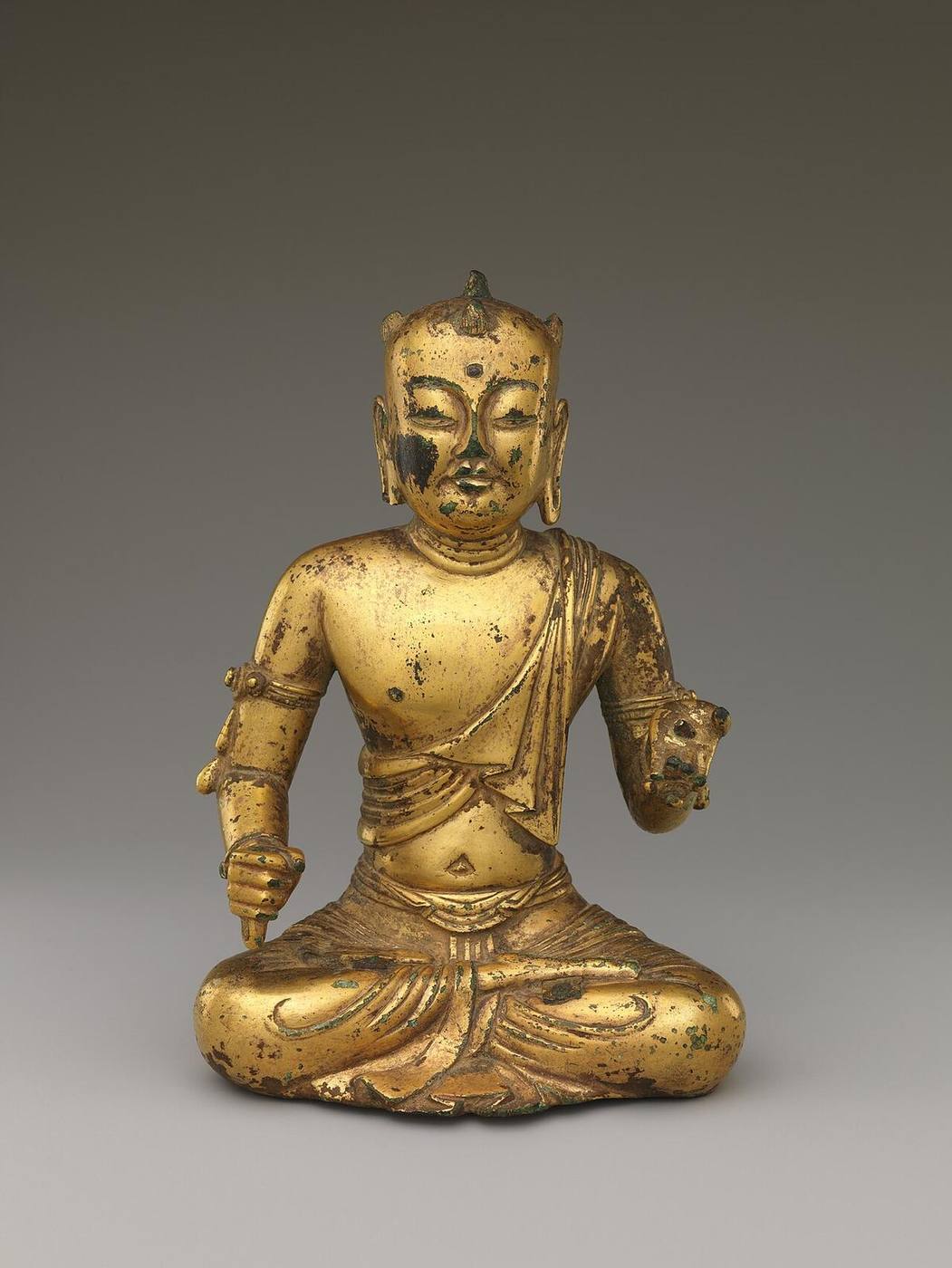
Look at the gilt-bronze statue of Five-Knot Manjushri from the Liao dynasty, or at Tibetan scrolls of his form. Each emblem on his statue balances sharp inquiry with living care.
His right arm lifts a flaming sword high above his shoulder. Notice the fire running up the steel. Plain iron cuts flesh and bone. A blade wrapped in flame burns through fog, self-deceit, and circular excuses in one stroke.
His left hand holds a stem rising to his shoulder, where a blue lotus holds the Prajnaparamita book. Look at both hands together. The sword never cuts away real study, and the book never sinks into mud because a flower holds it in air. Inquiry and study stay balanced across his chest.
On his head, his hair is tied into five knots, a style called Wuji Wenshu in China. Those five knots mark five kinds of clear knowing blooming together. His boyish face of sixteen years shows a mind free of stale cynicism. Between his brows sits a mark of inner sight, and under his seat rests a golden lion, showing clarity roars without fear when lies block the road.
Where Manjushri moves in the sky
Manjushri is a living figure of Buddhist devotion, honored at Mount Wutai instead of plotted in sky tables. Traditional Chinese astronomy charts the sky through twenty-eight lunar mansions and the twelve-year cycle of Jupiter, while modern Western astrology added outer planets such as Uranus in 1781. In modern Western chart reading, a few placements echo Manjushri's sharp inquiry.
Look first at Mercury and Uranus in a modern Western chart. Mercury rules speech, reading, naming, and sorting signals from chatter. When Mercury meets Uranus or Saturn in a chart, thought often refuses stale slogans and hunts for the crack in the wall.
Look also at Gemini, Virgo, Aquarius, and the third and ninth houses when birth time is known. Placements there often mark teachers, editors, scientists, and writers who bring theories back to real proof. Look to the Sun beside Mercury as well: light and speech aligned at one degree can burn fog away before pride hardens.
Unrolling a fresh page at daybreak
Meet Manjushri with upright spine and a clear desk, whether you follow Buddhist practice or visit from outside the faith. He answers sharp focus, never drama.
Come early in the morning before reading messages, news, or other people's views. Sit tall on a firm chair with dropped shoulders. Lay one closed notebook, a blank sheet of paper, and a wooden pen or brush beside an inkstone or small wooden tray on the desk before you.
Look at one knot of doubt you have circled for weeks. Refuse soft excuses. Ask plainly what stands right in front of your eyes now, stripped of old labels and wishes.
Sound Manjushri's mantra softly aloud or in thought: Om A Ra Pa Ca Na Dhih. Repeat it seven or nine times at an even pace. Then draw out the last word Dhih on one long exhale until mind noise drops into the open stillness Kenyon describes.
Open the page and write one plain sentence naming the truth you see, or the crack where a door stands open, as Tucker teaches. Do not write a speech. One true line is enough.
End the morning study without extra words. Shut the notebook and lay your wooden pen or brush flat across the inkstone or tray beside it. Exhale once completely into silence, like Vimalakirti in the bare room, and stand up without reopening the argument.
Questions people ask about Manjushri
Who is Manjushri in Buddhism?
Manjushri is the great bodhisattva of wisdom in Mahayana and Tibetan Buddhism. Known as Wenshu in China and Jampelyang in Tibet, he joins keen insight with care.
What does Manjushri's flaming sword cut?
His flaming sword harms no living being. It stands for clear sight that cuts through delusion, rigid views, circular excuses, and the dream of a separate ego.
Why is Manjushri depicted as a sixteen-year-old youth?
His title Kumarabhuta means Ever-Youthful. Staying sixteen years old shows an awake mind that stays fresh, curious, and free of stale cynicism.
What is the book resting on Manjushri's lotus?
The text floating on the lotus in his left hand is the Prajnaparamita Sutra, the Perfection of Wisdom book. Resting it on a flower shows true learning stays alive and open.
What is Manjushri's mantra and seed syllable?
His main mantra is Om A Ra Pa Ca Na Dhih. Practitioners often hold the final syllable Dhih on one full breath to sharpen speech, memory, and clear thought.
The blade and the open book
Manjushri is the young eye of daylight, the flaming sword that cuts fog without wounding the world.