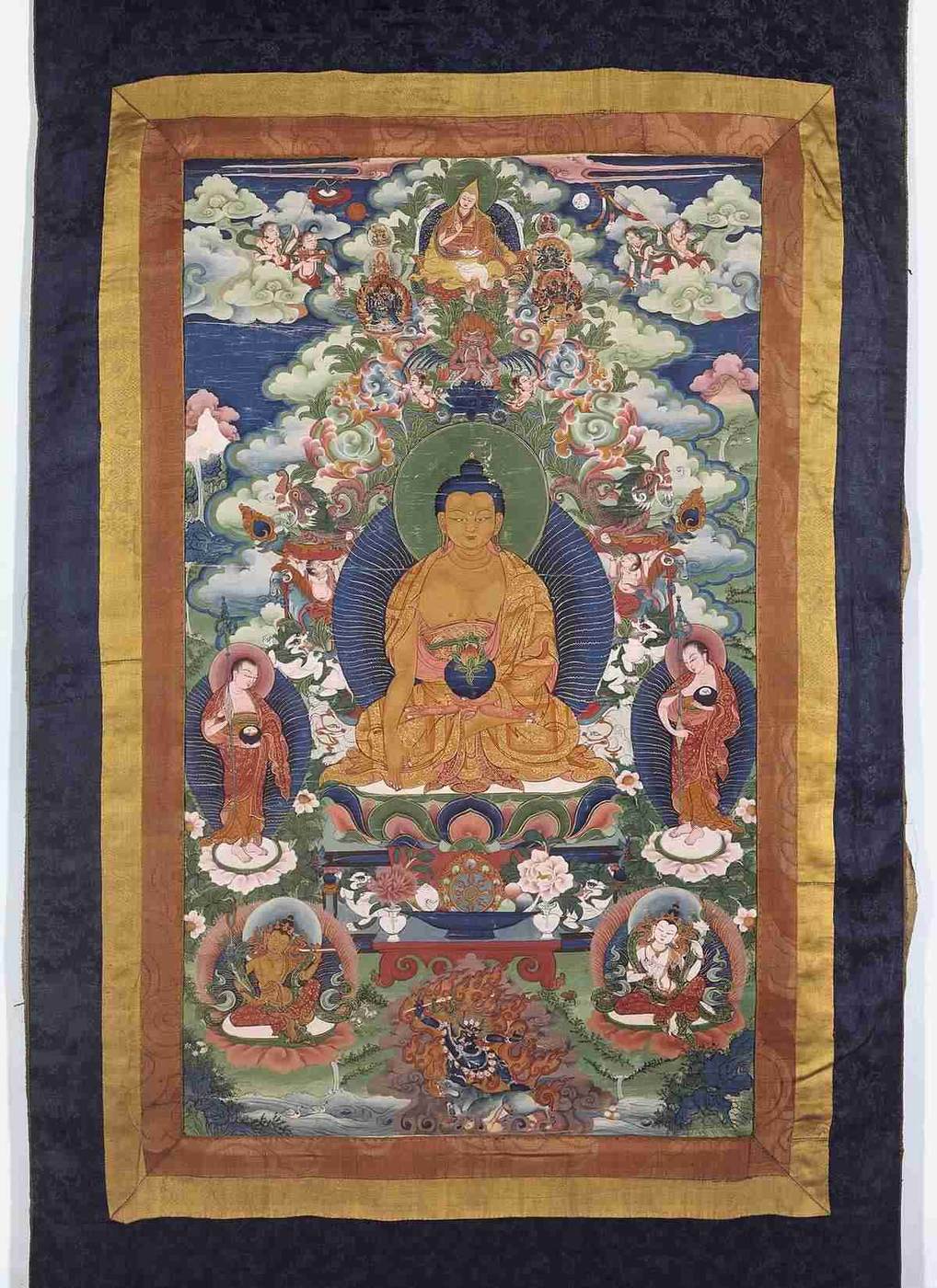
In the eastern light before sunrise, a carved bowl of dark lapis lazuli rests beside a branch of bitter myrobalan fruit. The stone is deep blue like the high mountain sky before the sun clears the ridge. Every edge of the rim and each small dried leaf stands sharp in the early morning air.
Medicine Buddha is the Buddha of that lapis blue dawn in living Mahayana and Vajrayana Buddhism. His Sanskrit name is Bhaisajyaguru Vaiduryaprabharaja. That means Master of Healing, King of Lapis Lazuli Light. In Tibet he is Sangye Menla. In China he is Yaoshi Fo, and in Japan Yakushi Nyorai. He rules Vaiduryanirbhasa, the Eastern Pure Land of Lapis Lazuli. In Buddhist tradition, Medicine Buddha is a contemplative refuge for inner wholeness, clarity of mind, and peace of heart, separate from bodily medicine. His blue form, his alms bowl, his myrobalan twig, and the ring of a five-metal singing bowl work together to mend inner splits of body, speech, and mind.
Why separation feels heavy and how lapis clears it
In Buddhist teaching, distress starts when the mind builds hard walls around itself and forgets that it belongs to an open world. Out of ignorance, called avidya in Sanskrit, human thought chops a fluid life into tight boxes. It clings to a lone self inside one box. That clinging breeds lasting pain, called dukkha. When you try to freeze a moving river behind stone, the water slams against the wall.
Division sits on the surface, while whole awareness sits underneath. In Session 74 of Carla Rueckert's Law of One transcripts, the indigo ray stands as the gate of inner healing, prayer, and clear light. That session teaches three calm steps to clear this center: know yourself, accept yourself, and see the Creator in all things. It also notes that chanted sound acts like dialing a phone. Tone wakes deeper mind through focused intent.
In his 2020 essay The Blue Medicine Buddha, Tom Kenyon shares a direct account of this work. Kenyon received the practice from a Gelugpa Tibetan Rinpoche on his thirtieth birthday. He states plainly what spiritual healing means in Buddhist work. It means a clear state of body, speech, and mind where one sees the world as an open play of light and energy inside Mind, clearing inner fog so awareness recalls its wholeness.
The twelve vows of Bhaisajyaguru
This is the tale written in the Bhaisajyaguru Sutra, carried east on the Silk Road and put into Chinese by Xuanzang and Yijing.
Once, while Shakyamuni Buddha stayed at Vaishali before a vast crowd of monks, bodhisattvas, and kings, wise Manjushri rose from his seat. Manjushri bowed and asked the Buddha to name past Buddhas and their vows, so beings in hard ages ahead could hear them and take heart.
Shakyamuni praised Manjushri and pointed far east, past worlds without count, to a realm called Pure Lapis Lazuli. There, he said, teaches a Buddha named Bhaisajyaguru, equal in awakening to Shakyamuni himself.
Long before full Buddhahood, while walking as a bodhisattva, Bhaisajyaguru spoke Twelve Great Vows to meet every split a living being faces.
He vowed that when he woke, his body would shine with boundless light, lighting dark worlds without end. He vowed his form would glow like lapis lazuli, brighter than sun and moon, waking travelers lost in night. He vowed to use clear wisdom so beings would not stay stuck in want or despair. He vowed to guide those on crooked paths back to balanced ground.
In later vows, he pledged to restore honor where ethics broke. He vowed to stand beside those weighed down by lone grief. He vowed to bring food, clothes, and shelter to the poor. He pledged to free prisoners from chains and fear, and help scattered minds find clarity and calm rest.
When those Twelve Great Vows ripened, his Eastern Pure Land shone open. Its ground was smooth lapis stone, clear as glass, crossed by gold paths and bright trees where no harsh cry rang out. Beside Bhaisajyaguru stood two helpers: Suryaprabha, holding the light of the sun, and Chandraprabha, holding the cool light of the moon. Around them stood twelve yaksha chiefs guarding those who keep the vows in daily life.
Laws held in lapis stone and bitter fruit
Look closely at the sutra and its signs, and two laws of mind emerge.
First, cloudiness traps heat while clear stone lets light pass with no fight. Muddy rock blocks sunbeams, turning hot on one face while freezing on the back. Clear lapis in Buddhist art stands for a mind free of thick self-defense. Thoughts, grief, and old memories pass through blue space like birds across the sky without leaving scars on the stone.
Second, real wholeness tastes sharp before it feels sweet. Many wish inner repair felt like warm honey poured on a bruise. Yet Medicine Buddha holds a bitter forest fruit in his right hand. Gathering loose habits back to center stings at first. Stray edges must pull tight before peace settles in.
The bowl, the myrobalan and the three syllables of Medicine Buddha
Stand before a temple statue or a Tibetan scroll from the Wellcome Collection showing Sangye Menla. Look closely at his blue skin, his plain robes, and what rests in his hands.
Start with his skin. Bhaisajyaguru glows lapis blue, like the sky past Earth's thin air. In Tom Kenyon's companion piece The Cave of Altruin, lapis walls mark a shelter of deep rest where striving falls away. In his Blue Medicine Buddha notes, Kenyon places inner gems in the lower torso forged by inner warmth, turning heavy fatigue into light.
Look next at his left hand resting in his lap. He holds an alms bowl cut from lapis stone or dark metal, filled with spiritual nectar. A begging bowl stays open at the top and hollow inside. It hoards nothing for private gain. In Buddhist art, only an empty bowl can hold what feeds a room.
Look at his right hand resting palm out over his knee in the varada sign of giving. Between thumb and finger rests a twig with myrobalan fruit, called arura in Tibet. In Tibetan lore, arura carries bitter and astringent tastes that pull slack tone back into order. Held in his open palm, myrobalan stands for clarity that faces confusion straight on instead of hiding it with flattery.
On his head rises the ushnisha crown bump of awakened sight. Over his shoulders hang three plain monk robes. No sword, armor, or gold crown rests on him. Wholeness enters through simple order.
In the Gelugpa practice Tom Kenyon shares, those signs link with three seed syllables: OM, AH, and HUM. OM shines white at the head, clearing the body of restlessness. AH shines red at the throat, clearing speech of harshness and lies. HUM shines lapis blue at the heart, clearing the mind into open presence.
Kenyon pairs those sounds with striking a large five-metal Tibetan singing bowl. On the level of symbol, the bowl's ring calls to Prajnaparamita, the open ground from which forms rise. In brain terms, Kenyon writes, that slow drone stirs the Reticular Activating System in the brainstem so brain waves slow into alpha and deeper theta beats while outer clutter fades.
East, center and west in the three Buddhas
On Himalayan and East Asian shrines, Medicine Buddha often sits in a triad beside Shakyamuni at the center and Amitabha in the west.
Trace the daily circle they map. Medicine Buddha rules the eastern dawn, with blue clarity setting body, speech, and mind in order as the day starts. Shakyamuni sits at noon on gold earth, teaching mindful presence through daytime work. Amitabha rules the red western sunset, gathering tired effort back into open light at dusk.
Beside Medicine Buddha stand Suryaprabha, Sun Light, and Chandraprabha, Moon Light. Solar warmth and lunar rest stand like twin pillars beside one lapis gate. Inner order needs both drive and pause.
Medicine Buddha on the eighth lunar day and modern charts
Medicine Buddha belongs to Asian Buddhist devotion, not to planetary tables. In Tibetan calendars, the eighth day of each lunar month is his special day for lamps, incense, and vows. Pairing his image with modern Western planets is a contemporary symbolic reflection, not traditional Buddhist astronomy.
In a modern birth chart, Chiron points to an old tear where life felt broken or hard to weave whole. Through Medicine Buddha's lens, Chiron marks a place where sharp insight turns into wise care for others. Jupiter brings trust, wide sky, and big vows like Bhaisajyaguru's twelve pledges. Mercury and Virgo notice small steps, seeing how daily habits and measured speech keep focus whole, while Pisces recalls the wide sea where every wave joins one water.
When a birth time is known, the sixth house rules daily craft, service, and humble order, while the twelfth house rules retreat, silence, and deep waters where habits rest.
Sitting at dawn with the lapis bowl
Approach Medicine Buddha with respect, whether you bow in a monastery hall or sit in a plain room outside Buddhism. Millions across Tibet, China, Korea, and Japan treat him as a living refuge for clarity of heart and calm speech.
Come at dawn, when the eastern sky shifts from dark indigo toward morning blue. Face east if you can. Set a small bowl of plain water before you, or keep a five-metal singing bowl on a cushion nearby alongside a smooth stone.
Sit tall with a straight spine and loose shoulders. Rest your left hand palm up in your lap, like holding an open begging bowl. Rest your right hand palm out on your knee.
If you have a singing bowl, strike it once softly. Listen until the last hum melts into silence, just as Tom Kenyon writes. Let that fading ring call stray thoughts home to the room.
Then practice the three-center sequence Kenyon learned from his Gelugpa teacher. Picture white light inside your head and sound OM softly, letting a stiff posture relax. Picture red light at your throat and sound AH, releasing bitter or rushed words. Picture lapis blue light inside your chest and sound HUM, letting the mind rest in wide space. Or chant his classic mantra softly: Tayata Om Bekanze Bekanze Maha Bekanze Radza Samudgate Soha.
On the eighth day of each lunar month, devotees offer lamps, incense, and water bowls to Medicine Buddha, wishing peace of mind for all beings.
End the morning sitting by letting the lapis light and figure fade gently back into open space until stillness alone remains, following Kenyon's instruction in The Blue Medicine Buddha. Set the wooden striker beside the bowl. Tuck a small blue stone or dry myrobalan seed into an empty cup on your table to hold the dawn clarity inside ordinary routine, then rise into your day with unhurried hands.
Questions people ask about Medicine Buddha
Who is Medicine Buddha in Buddhist tradition?
Medicine Buddha, called Bhaisajyaguru in Sanskrit and Sangye Menla in Tibetan, is the Buddha of Lapis Lazuli Light ruling the Eastern Pure Land. He spoke Twelve Great Vows to ease confusion, want, and spiritual pain.
Why is Medicine Buddha depicted with blue lapis lazuli skin?
His lapis glow stands for awareness free from muddy self-clinging. Just as light moves freely through clear stone, awakened sight sees past greed, anger, and confusion.
What is Medicine Buddha holding in his hands?
His left hand rests in his lap holding an alms bowl of spiritual nectar, marking openness and emptiness. His right hand opens down holding a myrobalan twig, whose bitter taste stands for direct inner repair.
What is the Medicine Buddha mantra?
Devotees often chant Tayata Om Bekanze Bekanze Maha Bekanze Radza Samudgate Soha, or work with the three sounds OM, AH, and HUM for body, speech, and mind.
What is the focus of Medicine Buddha practice in Buddhism?
In Buddhist practice, Medicine Buddha devotion addresses spiritual division, confusion, and sorrow of heart and mind. Devotees use chant, vows, and ethics for inner peace while relying on trained doctors for bodily illness.
The translucent shore of Medicine Buddha
Medicine Buddha is the lapis dawn in the east, the open bowl where a split mind returns to clear sky.