High above the Samye river valley, a crimson rock pass cuts through thin Tibetan air where snow gusts sweep across bare cliff stone. Loose slate clatters down the ridge whenever storm clouds gather around the peaks.
Padmasambhava is the master who met that storm in the eighth century and turned it into a roof. Across Tibet, Bhutan, Sikkim, and Nepal, he is known as Guru Rinpoche, the Precious Teacher. The Nyingma school honors him as the Second Buddha. His Sanskrit name means Lotus-Born. Lore remembers him appearing on a flower upon Lake Dhanakosha in Oddiyana.
He is a sage of history and a living teacher, never a distant king above strife. Where gentle scholars tried to lecture Tibet's wild forces and failed, Padmasambhava met them face to face. He bound them by oath, and hid treasures inside rock, water, and mind for later ages to open.
Folded treasure and chaos turning into order
Most people meet trouble by locking doors and fighting whatever shakes the plan. Padmasambhava built an opposite art. He folded wisdom inside time and turned shock into fuel.
In Tibet, Padmasambhava and his partner Yeshe Tsogyal sealed teachings called terma inside rock cliffs, mountain lakes, and the minds of students. Nothing was lost when wars scattered books. The treasure stayed folded inside the land until a later age opened the seal. In Tibetan rainbow-body traditions, intense heat and disruption stop being obstacles and turn into clarity when met without fear.
In Coming Discoveries from 2021, Lee Carroll shares a Kryon message about how new truths reach Earth. Great insights never drop by luck, the message teaches. They already wait inside the Field until humans reach the hour to pull them out. Terma runs on that same clock.
Amit Goswami links that force straight to Padmasambhava's circle in Quantum Creativity. There he names Yeshe Tsogyal, consort of the mystic Padmasambhava, who faced cruel bandits and turned those foes into students. In Tibetan tradition, the Book of the Dead, a terma traced to Padmasambhava, serves as a guide for staying awake at death when visions rise like storms.
Tom Kenyon traveled to Bhutan during Padmasambhava's feast. In Synchronicities in the Sky from 2024, he follows Longchenpa, heir to Padmasambhava's line. Kenyon describes the vajra mind that cuts illusion on sight and opens into Rigpa, clear awareness already awake under storm clouds.
The walls of Samye and the oath in the pass
This is the tale kept in the Padma Kathang and Tibetan chronicles.
Lake Dhanakosha bore a radiant child upon a lotus flower. Padmasambhava grew into a master of yoga across Oddiyana and India. He practiced in bone yards where kings dared not walk.
Far across the snow peaks, Tibetan king Trisong Detsen wanted to build the temple of Samye. He asked the scholar Shantarakshita to lay the ground and teach. Workers piled stones from sunrise to dusk. Every night wild gods and hill spirits tore the walls down into rubble. Earth shook, floods swept the valley, and builders fled home in fear.
At last Shantarakshita told the king that books could not tame those forces. Only one master alive knew their tongue: Padmasambhava.
Riders crossed high passes and brought the Lotus-Born teacher north to Tibet. Padmasambhava did not hide behind books and smoke. He walked into the dark passes alone. He lifted his vajra, struck the stone, and called every howling spirit into daylight.
The spirits rushed at him with snow, thunder, and animal shapes to break his nerve. Padmasambhava did not kill them. He showed each spirit its own face inside the open mind, broke its pride, and bound it by oath to guard the walls it had smashed.
At dawn the stones held firm, and Samye rose unbroken.
Years later, Padmasambhava sat with Yeshe Tsogyal and close students inside caves. Dark centuries lay ahead when wars would scatter temples. So he hid hundreds of terma scrolls and mind-seeds inside cliffs, lakes, and his students' minds. Treasure-finders called tertons would wake at the right hour and lift those folded words back to light. Then, riding a beam of sunlight, he left toward the Copper-Colored Mountain.
Bound oath-keepers and scrolls sealed inside stone
Place Samye's rising walls beside the hidden scrolls sealed in rock. Two clear laws stand out.
First, what you crush in the dark fights back harder. What you face openly and bind to truth turns into a guard at the gate. Padmasambhava never chased Tibet's wild forces away. He turned storm power into the temple wall itself.
Second, living wisdom can fold into time like a seed under winter snow. A terma scroll sealed inside stone stays whole through stormy years until a prepared mind turns the key.
Reading the vajra, the skullcup and the trident
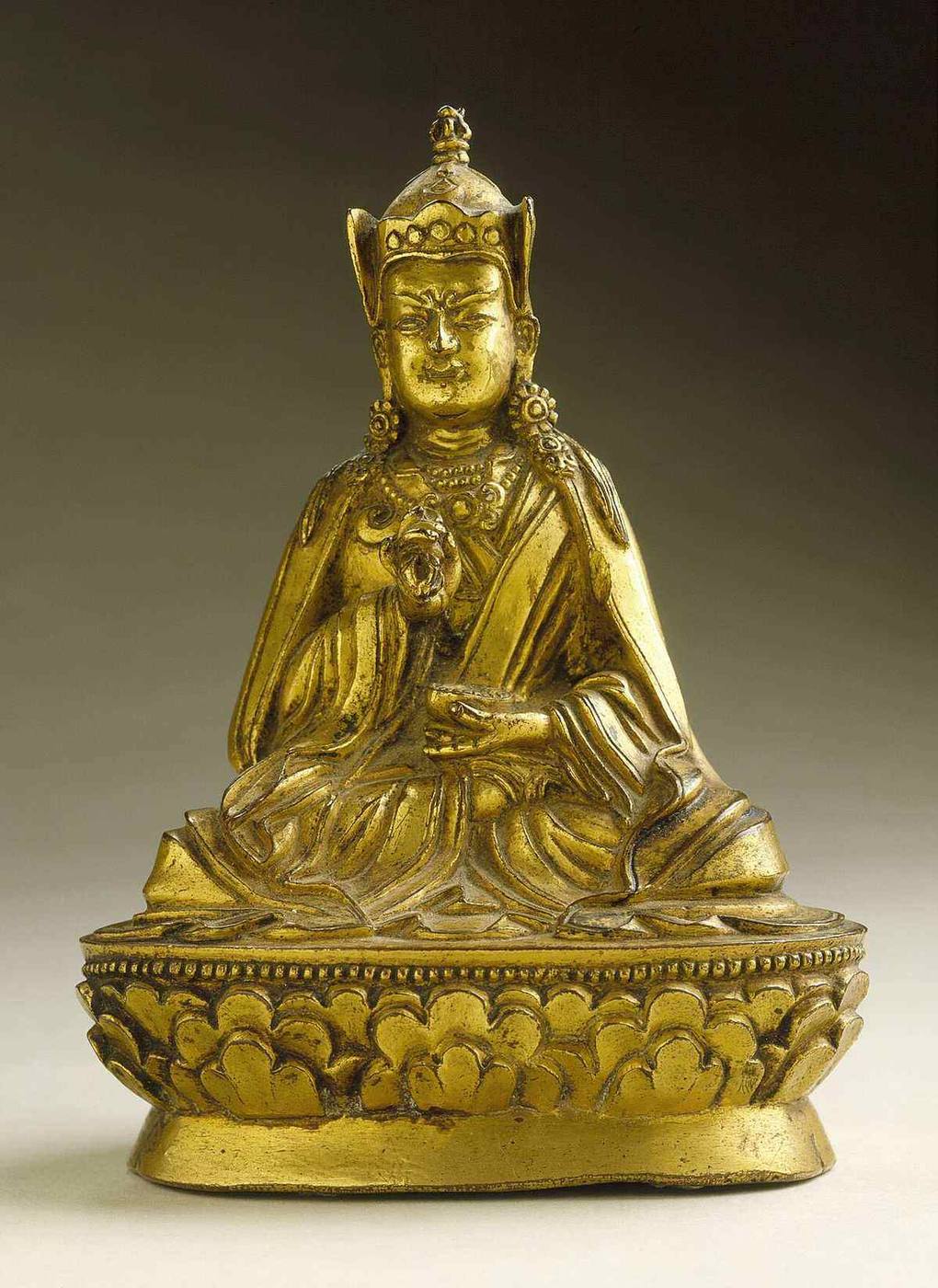
Look at the bronze statue of Padmasambhava in Los Angeles, or at Tibetan scrolls of Guru Rinpoche. Each object he carries marks a clear shift in how storm power moves.
His right hand holds a vajra at his heart. This diamond thunderbolt neither bends nor breaks under strain. It marks insight sharp enough to split panic while staying still at center.
His left hand rests in his lap holding a kapala, a skullcup full of nectar. Where ordinary eyes see only decay and ending, tantric art turns the skull into a cup of life. Death stops being a foe and becomes the bowl holding wisdom.
In full Tibetan art, a tall khatvanga trident leans on his left shoulder. Skewered on its shaft sit three heads stacked one over another: a fresh head, a rotting head, and a dry skull. Those three heads trace greed, anger, and delusion changed across impulse, decay, and bare bone. Above them shine sun, moon, and a crossed vajra, joining action with stillness.
On his head sits a lotus hat with upturned flaps. A crescent moon, a sun, and a vulture feather crown its peak. Vultures ride mountain winds over steep drops without fear, showing a mind that watches rise and fall from the open sky.
Padmasambhava on the tenth lunar day
Padmasambhava is a historical master and living lineage figure, not a planet or star in sky tables. In Tibetan Buddhism, the tenth day of each lunar month is kept for Guru Rinpoche and his feast prayers. Linking him to modern Western birth-chart placements like Uranus or Pluto is a contemporary symbolic reflection, distinct from traditional Tibetan lunar astronomy.
In a modern chart, Pluto mirrors the underworld, hidden vaults, crisis doors, and turning decay into fuel, like the skullcup in his palm. Uranus mirrors sudden flashes, breaking frozen walls, and the timing of hidden terma opening when an age turns. Jupiter, Sagittarius, Scorpio, and the eighth and ninth houses often reflect teachers and learners who walk into hard ground and bring back insight for the road ahead.
Meeting Guru Rinpoche at the twilight pass
Meet Padmasambhava with nerve and directness, whether you follow Tibetan practice or visit from outside the faith. He answers courage and presence, never hiding.
Come at twilight, or on the tenth day of the Tibetan lunar month, the day of Guru Rinpoche. Sit tall facing a window. Set a rough stone or a rolled paper scroll beside a cup of water on your table, joining mountain cliff and hidden lake.
Recall one fierce fear, clash, or knot you have fought in secret. Instead of shoving it back down, invite it into the open doorway of your mind, just as Padmasambhava called Samye's spirits into the yard. Look at it without rage and ask what force inside it can serve truth once bound by oath.
Sound his mantra slowly aloud or in breath: Om Ah Hum Vajra Guru Padma Siddhi Hum. Let Om clear the crown. Let Ah clear the throat. Let Hum drop like thunder into the heart. Rest three slow breaths between rounds in open Rigpa mind, as Tom Kenyon tells from Longchenpa, letting thoughts drift past like mist over high rock.
Finish the sitting by picturing a crimson lotus folding gently around the spark in your chest so nothing scatters when you rise. Lift the rough cliff stone or rolled scroll from the table and set it high upon a shelf. Leave the mountain pass still behind you and return calmly to your evening work.
Questions people ask about Padmasambhava
Who was Padmasambhava in Tibetan Buddhism?
Padmasambhava, called Guru Rinpoche or the Precious Master, was an eighth-century Indian master invited by King Trisong Detsen to Tibet. He founded the Nyingma school beside Shantarakshita and Yeshe Tsogyal.
What does the name Padmasambhava mean?
Padmasambhava means Lotus-Born in Sanskrit. Lore tells that he appeared as a child of eight sitting on a lotus flower upon Lake Dhanakosha in Oddiyana.
What are terma treasures in Guru Rinpoche's lineage?
Terma are hidden teachings, scrolls, and mind-seeds sealed by Padmasambhava and Yeshe Tsogyal inside caves, lakes, and students' minds. They are meant to open when times turn stormy.
Why does Padmasambhava hold a skullcup and a trident with three heads?
The skullcup holds wisdom nectar, showing fear of death turned into fuel. The three heads on his khatvanga staff mark conquering greed, anger, and ignorance across all three times.
What is Padmasambhava's mantra?
His main mantra is Om Ah Hum Vajra Guru Padma Siddhi Hum, joining body, speech, and mind with the presence of the Lotus-Born master.
The lotus inside the storm
Padmasambhava is the fearless art that turns wild storms into guards and hides living treasure under snow.