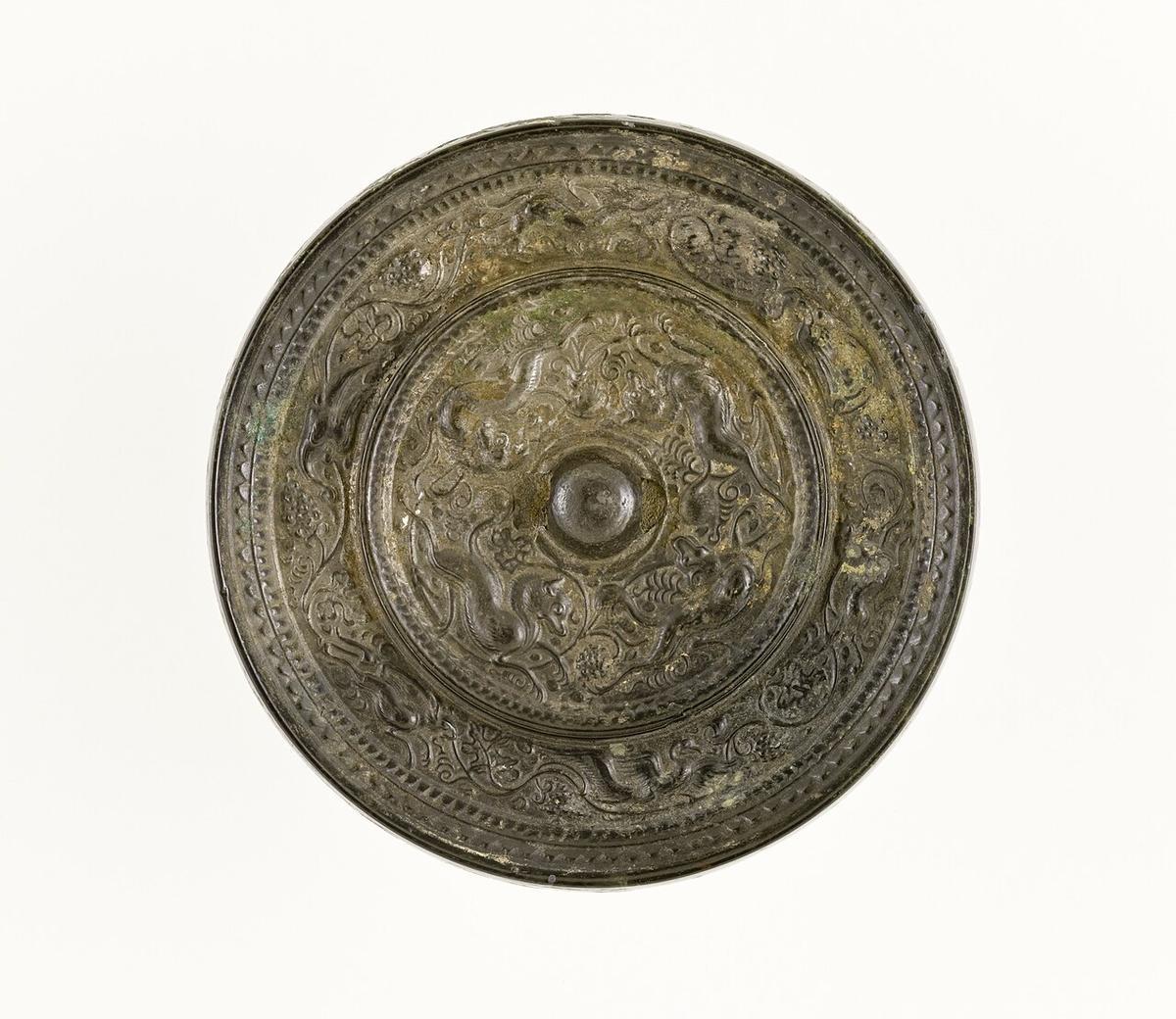
Step out into an open courtyard just after dusk in spring, and the green horns of the Azure Dragon climb above the eastern tree line. Three months later the Vermilion Bird spreads bright constellations across the southern sky, followed by the White Tiger in autumn's west and the Black Tortoise rising through winter frost.
Long before Western star wheels reached East Asia, Chinese astronomers split the Moon's path into twenty-eight lunar mansions. They grouped those twenty-eight houses into four vast creatures, seven mansions to each side of the sky. They called them Si Xiang, the Four Symbols. East holds the Azure Dragon, and south holds the Vermilion Bird. West holds the White Tiger, and north holds the Black Tortoise.
In Chinese cosmology, these four beasts are intelligences of direction and season. They also form an ancient instrument. Cast around bronze mirrors and carved on tomb stones, they map how life turns safely inside the cycle of Wood, Fire, Metal, Water, and Earth.
How a turning sphere builds four doors
Earth tilts on its axle as it circles the Sun. Because of that tilt, sunlight hits the ground at shifting angles all year. Spring opens the soil. Summer lifts the sap. Autumn dries the stalk, and winter drives warmth deep underground.
A sphere without directions has no door. Maia Nartoomid, in her essays on sacred geometry, quotes the Egyptian scholar Schwaller de Lubicz on how space takes form. For a sphere to become an ordered world, he wrote, three axes must appear. One is the polar shaft, and the other two form the four arms of the equatorial cross. Out of that cross rises all celestial measure.
Chinese astronomers wove that cross into daily life through the Five Phases, called Wu Xing, and texts like the Huainanzi. Instead of forcing every month to look like high noon, they watched how Wood, Fire, Metal, and Water hand the year from one season to the next around Earth at the center. When people live inside that circular rhythm, work and rest keep time with rain, heat, harvest, and frost.
Four beasts walking the night vault
Han sky watchers followed the march of these four quarters night by night.
As spring warmed the yellow rivers, the Azure Dragon lifted its green horns above the eastern horizon at dusk. Rain clouds followed its tail, waking roots and bamboo shoots through the power of Wood.
When summer reached its peak, the Vermilion Bird spread red wings across the southern sky. Heat climbed high, blossoms opened, and noon light flooded every valley through the power of Fire.
As days grew short and crisp, the White Tiger rose in the west. Autumn frost cut back tall grass. Sickles cleared the ripe grain, and leaves fell straight from the boughs through the power of Metal. The old almanacs warned never to skip autumn, or winter finds rot inside the granary.
Then the Black Tortoise climbed the north sky, a heavy shell locked in embrace with a coiled serpent. Frost sealed the streams. Seeds slept beneath mud, and force drew inward into deep Water until the Dragon stirred east again. At the middle of the four beasts rested the Yellow Dragon of Earth, holding the floor still while the edges turned.
Four seasons in turn and Yellow Earth at center
That seasonal circuit teaches two clear laws of timing.
One law is that every living cycle walks through all four quarters in turn. A tree that tries to stay in summer bloom without dropping its leaves dies before the next rain. A mind that chases constant spring starts and summer noise without autumn cutting or winter rest burns its fuel to ash.
A second law is that a compass only holds north while tuned to its center. Han almanacs placed Yellow Earth in the middle so none of the four outer beasts tore the year off balance. Anne Tucker speaks of a matching skill in her talk on New Earth awareness. She invites listeners to stretch their inner compass so they can feel which direction calls them next. Rigid habits fail when the season shifts. A person has to check all four horizons again.
Reading the Han mirror as a compass
Museum shelves hold Han dynasty bronze mirrors called TLV mirrors, like the famous plate in Los Angeles. Turn one over in your hands. Its back is a working map of the Four Symbols.
At the center sits a raised boss, drilled for a silk cord. That round knob marks Yellow Earth and the Pole Star overhead. It is the one spot that stays still when you spin the bronze.
Around that boss runs a crisp square frame. In Chinese thought, Heaven is round and Earth is square. The square marks corners, seasonal limits, and true measure upon the ground.
Around the square stand the four beasts in their quarters. East holds the Azure Dragon, long and sinuous, carrying upward spring force. South holds the Vermilion Bird, lifting heat and clear sight into the upper sky. West holds the White Tiger, pale like iron and salt, guarding the autumn cut that ends what is overripe. North holds the Black Tortoise wrapped with its snake, two creatures sharing one shell so winter rest stays guarded while fertile life coils inside.
Outside the square runs the round rim of heaven, etched with clouds and stars. Place your finger on the central boss, and all four powers sit at equal reach.
The Four Symbols in the birth chart
The Four Symbols belong to Chinese astronomy and Feng Shui, mapping the twenty-eight lunar mansions along the Moon's path alongside the twelve-year cycle of Jupiter. They do not appear in Western planet tables or in modern Western charts that include outer worlds like Uranus, Neptune, and Pluto.
Yet a matching fourfold cross appears in a modern Western natal wheel whenever a birth time is known.
Look at the four angles of a modern Western chart. The Ascendant sits in the east where the dawn sky rises, echoing the Azure Dragon and new spring starts. The Midheaven stands at the south peak of noon light, echoing the Vermilion Bird and visible work in the world. The Descendant sets in the west, echoing the White Tiger where day yields to night and meetings weigh what lasts. The fourth-house cusp hides at the northern midnight root beneath the feet, echoing the Black Tortoise and winter rest.
Look also at the cardinal signs of Aries, Cancer, Libra, and Capricorn. Each opens one of the four seasons on the zodiac wheel. Together with the Moon's monthly quarters and Saturn's slow measure, they reflect the same four-room rhythm in a modern chart.
Orienting to the four quarters in a calm room
Meet the Four Symbols with respect for the Chinese tradition that keeps their compass in temples and gardens. Turn to this practice when life feels stuck in one season, whether frantic summer or frozen winter.
Stand in the middle of a calm room or garden, facing east at morning if you can. Set a small paper calendar or folded notebook open on a nearby table. Let your arms hang loose at your sides and settle your weight evenly over both feet.
Face east and breathe in once. Name what is newly sprouting in your life, small as a shoot of bamboo. Feel the upward lift of the Azure Dragon in your ribs.
Turn a quarter circle to face south. Let your chest widen under noonday light. Name what stands in plain view right now, where your effort shines like fire under the Vermilion Bird.
Turn a quarter circle to face west. Breathe out slowly and firmly. Name one task or burden whose season has ended, and let the White Tiger cut it free with crisp autumn air.
Turn a quarter circle to face north. Soften your knees and drop your gaze toward the floor. Name what needs hidden rest beneath winter mud, held safe by the Black Tortoise until spring returns.
Turn a final quarter step back toward the east so all four horizons close into a full circle. Walk to the table, shut your seasonal notebook or roll the calendar scroll closed, bow once to the room, and carry that clear sense of timing back into your day.
Questions about the Four Symbols
What are the Four Symbols in Chinese culture?
Si Xiang, the Four Symbols, are four guardians representing the four cardinal directions, four seasons, and four quadrants of the twenty-eight lunar mansions. They are the Azure Dragon, Vermilion Bird, White Tiger, and Black Tortoise.
Which element belongs to each of the Four Symbols?
In Five Phases cosmology, the Azure Dragon of the East belongs to Wood and spring. The Vermilion Bird of the South belongs to Fire and summer, the White Tiger of the West to Metal and autumn, and the Black Tortoise of the North to Water and winter.
Why is the Black Tortoise shown with a snake?
Han art shows Xuanwu as a tortoise encircled by a black serpent. Together they depict winter stillness guarding life coiled inside dark water until spring.
What sits at the center of the Four Symbols?
Yellow Earth sits at the center, often pictured as the Yellow Dragon or the central boss of a bronze mirror. It anchors the four outer seasons around one pivot.
How can someone use the Four Symbols for timing today?
Walk the four directions from east to north in turn, matching each quarter to what is sprouting, shining, ending, or resting in your life. Finish by facing east again and closing your seasonal notebook or scroll.
The compass of four seasons
The Four Symbols are the turning wheel of the year, four gates that keep life moving in season.