In a high Himalayan shrine darkened by juniper smoke, storm clouds press against the stone ridge outside while a bronze thunderbolt rests beside a brass bell on a slate altar. Static gathers in the dry air as thunder rolls along the mountain pass.
Vajrapani is the bodhisattva of that lightning. Across Tibet, Nepal, China, Mongolia, and Japan, he stands wrapped in flame with a raised thunderbolt in his fist. In Tibet he is Chana Dorje. In China he is Jingangshou. In tantric texts he is Guhyapati, the Lord of Secrets.
He is a living figure of Buddhist devotion, never a demon of spite or a warlord chasing conquest. In Tibetan temples he completes the Triad of Three Protectors beside Avalokiteshvara and Manjushri. Avalokiteshvara carries compassion. Manjushri carries wisdom. Vajrapani carries the power of all the Buddhas, the voltage that keeps mercy and insight from folding when fear tests the gate.
Voltage, resistance and the lightning rod
Polite habits often confuse softness with goodness, and strength with harm. Vajrayana Buddhism draws a sharper line. Mercy without a spine bends into helplessness. Insight without force stays trapped on paper.
In the ninety-third Law of One dialogue, spiritual polarity is compared to electrical charge and thunderstorms. Opposite charges in storm clouds build voltage until lightning arcs across the sky. In the same way, the mind grows vivid when clear purpose meets resistance.
Anne Tucker uses that law of current in her talk You Are Here to Change the World. Current slows down wherever resistance blocks the wire, she says. In Now Is the Time to Expand the Glimmers, she speaks to listeners waiting for a bolt from the sky to shatter old ruts. Each person stands as the live wire right now.
Tibetan tantric texts trace a similar flash along the body's central channel. When scattered energy gathers and rises through the spine, inner fog clears like lightning across a dark ridge.
Tom Kenyon met that power in Lhasa through Yabsang Rinpoche, a Tibetan healer in the Vajrapani line. In his essay Death and Dying from 2023, Kenyon writes that Vajrapani stands for the power of all the Buddhas across time.
In Yabsang's dark room, monks fanned incense with peacock feathers, birds famed in lore for eating poison without harm. Yabsang held a silver mirror before each guest and chanted Vajrapani's mantra to channel awakened strength. Each seeker spat onto the mirror, rinsed with blessed water, and looked into the cleared silver again. Years later, when Yabsang lay dying in Lhasa, Kenyon sang his Vajrapani chant with bell and dorje. The dying lama lifted his own bell and dorje and sang the same tone beside him.
In his essay on the Chakrasamvara Thangka from 2018 and his Siddhis handout from 2016, Kenyon explains why those two tools never part. The dorje, or vajra, marks active bliss and right method. The bell in the left hand marks open emptiness, the Mother of All Buddhas. Vajrapani told Kenyon never to send sound into a body center without pairing it with open space. Power without space turns harsh. Space paired with the thunderbolt turns invincible.
The scholar under the blazing iron
This is the early tale told in the Ambattha Sutta, joined with the lore of Gandhara and Tibet.
One day a proud scholar named Ambattha walked into the Buddha's forest gathering, boasting of his birth and mocking the Buddha's clan. Shakyamuni answered calmly and asked Ambattha one direct question about his family line. The young man knew the truth well yet hated to admit it aloud.
Ambattha stayed silent. Pride locked his jaw. The Buddha asked a second time, and still Ambattha kept shut. The Buddha warned him that anyone who dodges a fair question three times would have his head split in seven pieces.
At that instant, above Ambattha's head, the sky cracked open. There hovered Vajrapani, a fierce spirit gripping a blazing iron bolt glowing like live coals. Only the Buddha and Ambattha could see him hanging above the scholar's crown.
Sweat broke across Ambattha's brow. His knees shook, his pride melted like smoke, and he spoke the plain truth before the whole crowd.
Along the Silk Road in Gandhara, stone carvers remembered that guard beside the Buddha. They carved Vajrapani wearing the lion skin of Herakles, standing one step behind the teacher. Centuries later in Tibet, that guard stepped forward into dark-blue fire as Guhyapati, Lord of Secrets, guarding deep teachings from vain hands and trampling sloth underfoot.
Live voltage and thunder wedded to the bell
Place Ambattha's story beside Yabsang's bell and dorje, and two laws of power appear.
First, truth needs a guard with real voltage. Compassion hears pain and wisdom draws the map. Without Vajrapani's resolve, fear talks both back into silence whenever arrogance slams the door.
Second, fierce force must stay wedded to open space. Lightning without a ground wire burns the house. Paired with the bell of emptiness and a silver mirror, wrathful strength burns away only fog, sloth, and self-deceit.
Reading the bronze from thunderbolt to serpent
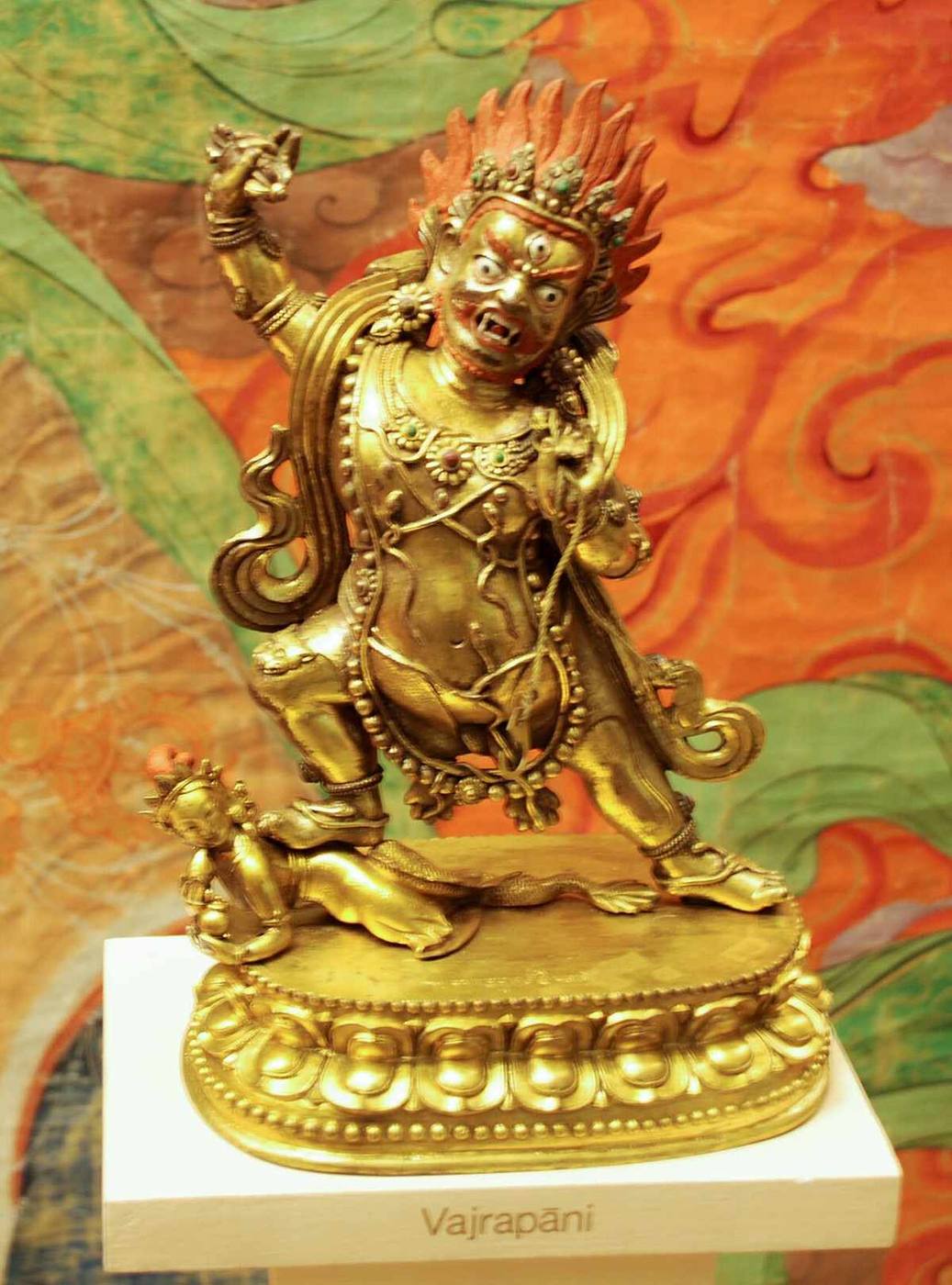
Stand before the bronze Vajrapani at the American Museum of Natural History, or study Tibetan paintings of his form. Every curve works like a surge guard and circuit breaker.
Look first at his right hand raised beside his flaming hair. He grips the five-pronged vajra, a Sanskrit word holding two things in one metal shaft: diamond and lightning bolt. Diamond cannot be scratched or broken by stone. Lightning leaps through dark clouds in a fraction of a second. Together they mark resolve that refuses bribery and delay.
Look next at his left hand held before his chest. He grips a coiled lasso, ready to catch wandering impulse and bind bad habits before they scatter. In painted scrolls, his skin glows dark blue like storm clouds before rain. Orange flames crown his head to burn sloth on sight.
His mouth bares sharp fangs, and a third eye opens between his brows, refusing flattery when a border needs holding. Serpents coil around his chest, and a tiger skin wraps his hips, showing raw animal force tamed into armor.
Look down at his feet. He stands wide in the warrior stride called pratyalidha. His right knee bends forward while his left leg braces back, pinning a serpent underfoot on the lotus base. That stance belongs to someone who never retreats when truth is cornered.
Vajrapani in Tibetan elemental cycles and Western signs
Vajrapani is a living figure of Buddhist devotion, not a planet or star in sky tables. In Himalayan tradition, his wrathful strength follows the Tibetan lunar calendar and elemental cycles. It does not come from Western star signs. Pairing his lightning current with outer planets like Uranus or Pluto is a modern symbolic mirror, distinct from classical Buddhist astronomy.
In a modern birth chart, Mars and Pluto mirror his intense nerve. Mars rules heat, courage, and the instant muscle that guards a gate, while Pluto points to deep reserves and the storm-blue current that refuses half-measures. When Mars meets Pluto or Saturn, a chart carries high voltage that calls for clear discipline.
Uranus, Aries, Scorpio, and the first and eighth houses reflect that same protective arc. Uranus brings the electric spark that breaks deadlocks, while the first and eighth houses show where courage meets deep shadow without flinching.
Holding the thunderbolt stance at noon
Approach Vajrapani with an upright spine and clear intent, whether you walk inside Tibetan practice or meet him from outside. He answers courage and direct resolve, never complaints.
Come at midday or before a hard talk you have put off. Stand or sit firmly on a straight stool with both feet set apart on the floor, like a lightning rod grounded in soil. Set a small brass bell and one heavy smooth stone in front of you.
Bring to mind one place where laziness, fear, or false peace kept you silent when action was called for. Never whip up spite against another person. Turn the flame strictly against your own fear and delay.
Draw breath deep into your belly and sound his mantra aloud or in breath: Om Vajrapani Hum. Repeat it nine times in a low chest tone, recalling Tom Kenyon's low chant beside Yabsang Rinpoche that wakes strength without strain. Feel the charge rise up the spine like lightning, as Muktananda describes, into open space above your crown.
Remember that power belongs to the whole circuit, never to vanity. Hold the still charge for five breaths, seeing clearly the single right step ahead.
Finish the practice so heat does not stay trapped in your jaw or fists. Ring your brass bell once, returning the bolt to open space like the bell beside the dorje. Pick up the heavy stone weight, grip it once tightly in your fist as you exhale slowly, then open your fingers and release it back onto the table. Drop your shoulders and step forward with an open hand.
Questions people ask about Vajrapani
Who is Vajrapani in Buddhism?
Vajrapani is the bodhisattva of awakened power and protective resolve in Mahayana and Vajrayana Buddhism. Beside Avalokiteshvara and Manjushri, he forms the Triad of Three Protectors guarding compassion, wisdom, and strength.
What does the name Vajrapani mean?
Vajrapani means Thunderbolt-in-Hand or Diamond-in-Hand. In Tibet he is Chana Dorje, and in esoteric texts he is Guhyapati, the Lord of Secrets.
Why does Vajrapani look fierce and wrathful?
Wrathful forms in Tibetan art never attack weak people. Fire, fangs, and wild eyes stand for unstoppable resolve that burns away laziness, cowardice, delusion, and complacency.
What is the vajra or dorje that Vajrapani holds?
The vajra is a ritual scepter joining the strength of a diamond with a sudden lightning flash. In Tibetan practice it pairs with a bell to unite right method with wide wisdom.
How does Vajrapani relate to compassion and wisdom?
Compassion hears pain and wisdom sees clearly, while Vajrapani supplies the nerve and strength to act. Without his protective voltage, good intentions fold under pressure.
The diamond and the lightning bolt
Vajrapani is the live current that guards the gate, unbreakable as diamond and swift as storm fire.