Beside a winter courtyard gatepost, dark pine-soot ink gleams inside a carved slate inkstone next to a heavy iron seal. Cold wind rattles the wooden lintel while fresh woodblock paper waits to dry upon the threshold.
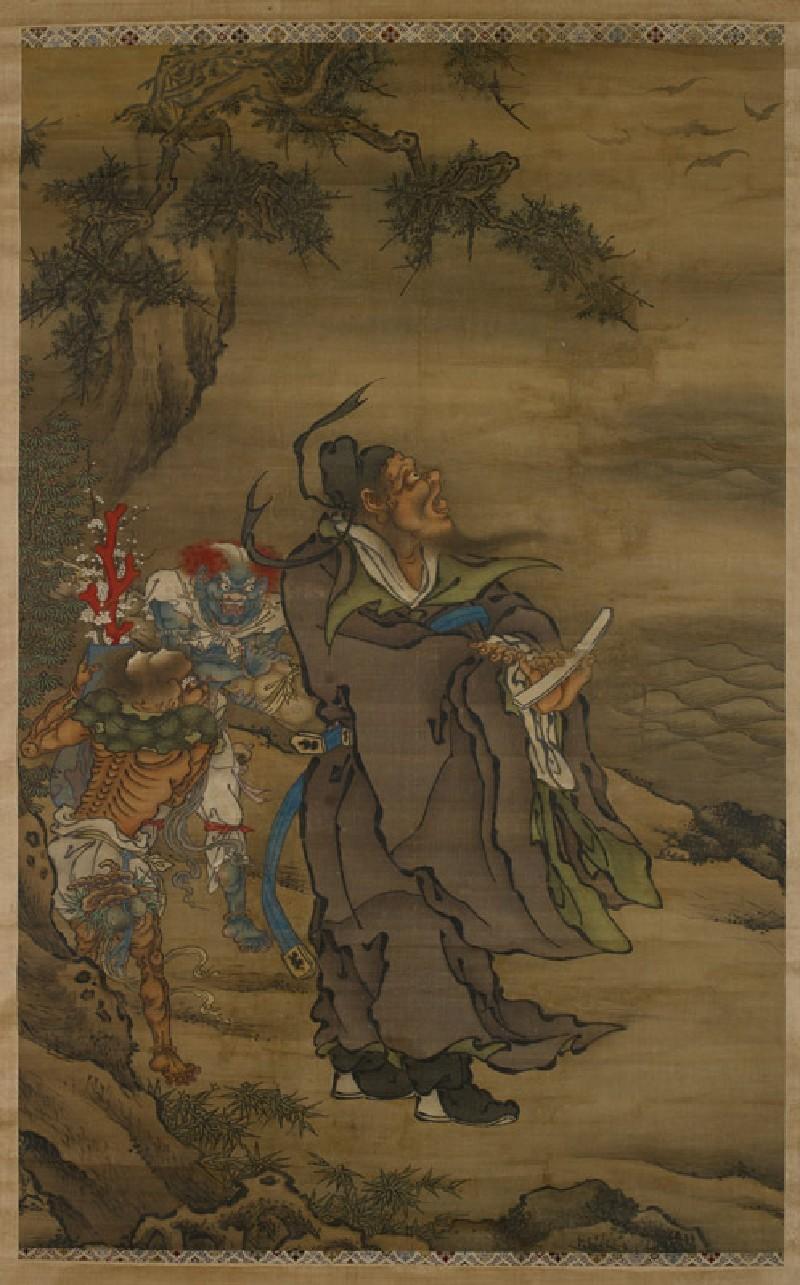
In Chinese homes from the Tang dynasty onward, that doorway watcher is Zhong Kui, the Demon Queller and King of Ghosts. Woodblock prints paste his bearded face and iron sword on front doors during Duanwu and the New Year. He wears a scholar's black cap, glaring eyes, and a rough brow that once drove a vain court to strip his top exam rank. Around his head fly five red bats, a pun on the five blessings. His doorway portrait acts as a house filter that sees past smooth masks and stops deception at the sill.
How bats read the dark and masks hide the truth
Human eyes trust flat paint too quickly. When something wears bright silk and smiles politely, daylight sight calls it safe. Creatures built for darkness use a sharper measure.
Bats fly through pitch darkness by bouncing sharp cries off branches, stone walls, and small wings in flight. A returning echo shows a room's true form regardless of shiny paint. Our old theater tradition remembers the same danger in masks. Mistake painted wood for a living face, and thieves step straight inside.
In recent Kryon talks, Lee Carroll speaks about false fronts cracking open as awareness rises. Closed loops of self-interest cannot spot cracks in their own ring, while systems built on greed break apart under plain light. Zhong Kui stands by the door to hasten that clearing.
The scholar on the palace steps
This is the story kept in Tang records and Ming scrolls of Zhong Kui.
During the Tang dynasty, a scholar named Zhong Kui traveled from the Zhongnan Mountains to sit for the highest imperial exams. His essays beat every rival in the hall, and examiners placed his name first on the list.
When the court called the top scholar forward, ministers gasped at his face. Zhong Kui had thick brows, bulging eyes, a heavy jaw, and skin scarred like rough bark. Judging by surface looks, officials urged the throne to strip his first-place rank.
Wounded yet refusing to buy honor with bribes, Zhong Kui walked down the stone stair and struck his head against the palace steps until he died. Hearing of his unyielding spirit, the emperor repented too late and buried him in the green robe of a high officer.
In the underworld, King Yama saw a soul no bribe could bend. Yama named Zhong Kui the King of Ghosts and armed him with an iron sword to hunt down rogue spirits that prey on the living.
Years later, Emperor Xuanzong fell into a harsh fever after returning from Mount Li. In a night dream, a small imp in red trousers crept into his chamber, stole a jade flute and a silk purse, and danced around the bed. Suddenly a giant figure strode through the door in a torn black cap, green robe, and leather boots. He seized the imp, tore out its eye, and swallowed it whole.
Asked his name, the giant bowed and said he was Zhong Kui, sworn to clear deceitful spirits out of town. At dawn Emperor Xuanzong woke with a cool forehead and zero fever left. He summoned court painter Wu Daozi to draw Zhong Kui from that night dream. Woodblock copies hung over palace doors at year's end to guard every home.
Unbribable scars and the watch at the timber sill
Place the palace steps beside the night dream, and two laws of protection step clear.
First, what vanity throws out often shapes the strongest shield. Courtiers hated a scarred face that spoiled their mirror. Refusing to polish himself for applause made Zhong Kui immune to bribes in the dark. Anne Tucker says in her shift talks that staying upright inside tunes a mind to truth. Stepping onto your threshold drops half-truths right at the door.
Second, unseen guests need checking before they cross wood sills. Maia Nartoomid writes in her records about the karmic threshold. There, awareness stops repeating old noise and asks for plain sight. A door with no watcher lets impostors walk straight to the hearth.
Reading the scroll with five bats
Hang a Ming scroll of Zhong Kui beside a door and read it from boot to cap. Each brush stroke along the scroll serves one doorway duty.
Look first above his shoulders, where five red bats wheel in flight. In Chinese, the word for bat sounds like the word for blessing, so five bats mean the five blessings of long life, wealth, health, virtue, and peaceful completion. Why pair a fierce demon-queller with bats? Because bats read dark air by echo instead of painted glare. Blessing stays safe only when clear sound checks each visitor.
Look next at his bulging eyes and bristling beard. His stare never blinks before charm or gold. He wears the black cap of a true scholar and the court robe given by the emperor, marking merit that outlived palace politics.
In his right hand gleams an iron sword, often called the Seven-Star blade. Iron in folk lore breaks spells and cuts illusion in two. At his sash hangs a bottle gourd or a copper coin with a square hole, round sky around square earth, trapping restless noise inside measure.
Folk artists paste his print on the front door during Duanwu, the fifth day of the fifth lunar month, and again on New Year's Eve.
Wu Daozi's brush and the sister's wedding
Zhong Kui does not stand only as a lone fighter in the dark. Two other figures complete his household circuit.
First stands his loyal friend Du Ping, who buried Zhong Kui with honor when court flatterers turned away. Folk plays tell that on a winter night after becoming King of Ghosts, Zhong Kui returned with ghost torchbearers to give his younger sister in marriage to Du Ping. True integrity keeps its word even across death.
Second stands painter Wu Daozi, whose brush turned a fleeting dream into a doorway shield. Vision without form fades by noon. Putting true pattern onto paper turns insight into a gate any family can hang above a sill.
Zhong Kui in Chinese lunar time and Western charts
Zhong Kui belongs to Chinese household worship and classical lunar reckoning. Doorway prints mark Duanwu and the winter turn of the Lunar New Year alongside the Twenty-Eight Lunar Mansions and Twelve Earthly Branches. Matching his threshold watch to modern Western planets is a contemporary symbolic reflection, not traditional Chinese sky lore.
In a modern Western birth chart, Saturn and Pluto mirror his unbending gate. Saturn sets the doorpost and clear measure, while Pluto strips away surface paint to show what breathes underneath. When Saturn meets Pluto by conjunction, square, or opposition, flattery fails and plain truth takes charge.
Scorpio and Capricorn placements, or the eighth and twelfth houses, echo that same discernment. Scorpio detects hidden motives under smooth talk, while Capricorn holds Zhong Kui's scholar grit. Lilith in a modern chart marks what a polite room tries to exile for looking too rough, yet when welcomed with clear sight, that rejected force guards the house.
Sealing the winter doorway at dusk
Approach Zhong Kui with respect for Chinese homes that hang his portrait at New Year and Duanwu. Call on him when smooth bargains hide hidden costs, when a room feels drained by loud noise, or before resetting a home threshold.
Stand just inside your front door at dusk, facing the closed wood. Keep a capped jar of pine-soot ink or a small iron seal on a nearby hallway shelf.
Plant both feet squarely on the floor with your spine tall and chin level. Soften your eyes instead of straining, listening like a bat reading dark air in the hallway.
Take five slow breaths, one for each bat of the five blessings. On each exhale, picture false flattery, painted masks, and uninvited noise stepping back outside the sill. Name one false bargain or disguise you refuse to let past your doorpost tonight.
Tap the wooden doorpost gently once with your knuckles to mark the line in solid matter. Keep your voice calm and plain. No shouting is needed to hold a gate built on truth.
When finished, turn away from the threshold toward the lit room. Slide the winter door latch shut behind you, cap the pine-soot ink jar tightly, and set the iron seal flat beside it on the desk. Thank Zhong Kui silently for clear sight at the sill and step back into ordinary evening rest.
Questions people ask about Zhong Kui
Who is Zhong Kui in Chinese folklore?
Zhong Kui is the Daoist and Chinese folk King of Ghosts, honored as a household guardian who catches deceptive spirits and watches doorways at New Year and Duanwu.
Why was Zhong Kui stripped of his exam title?
Tang legend says Zhong Kui earned first place in the imperial exams by merit, yet shallow officials recoiled from his scarred face and denied his rank. He died on the palace steps instead of compromising his integrity.
Why are five bats painted around Zhong Kui?
In Chinese, the word for bat sounds like blessing. Five red bats painted around Zhong Kui stand for the five blessings of long life, wealth, health, virtue, and peaceful completion kept safe inside the door.
How did painter Wu Daozi connect to Zhong Kui?
After dreaming that Zhong Kui caught a palace imp, Emperor Xuanzong woke well. He told artist Wu Daozi to paint Zhong Kui from memory so prints could guard homes far and wide.
How can someone honor Zhong Kui at home today?
Many families hang his print near a doorway at New Year or Duanwu. Standing tall by the doorpost at dusk, taking five calm breaths, and locking the door latch afterward respects his spirit of fearless truth.
The guard beside the doorpost
Zhong Kui is the rough-faced truth at the sill, the clear eye that bars smooth lies so blessing stays safe within.