In a stone courtyard at midnight, a bronze compass needle settles while the seven stars of the Big Dipper swing above the dark roof tiles. From spring through winter, the ladle's handle sweeps all four edges of the sky like a clock hand turning around one still pin.
High in the northern sky of China, seven stars form a ladle that never sinks below the earth. Around the handle's sweep sits an older presence whom Daoist temples honor as Doumu Yuanjun, the Mother of the Bushel. In Buddhist shrines across East Asia, she shares an altar with Marici, the ray of dawn that walks ahead of the sun.
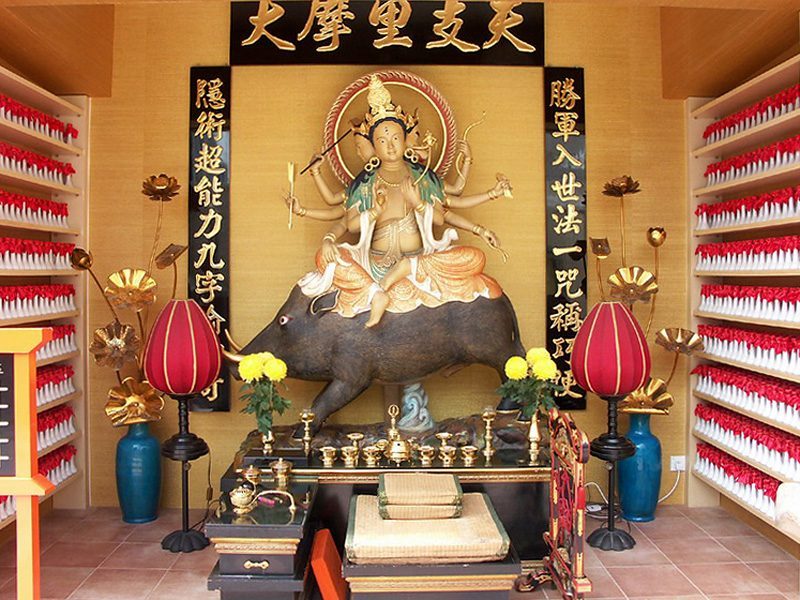
Doumu is the mother intelligence of the northern pole. In Daoist tradition, she stands behind the constellations and births nine stars that measure time, season, and span. Her statues form an instrument made of arms, faces, sun, and moon. Each part teaches how to hold the hub while the wheel turns.
The pin inside a spinning sky
Step outside on a clear night in the north and watch for an hour. Stars in the east climb while stars in the west drop toward the trees. One point above the horizon stays in place while the whole vault wheels around it.
That pin is the North Star, or Polaris. Earth turns on its axis once a day, and the north end of that axis aims near Polaris. Constellations rise in the east and sink in the west, and travelers walking south see Polaris drop lower toward the sea rim. Yet its place due north holds true for ships crossing dark water.
Chinese sky watchers named the circle around Polaris the Purple Forbidden Pivot. Seven stars of Ursa Major, called Beidou or the Northern Bushel, swing around that pivot like a clock hand. In spring the handle points east. In summer it points south. In autumn it points west, and in winter it points north.
Where astronomy sees an axis of spin, Daoist temples saw a mother. Doumu is the stillness behind that pivot. Classic Chinese thought treats sky, earth, and living breath as one unfolding whole instead of dead parts locked in isolation.
Maia Nartoomid points to Ursa Major as well in her Temple Doors writing. She notes that Thoth links two sky vaults to the Great Pyramid in Egypt. One sits in Orion as a door between past and future, and the other waits in Ursa Major as a future interface for Earth.
Tom Kenyon brings that hub down to daily sight. During turbulent shifts, he teaches, personal perception acts as the pivot point around which a person's world turns. Anne Tucker speaks in the same vein in her talks on rapid change, calling our era a pivot point between an old world and a new one.
Doumu sits at that pin. She does not chase the rim. She holds the axle.
Nine lotuses in the Dragon-Han heaven
The Daoist scripture known as the Doumu Jing, preserved in mountain temples, tells how the Mother of the Bushel took her high seat.
Long before human kingdoms rose along the yellow rivers, in a high age called Dragon-Han, there lived a noble queen. Her husband was King Zhouyu, ruler of a realm at the edge of the sky. Court duties swirled around the palace, yet the queen kept her heart free of greed and noise. She bowed toward the Dao each dawn and tended every creature in her land with mercy.
One spring morning, the queen walked out to a pond inside her garden. On the water floated nine buds of lotus. She knelt by the bank and bathed her hands while offering a wish for all worlds.
As her breath touched the pond, the buds opened one by one. Out of those nine blossoms stepped nine sons, bright as sparks from a furnace. They grew into the Nine Star Lords of the Northern Bushel. Seven shine in the bowl and handle of the Big Dipper that every eye can see. Two walk beside the handle as unseen companions, guarding the hinge of heaven.
When her nine sons took their stations around the pole, the queen rose into the high vault. She took her seat inside the Purple Pivot, behind the turning Dipper. From that throne she watches over births, turns the seasons, and answers prayers when mortal paths tangle.
Later, along trade roads between India and Tang China, Daoist priests met the Buddhist goddess Marici. Marici means a ray of light, the gleam before sunrise that no blade can catch. Her name joined with Doumu, and temple altars gave the Mother of the Bushel the many arms and faces of the dawn goddess.
The still axle and the two hidden stars
Two working principles emerge from the story of the pond and the pole.
One principle is that what steers a spinning system must sit outside the rim. Step onto the edge of a wheel, and each turn flings you outward. Stand at the axle, and the whole circle moves around you while your feet stay still. Doumu sat calm in the garden before she climbed to the stars.
A second principle is that visible time runs on hidden anchors. The eye counts seven stars in the Big Dipper. Daoist astronomers counted nine, adding two stars beside the handle that almost no naked eye can spot. Every outer cycle rests on unseen supports. Without hidden weight inside the hub, the seven spokes fly apart.
Reading Doumu's statue as a sky tool
Stand before an image of Doumu in a temple hall. Each arm and emblem on her altar figure shows a different part of that northern hub.
She sits upright on a lotus throne, never leaning left or right. A lotus grows out of mud yet opens unmarked in the air. Her seat shows that stillness takes root inside the noise of life instead of fleeing the world.
From her torso grow eight or more arms, while her shoulders carry three or four faces watching all horizons at once. Two eyes see only what lies in front of the nose. Four faces watch east, south, west, and north in one breath, matching the four turns of the Dipper across the year.
Look at her highest pair of hands. One palm holds a disk of the sun. The opposite palm holds a moon crescent. Day and night, rising heat and cool autumn dew stay balanced inside one body. Between those hands sits the axis that keeps light from burning out and dark from freezing over.
Her lower hands grip working tools. One holds a bow and arrow, setting aim across distance without drift. Another holds a bell or bronze seal, stamping order onto scattered hours. Beside her Buddhist form as Marici, seven pigs pull a chariot across dawn clouds, showing fierce appetites harnessed to pull light forward.
Doumu and the birth chart
Doumu belongs to Daoist and Buddhist devotion, not to Western natal horoscopes. Traditional Chinese sky lore centers her around Polaris and the Northern Bushel, while Chinese calendars measure years through the twenty-eight lunar mansions and the twelve-year cycle of Jupiter. Modern Western astrology adds outer planets unknown to ancient watchers, such as Uranus, Neptune, and Pluto, alongside its own chart angles.
Still, a similar sense of an unmoved center appears along a modern Western chart's spine.
Look first at Saturn and the Lunar Nodes. Saturn rules seasons, duty, and the bones of time, much like the Dipper measuring years across the north. The Lunar Nodes trace where the Moon's path cuts the Sun's road, forming the hidden pivot that eclipses swing around.
Look next at the Midheaven and the fourth-house cusp when birth time is known. That vertical line runs from the root beneath your feet to the crown overhead. Planets touching that line act like stars near the pole, holding course while faster transits spin past.
In the sky itself, Doumu lives in Ursa Major and Polaris. Sailors set Polaris at the top of the map so a ship could cross black water when clouds hid the coast.
Facing the northern ladle at night
Meet Doumu with respect for the tradition that keeps her lamps burning. Turn to her when seasons shift fast and your mind feels pulled across too many directions.
Step outside after dark and face north. Trace the two outer stars of the Big Dipper straight to Polaris. If clouds hide the sky, face north indoors and picture that fixed point overhead.
Sit upright on a stool with your spine stacked like a plumb line. Rest your left hand palm up for the moon, and your right hand palm up for the sun. Drop your shoulders and soften your belly around the navel.
Breathe in through the nose for four counts and feel the spine lengthen. Breathe out for six counts and let attention sink down to the navel. Hold Kenyon's teaching in mind: your awareness is the pivot, and the week's noise is the rim turning past.
Stay at that center for five minutes without pushing thoughts away. Name one duty that matters today, and let lesser demands fall into orbit around it.
When you finish, trace the Dipper's gentle turn in your mind as you turn away from the northern window back into the room. Pour a small cup of warm tea, drink it slowly while sitting upright, thank the Mother of the Bushel in silence, and step back into your evening.
Questions about Doumu and the Northern Bushel
Who is Doumu in Daoism?
Doumu Yuanjun is the Primordial Mother of the Big Dipper in Daoist tradition. She sits at the northern pole of the sky and governs the nine star lords that measure time, seasons, and human fate.
How is Doumu linked to Marici?
During the Tang and Song eras, reverence for the Dipper mother blended with the Buddhist goddess Marici, whose name means Ray of Light. Both carry multiple arms, hold sun and moon emblems, and guard travelers at dawn.
What are the nine stars of Doumu?
Doumu is the mother of the seven visible stars of the Big Dipper plus two unseen companion stars called Zuofu and Youbi. Daoist sky lore treats all nine as one northern wheel.
Why does Doumu hold the sun and the moon?
Her statues hold a sun disk in one hand and a moon crescent in the other to show balanced polarity. Seated between day and night, she keeps hot and cool currents centered.
How can someone connect with Doumu today?
Face north after dark, sit upright, and follow slow breaths down to the navel. Finish by turning gently back into the room and drinking a small cup of warm tea.
The star that stays home
Doumu is the unmoved hub of the sky, the mother who births the turning hours from one calm center.