Along a misty stone path up Mount Jiuhua, six iron rings chime against the wood of a monk's staff at every step. Small frogs and beetles scatter safely off the damp slate at the sound before a sandal touches ground. Where dark cedar roots grip the mountain floor, a carved monk in a patched robe watches beside a stone incense burner.
Ksitigarbha is the bodhisattva who belongs to that depth. Across East Asia, travelers meet his stone figure at mountain passes, temple gates, and village graves. In China he is Dizang Wang, ruler of Mount Jiuhua. In Japan he is Jizo, standing beside country roads in a plain robe. In Korea he is Jijang, and in Tibet he is Sai Nyingpo.
His Sanskrit name means Earth-Womb or Earth-Store. Like the crust of a planet holding water and ore in the dark, he carries every creature that fell out of sight. He is a living figure of Buddhist devotion, never a creator god or a judge above the clouds. He walked past the gate of peace to stand beside beings in the lowest rooms of sorrow.
The doorway below the surface
Most great bodhisattvas wear royal silk and crowns of gold. Ksitigarbha appears as a monk with a shaven head and a patched robe. That dress speaks before a word is spoken. A prince stays inside a palace. A wandering monk can walk straight through prison doors.
His work begins where hope goes cold. In Buddhist teaching, beings drift after death through intermediate states shaped by anger, habit, and regret. Those who fall into deep confusion enter realms of fire, ice, and exile. Even when a mind misses bright release and meets a dark world of its own making, that threshold stays open to help. Ksitigarbha walks into those rooms with a ringing staff and a bright jewel, refusing to vanish into private peace while others remain trapped below.
Tom Kenyon describes a similar vault in his work on memory. In his essay on the Trees of Life from 2014, he calls the underworld the storehouse of sadness, despair, and regret. In his Ancestral Healing talk from 2023, he adds that old sorrow passes down family lines like roots underground. Sending care to ancestors frees both the line behind us and the life here today.
In East Asian temples, families gather on memorial days to chant for parents, grandparents, and forgotten strangers alike. Nothing sits as an island apart from the rest of the family root. Ksitigarbha is the awareness that leaves no thread abandoned.
The vow in the court of the ten kings
The Sutra of the Past Vows of Ksitigarbha, joined with the lore of Dunhuang and Mount Jiuhua, preserves how this vow began.
Ages before our world began, a young Brahmin girl lost her mother. The mother had mocked the teachings and left a wake of harm, and after death she fell into torment. The daughter sold her home and goods to make sincere gifts at a shrine. Standing before an image of the Buddha, she wept until a voice spoke from the air. It told her to go home, sit upright, and call the Buddha's name with one mind.
She sat for a full day and night. Suddenly her mind dropped below the earth to a boiling sea of iron waves. A demon king named Ghost King came forward beside the shore. He bowed and told her that her mother had left that sea three days before, lifted by her daughter's care and gifts. Around them, countless trapped souls rose out of the dark water in the same hour.
Hearing that, the girl did not turn back toward ease. Standing beside the iron sea, she spoke a vow that shook every world. She promised that until the last suffering being left torment, she would never rest in final peace.
In another birth as Bright Eyes, she widened that pledge across all six realms of birth and death. Until the hells are empty, she declared, I will not become a Buddha. Only when every being is freed will I cross the final gate.
Centuries later, under the Tang dynasty, a Korean prince named Jin Qiaojue sailed to China. He climbed Mount Jiuhua and lived inside a damp cave, eating wild herbs and white mountain clay with rice. When he died at ninety-nine, his students opened his shrine three years later and found his body whole. From then on, pilgrims saw the monk as Ksitigarbha walking the earth in plain cloth.
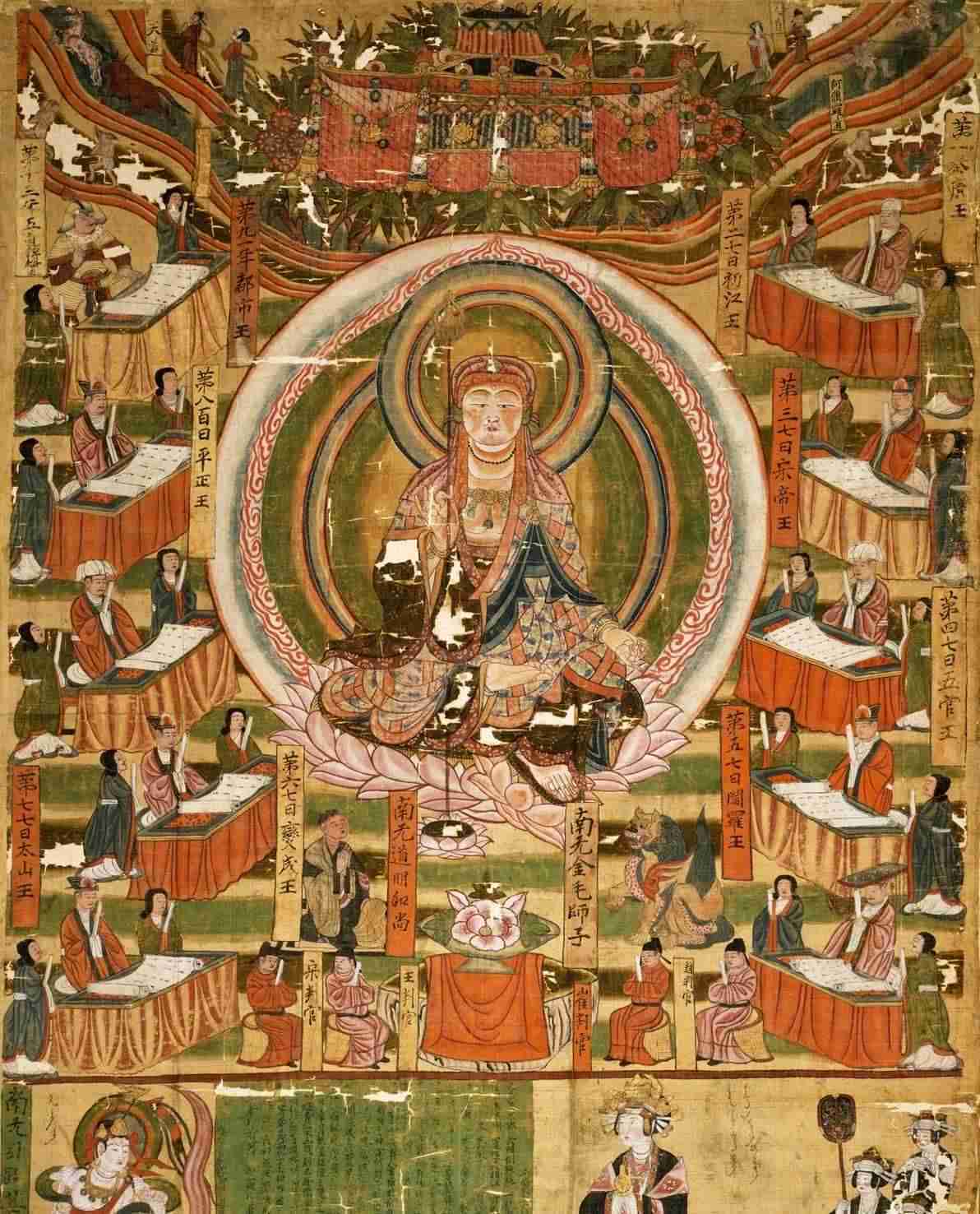
On silk scrolls from Dunhuang, you can see the court around him. Ten stern kings sit behind long desks with scrolls and ink, weighing every deed of the dead. In the center, Ksitigarbha sits calm on a pink lotus inside a ring of light. He holds no sword against the judges. He stays in the room until every name on the page meets mercy.
Buried roots and the staff that rings locked doors
Those vows point to two plain rules about hidden sorrow.
First, nothing pushed into darkness vanishes on its own. A root buried under winter rock still draws water in secret. Grief and family burdens hidden below sight keep shaping the surface until someone climbs down the stairs to meet them. Ksitigarbha's patience proves no corner of life lies beyond care.
Second, sound opens doors that force leaves bolted. The ten kings guard strict books of cause and result. Nobody storms that hall with spears. Ksitigarbha enters with six rings chiming on his staff, and locked gates loosen by sound.
The staff, the jewel and the red bib
Look at any scroll or roadside figure of Ksitigarbha. Each item carried by this monk serves a clear purpose in dark rooms.
His right hand holds a staff topped with a hoop and six metal rings. Monks carried that staff on mountain paths so its rattle warned snakes and beetles off the trail before a foot came down. In Ksitigarbha's hand, those six rings mark six worlds of wandering beings, from gods down to the lowest hells. One shake sends a tone across every level at once.
His left hand holds the cintamani, the jewel that answers sincere vows. It is no prize for greed. It is one lamp inside a black mine. One flame never fights the dark with rage. Darkness simply loses its claim where light sits.
His shaven head and patched robe tell the traveler that rank has no use below. Gold crowns dazzle the eyes. Plain cloth puts frightened souls at ease. In Japan, grieving parents tie red bibs and knit small hats onto stone Jizo figures by the road. Red marks hearth fire and shelter, guarding travelers and young souls who crossed early so they never walk unseen.
Where the earth-store moves in the sky
Ksitigarbha is a living figure of Buddhist devotion, not a star or lunar mansion. Traditional Chinese astronomy charts time through twenty-eight lunar mansions and the twelve-year cycle of Jupiter, while modern Western astrology added outer bodies like Pluto in 1930 and Chiron in 1977. Seen through modern Western symbolism, a few placements mirror Ksitigarbha's patience with buried ground.
Look first at Saturn and Pluto in a modern Western chart. Saturn rules bedrock, endurance, duty, and stone that outlasts summer storms. Pluto rules what sits underground, hidden debt, death doors, and treasure buried in dark soil. When Saturn meets Pluto in a chart, a person often carries a strong care for hard truths that others flee.
Look next at the South Node of the Moon, Capricorn, and Scorpio. Check the eighth house and twelfth house when birth time is known. Placements there often match people drawn to hospice rooms, elder care, grief support, and ancestor remembrance. Look also at Chiron, which marks where an old wound opened and turned into a lantern for someone else in the dark.
Lighting a dusk lamp beside Mount Jiuhua's vow
Approach Ksitigarbha with stillness and care, whether you keep a Buddhist shrine or visit from outside the faith. He answers sincerity, never haste.
Come at dusk or before dawn, when the house is still. Sit upright on a firm chair with both feet flat on bare floor or soil. Set one smooth river stone and a small candle before you, recalling Mount Jiuhua and the deep ground.
Bring to mind one person who died, one family sorrow, or one memory locked behind a door. Do not rush to fix it. Sit beside it inside the glow of the candle, like Ksitigarbha seated among the ten kings.
If you own a small bell or metal rattle, ring it once to wake the room, like one shake of his staff. Otherwise let breath carry that chime inside your chest. Sound his name slowly aloud or in thought: Namo Dizang Wang Pusa. Or use his short line: Om Ha Ha Ha Vismaye Svaha. Repeat it nine times without strain. Picture a warm pearl inside your chest while care reaches down into old roots, as Kenyon teaches for ancestors.
Let whatever rises in memory be seen without argument. You are only the witness holding a lamp at the door.
When you are ready to rise, mark the end clearly. Set your small bell or staff rattle softly down on the wooden table or stone beside you until its final ring fades into stillness. Snuff the candle gently, breathe out slowly three times, and walk out into bright air knowing the lamp stays lit without your strain.
Questions people ask about Ksitigarbha
Who is Ksitigarbha in Buddhism?
Ksitigarbha is one of the four great bodhisattvas of East Asian Buddhism, honored in China, Japan, Korea, and Tibet. He vowed to stay inside birth and death until every being in the lowest realms goes free.
What does the name Ksitigarbha mean?
Ksitigarbha is a Sanskrit name meaning Earth-Womb or Earth-Store. In China he is Dizang Wang, and in Japan he is Jizo, pointing to soil that holds all things without turning away.
Why is Ksitigarbha dressed like a monk instead of a prince?
Other bodhisattvas wear gold crowns and silk. Ksitigarbha wears a monk robe and carries a staff. That form shows he walks into prisons, graves, and dark realms as a friend to the lost.
What are the two objects Ksitigarbha carries?
His right hand holds a six-ringed staff whose chime warns small creatures and opens gates across six realms. His left hand holds a wish-fulfilling jewel that sheds light inside total darkness.
Why do Japanese Jizo statues wear red bibs?
In Japan, Jizo guards travelers and children who died young. Families tie red cloth bibs and hats onto stone figures as signs of care, prayer, and hearth warmth along unseen roads.
The lantern in the bedrock
Ksitigarbha is the vow that climbs down to the lowest room and keeps the lamp lit until the last door opens.