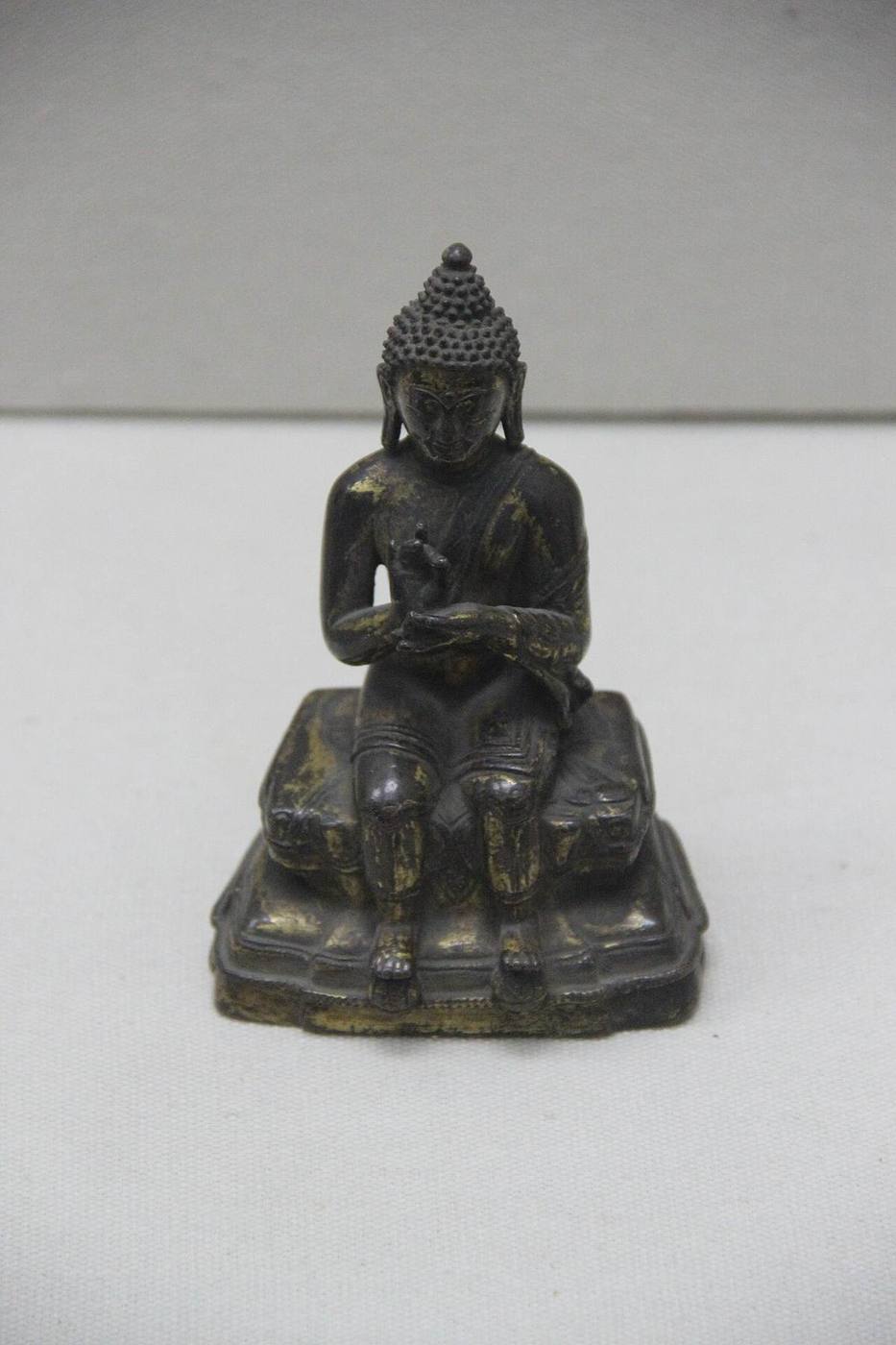
On a carved wooden throne inside a sunlit temple hall, a gilt-bronze bodhisattva sits with both feet planted squarely on the stone floor. Unlike figures tucked into cross-legged stillness, his knees bend forward as if ready to stand at a single chime. Above the hall eaves, a gilt bell hangs motionless in the morning air, waiting for its hour to ring.
Maitreya is the bodhisattva and coming Buddha of that hour. Across Gandhara, Tibet, China, Korea, and Southeast Asia, he waits to arrive when old teachings fade from view. In Pali texts he is Metteyya. In China he is Mile Fo. In Tibet he is Jampa, and in Japan he is Miroku.
His name comes from the Sanskrit word maitri, meaning loving-kindness and true friendship. He is a living figure of Buddhist devotion, never a creator god or a king judging earth. Across every school he holds one promise: awakening did not end in the past, and kindness is the seed that carries light through time.
The arrow of time and the edge of now
To understand Maitreya, look first at how the present moment carries the future.
In Now: The Physics of Time, Richard A. Muller points to the leading edge of time called now. The past is fixed and cannot be rewritten. Only inside the moving edge of now can awareness pick among open futures and build order against decay.
Anne Tucker speaks to seekers waiting for a bolt of lightning to sweep away a worn world. In her talk Now Is the Time to Expand the Glimmers, she says no one stands apart waiting for rescue. Each person is the bridge inside this hour, holding what has been, what is here, and what could grow next.
Tom Kenyon shows how Maitreya turns that bridge into action in his essay on the Nature of Compassion. He parts compassion from loving-kindness. Compassion watches pain as a caring witness. Loving-kindness steps out to lift a load or mend a broken road.
Kenyon saw that link lived out in Tibet through Yabsang Rinpoche, a master healer. When Kenyon and his wife gave a gift to Yabsang's mountain temple, the old lama chose two works. First, he built a strong bridge across a gorge so pilgrims and yaks would stop falling to their deaths. Second, he ordered a statue of Maitreya, the future Buddha. Earlier in Tibet, Kenyon led a Maitreya rite high on steep cliffs where thin air made singing hard. Drawing on what he calls the gold body, a layer of subtle energy, he found breath and voice returning at high reach.
That is Maitreya's path. Hope is never wishing on clouds while a bridge rots over stone. Loving-kindness builds the bridge today so tomorrow's walkers cross safe.
The prophecy under the dragon-flower tree
The Pali Lion's Roar Sutra and later Sanskrit books record the long turn of ages leading to Maitreya's birth.
In a far age, human years shrink as speech turns harsh, trust breaks, and neighbors lift blades against one another. Seven days of fierce war strip away what pride had built. A few survivors crawl out of caves and hills, look at each other with grief and awe, and vow never to kill again.
From that small seed of restraint, lives slowly lengthen and grow wise. Fields yield full grain, towns stand open without walls, and the teaching of Shakyamuni Buddha fades from memory.
High in the Tushita realm, Maitreya watches the hour ripen. Born once more into a human home inside the city of Ketumati, he walks away from wealth to seek truth. In a single night under the blooming nagapushpa, the dragon-flower tree, he wakes into full Buddhahood.
Under those blooms he gathers three vast circles of students. Tradition says those who arrive there did not win seats by luck. They kept small vows of truth, patience, and care across forgotten lives when nobody watched.
Centuries later in China, a Chan monk named Budai walked through towns carrying a cloth sack of sweets and toys for kids. Laughing in open squares, he left a short verse before dying that named himself a vessel of Maitreya. From his round belly and broad smile grew the folk figure called the Laughing Buddha. Older stone and bronze works still show Maitreya as a slender teacher ready to walk into history.
Present hands and the elder's shrine on the crown
That prophecy holds two plain truths about patience and renewal.
First, tomorrow grows out of present care, never out of idle waiting. Muller shows that now is the single hinge where choice turns chaos toward form. Waiting for rescue while ignoring the road before your door only drags out the frost.
Second, true renewal honors its root before stepping ahead. Maitreya never mocks the Buddha who came before him. He wears the elder's shrine right on his head so wisdom stays whole across ages.
The chair, the flask and the crown stupa
Stand before a gilt-bronze Maitreya statue, such as the Ming figure or stone carvings from Gandhara. Almost every Buddha sits cross-legged on a lotus, locked in stillness. Maitreya sits upright on a chair, and each feature joins memory of the past with readiness to walk.
Look first at his legs. He sits in bhadrasana, upright on a chair with both feet planted squarely on the ground. That pose stands halfway between rest and walking. One breath is enough for him to rise and step straight into the world.
Look next at his head and crown. Set into his hair sits a tiny stupa, the bell shrine holding relics of Shakyamuni Buddha. Wearing that old shrine on his head keeps memory clear above his brow while his feet face forward into what comes next.
Look at his hands and side emblems. Often he holds a traveler's water flask, called a kundika, made for dusty roads. Fresh water keeps a walker alive across dry miles between one rain and the next. His fingers form the teaching sign, thumb touching finger to turn the wheel of truth anew. Beside his shoulder rises a branch of dragon-flower to mark the open hour.
Where Maitreya shines in the sky
Maitreya is a living figure of Buddhist devotion, not a star in a sky table. Traditional East Asian astronomy measures long stretches of time through twenty-eight lunar mansions and the twelve-year cycle of Jupiter. Modern Western horoscopes also weave in outer planets such as Uranus, spotted by telescope in 1781. In modern Western symbolism, a few placements echo Maitreya's spirit of patient renewal.
Look first at Jupiter and Uranus in a modern Western chart. Jupiter rules faith, generosity, teaching, and the patience that plants trees for grandchildren. Uranus rules sudden renewal, kinship, and the air of Aquarius, the sign drawn as a water-bearer pouring clear water beside Maitreya's flask.
Look also at the North Node of the Moon, the ninth house, and the eleventh house when birth time is known. Placements there often point to where a life turns away from stale habit toward wider kin and shared roads that outlast one season.
Sitting upright in Maitreya's waiting chair
Meet Maitreya with warmth and grounded poise, whether you follow Buddhist practice or visit from outside the faith. He answers plain friendliness.
Come in morning light, before daily plans scatter. Take an upright seat on a wooden chair, heels anchored beneath your knees and spine tall. Keep your legs uncrossed in his bhadrasana pose, ready to rise and move. Set an empty ceramic tea bowl on a table beside you.
Bring attention to the center of your chest. Recall one time you showed kindness without asking for praise. Feel warm light gather behind your ribs, recalling Kenyon's gold body that kept breath strong on mountain cliffs. Let that warmth spread in four ways: first to someone close, then to a stranger, then to someone hard to love, then to the whole town around you.
Sound his mantra softly aloud or in thought: Om Maitreya Svaha, or Namo Mile Fo. Speak it nine times, keeping both feet pressed into the floor so hope never floats into daydreaming.
Next, pick one real bridge you can mend or build before dusk. Make a call long put off, keep a promise on time, speak a clear apology, or help someone directly with your hands.
End the sitting calmly before you rise. Rest both hands gently one over the other across the center of your chest beside the empty tea bowl, letting warmth settle in your ribs. Look out toward the morning sky or an open window, stand up from the chair, and begin that single act of repair.
Questions people ask about Maitreya
Who is Maitreya in Buddhism?
Maitreya is the bodhisattva foretold in Pali, Sanskrit, Tibetan, and Chinese Buddhist texts to appear as the next Buddha when old teachings fade. He stands for loving-kindness and future renewal.
Why is Maitreya shown sitting on a chair instead of cross-legged?
Unlike Buddhas seated in lotus posture, Maitreya sits in bhadrasana with both feet flat on the floor. That pose shows he is ready to rise and step into history when kindness ripens.
What are Maitreya's main symbols?
His main emblems are a tiny stupa in his crown honoring Shakyamuni Buddha, a traveler's water flask, and the nagapushpa or dragon-flower tree beneath which he wakes.
Is the Laughing Buddha the same as Maitreya?
In Chinese folk lore, the tenth-century Chan monk Budai became honored as an earthly sign of Maitreya. Older Indian, Gandharan, and Tibetan art shows Maitreya as a slender prince or seated teacher.
What does the name Maitreya mean?
The name comes from the Sanskrit word maitri, meaning active friendship, goodwill, and loving-kindness toward all beings.
The seed and the open bridge
Maitreya is the warm seed of friendliness, feet planted on the ground and ready to walk into tomorrow.