Along a rocky fishing harbor on Meizhou Island at dawn, wet salt clings to wooden pilings while red paper lanterns sway beside temple eaves. Beyond the breakwater, wooden boats cut through gray swells toward open water. One warm red glow on the shore doorframe holds firm in the sea wind so every crew knows where the channel opens.
Out of that mist along the coast of Fujian shines a red lantern. Sailors watch for that glow when typhoons erase every star. They call its keeper Mazu, which means Ancestral Mother, or Tianhou, the Empress of Heaven. Born Lin Moniang on Meizhou Island during the Song dynasty, she stays alive in living shrines across Fujian, Taiwan, Macau, Hong Kong, and Manila. Her lantern, her loom, and her two temple aides work like a coastal tool for reading weather, carrying a clear signal, and holding course across rough water.
How a needle finds north in shifting water
A ship at sea sits on ground that never holds still. Waves lift the hull and drop it again. Yet inside a brass bowl on deck, a magnetized iron needle keeps its aim toward the pole. Song-dynasty mariners along the Fujian coast floated those needles in water bowls long before ocean charts grew detailed, trusting an unseen line that held true even under black cloud cover.
Earth wraps that magnetic field around its whole body. Lee Carroll explains in his 2017 Tel Aviv talk that Earth's magnetic grid shifts across ages. Whales steer by iron crystals inside their skulls and must relearn their ocean roads when the grid moves. He compares waking sight to moving from a match to a lighthouse beam. A match lights only your boots. A lighthouse marks the reef a mile ahead.
Harbor pilots learn early that flat ink lines on paper never replace contact with live water. Paper charts help you plan, yet crossing the strait demands listening to swell, wind scent, and a true bearing all at once. Mazu sits inside that wide sea sense.
The Silent Girl at the loom
Coastal shrines from Meizhou Island to Manila preserve the memory of Lin Moniang in harbor songs and temple woodcuts.
In the tenth century, a daughter was born to the Lin family on Meizhou Island off Fujian. Through her entire first month of life she never cried once. Her parents named her Moniang, the Silent Girl.
As she grew, she paid close heed to morning clouds, wind scent before rain, and currents along the reef. Fishers trusted her warnings even when the sky looked blue.
One autumn day, her father Lin Yuan and her brothers sailed out to fish while Moniang wove at her wooden loom indoors. A typhoon roared across the strait. Tall waves broke over their boat and tore the sail away.
At her loom, Moniang shut her eyes and sat still. Her spirit left the house and flew straight into the storm. Through salt spray she reached the sinking boat. She caught two brothers in her hands and gripped her father's belt between her teeth, pulling all three toward shore.
Back inside the house, her mother saw Moniang slumped cold beside the loom as if dead. Fear struck the mother, and she called her daughter's name while shaking her arm. Moniang opened her mouth to answer her mother's voice. The instant her teeth parted, the tide swept her father back into the sea.
When Moniang woke, she wept over the grip she could not keep. From that hour on she gave her strength to guarding ships on open water. Legend says she climbed a coastal peak at age twenty-eight and rose into heaven on clouds. Sailors swore they still saw a maiden in crimson standing on the masthead with a lantern when storms closed in.
Clear channels and the grip that never splits
The story of the loom and the strait carries two practical laws of navigation.
First, a signal crosses distance only when its line stays clear. Anne Tucker, in her talk on becoming an open portal, compares a person to a copper wire. When rust and bends clog the wire, the signal drops out early. When interference clears, current travels far. Marina Jacobi adds a note from water physics. Fine water inside the body holds and passes signals across states, so clear water keeps the message true. Moniang reached the strait because stillness kept her line free of noise.
Second, split attention drops what it holds. At the loom, Moniang gripped three lives through whole focus. One shout from shore pulled her mind into two rooms. Tom Kenyon and the Hathors teach in A Message for the Life Sustainers and The Planetary Creatrix that when storms roar around you, inner knowing is your sole compass. Keep one hand on the tiller and both eyes on the horizon. Turning back mid-crossing breaks the hold.
Lantern, tablet and phoenix crown on the harbor altar
Step inside a Mazu temple beside a fishing dock. Each object inside a harbor shrine helps steer a crew through rough weather.
First hangs the red lantern above the gate or bow. On dark water, white mist scatters pale glare fast, while a red glow cuts farther through fog. Her lantern does not halt wind by force. It gives a lost helm one fixed point to steer toward until dawn.
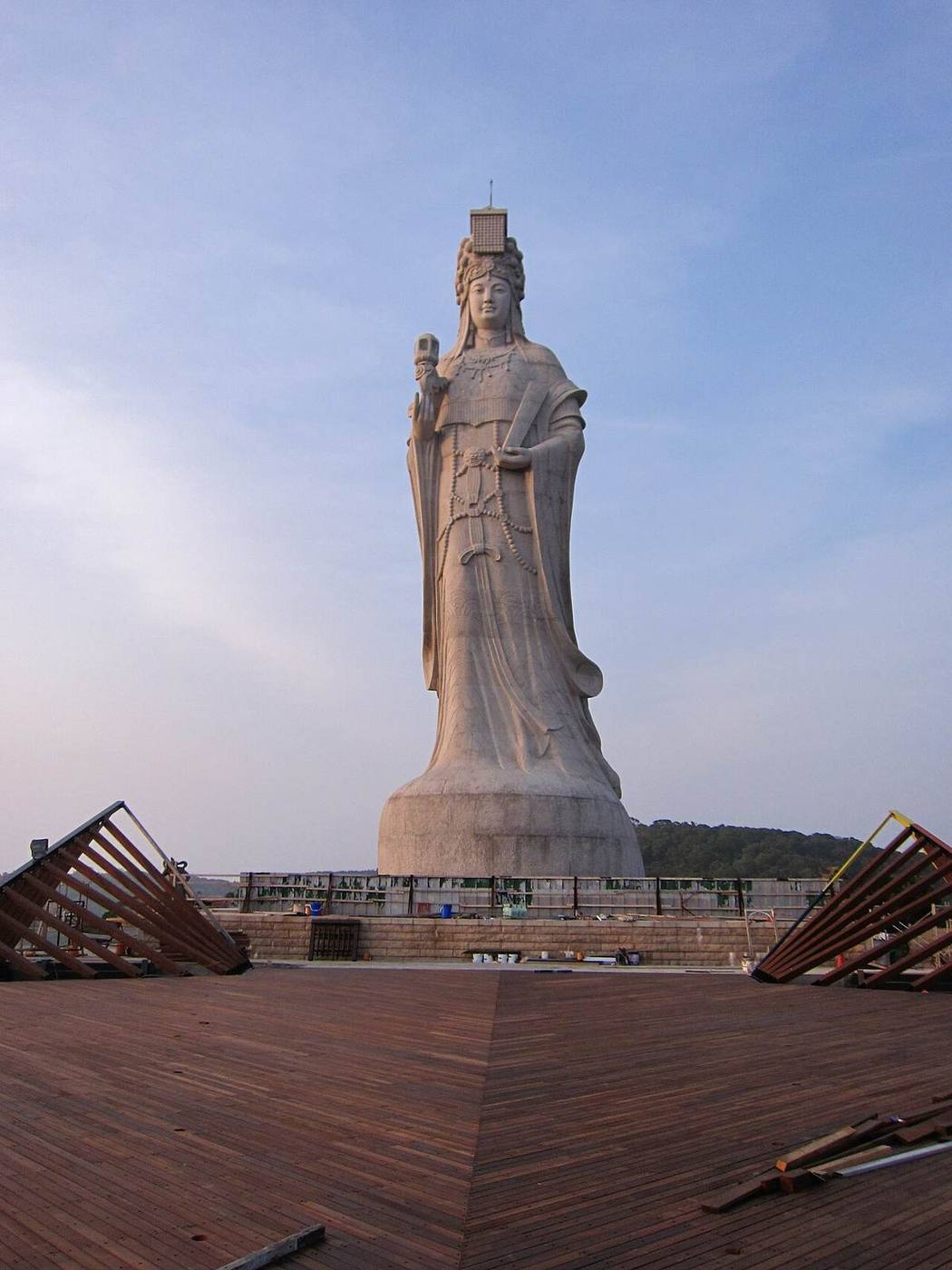
Look at her robe and crown. Emperors named her Tianhou, Empress of Heaven, and dressed her in a red robe beneath a phoenix crown hung with bead curtains. Those beads hang across her eyes like an emperor's veil. They remind a watcher to screen out haste before speaking.
In her hands rests a flat jade tablet called a hu, or a curved ruyi scepter. Court officers held the tablet upright to track duty. On a sea altar, that stone piece anchors upright balance inside a rolling world.
Behind her myth stands the wooden loom. A loom draws threads across tight warp lines until cloth resists wind. Navigation works the same way. Tide, wind, and star join one tight weave.
Thousand-Mile Eye and Wind-Following Ear
Mazu stands flanked by two tall aides with fierce faces who form one circuit with her.
On one side stands Qianliyan, Thousand-Mile Eye, shading his brow to scan distant swells. On the other side stands Shunfeng'er, Wind-Following Ear, cupping one ear toward the breeze to catch faint warnings miles away.
Folk tales say these two began as wild spirits on Peach Blossom Mountain who demanded Moniang as a bride. She beat them in combat and turned their gifts into loyal service. Look at how all three work as one receiver. Sight reaches far across flat water. Hearing catches wind shifts behind clouds before eyes spot rain. Mazu sits at center and weighs both reports before turning the helm.
Far sight without a calm center breeds alarm. Listening to every wind rumor without sight breeds panic. Eye, ear, and still center turn raw weather into safe passage.
Where Mazu steers in the sky
Mazu belongs to living Chinese and Southeast Asian sea worship, not to star tables. Traditional Chinese navigators watched Polaris, the Big Dipper, the twenty-eight lunar mansions, and the twelve-year cycle of Jupiter. Modern Western astrology added Neptune in 1846 to describe sea fog, deep water, and subtle currents. In a modern Western chart, a few placements echo Mazu's calm seamanship.
Look first at the Moon and Neptune together. The Moon rules tides and home ports, while Neptune reflects sea mist and subtle signals. When they meet by conjunction, trine, or square, you often sense weather shifts early and learn not to lose your bearings in passing waves.
Look next at Venus in water signs or in the ninth and twelfth houses. Venus seeks safe harbor. In the ninth house it watches far coasts. In the twelfth house it listens inside stillness like Moniang at her loom.
Look last at Polaris in Ursa Minor and the North Node. Sailors fixed Polaris above the mast before glass dials existed. In a modern Western chart, the North Node points toward open water ahead, inviting trust in your inner compass when the old shore fades.
Trimming the harbor lantern before a voyage
Honor Mazu with respect for coastal temples that light incense before her each dawn. Call on her before long travel, when fog hides your road, or when loud voices pull your focus in two directions.
Come at dusk or before dawn, when wind shifts and rooms grow still. Set a small red paper lantern or one red candle beside the doorway or on a table near the threshold.
Stand with your knees unlocked and your stance shoulder-wide, as if balancing on a wooden deck over calm swells. Rest your hands lightly at your sides or on a chair back as if touching a loom beam.
Begin with Shunfeng'er, the listening ear. Shut your eyes for three slow breaths and hear distant sounds outside without fighting them. Let noise pass through without hooking your mind.
Next open your eyes partway and rest your gaze on the red lantern glow, stepping into Qianliyan, the far eye. Name the single crossing before you in one plain sentence. Refuse to split your mind across three chores. Follow the Hathors' compass rule: steer by the calm pull inside your chest.
Finish gently before stepping out the door. Snuff the candle without blowing across it, or hang the small red paper lantern back on its hook beside the doorframe. Thank Tianhou silently for clear bearings, pick up your bag, and cross the threshold with undivided attention.
Questions people ask about Mazu
Who is Mazu in Chinese tradition?
Mazu is the Chinese sea goddess and protector of sailors, fishers, and travelers. Born Lin Moniang in tenth-century Fujian, she is revered across China, Taiwan, and Southeast Asian ports as Empress of Heaven.
Why was Mazu called the Silent Girl?
Coastal legend says Lin Moniang did not cry once during her first month after birth. Her parents named her Moniang, meaning Silent Girl, matching her calm poise while reading storms.
Who are Qianliyan and Shunfeng'er beside Mazu?
Qianliyan means Thousand-Mile Eye and Shunfeng'er means Wind-Following Ear. Legend says Mazu tamed these two spirits at Peach Blossom Mountain so they could guard travelers by spotting hazards and hearing distant wind warnings.
Why did Mazu drop her father in the loom legend?
While weaving at home, Moniang sent her spirit into a typhoon to save her father and brothers. When her mother woke her aloud, Moniang opened her mouth to answer and lost her grip on her father, showing how split focus breaks rescue work.
How do devotees honor Mazu respectfully today?
People visit harbor temples to offer fruit, tea, and incense, especially on the twenty-third day of the third lunar month. Sitting at home with a red candle, calm breath, and focused intent honors her spirit simply.
The lantern above the strait
Mazu is the beacon on dark water, the undivided mind that keeps one true course through fog and wind.