Along the yellow loess banks of the Yellow River, wet clay holds crane tracks beside a wooden set-square and a two-legged compass. Morning light catches the brass hinge of the compass and the crisp ninety-degree corner of the square resting side by side on a flat river stone.
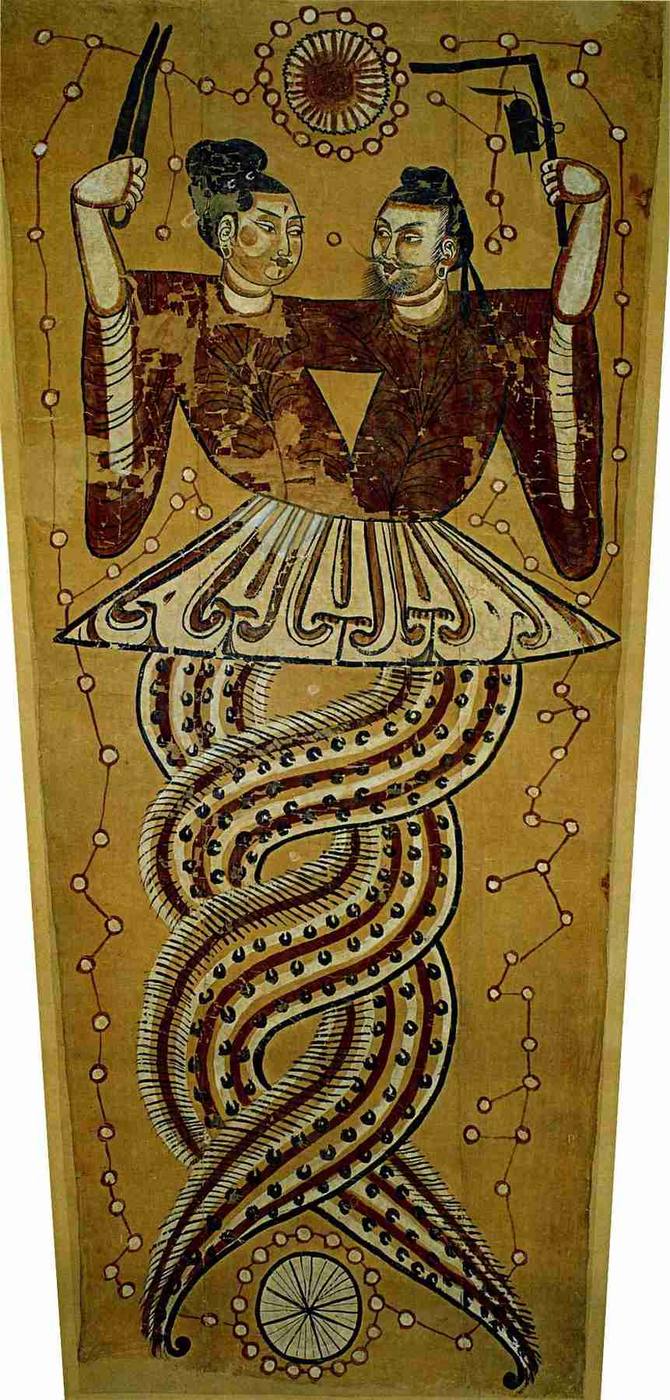
On silk banners found in ancient tombs along the Silk Road, two figures stand side by side beneath the sun and moon. Their upper bodies are human, and their lower tails twist together like serpents in a rising braid. These are Nuwa and Fuxi, the founding ancestors of Chinese cosmology.
Fuxi lifts a carpenter's square to mark straight edges upon the earth. Nuwa lifts a compass to trace the round paths of heaven. Together they form a dual intelligence of creation and repair. Their braided tails and twin tools map how opposites build life and patch a torn world.
Why life builds itself in pairs
Nature rarely builds out of one lone strand. Even a magnet refuses to carry a north pole without a south pole at its back. In Chinese cosmology, yin and yang weave together so stillness gives motion its edge and curved water finds form along straight banks.
Look at the twin strands of human DNA beside those Silk Road tomb banners. Two spiraling chains wind around one central axis, parting and pairing again so life keeps reproducing its pattern. China painted that twin braid in stone and silk two thousand years before microscopes saw a cell.
In a Kryon talk from 2018, Lee Carroll extends that double helix into consciousness. He describes a hidden twenty-fourth pair inside human DNA that acts as a bridge to wider awareness. In News About DNA Changes, Anne Tucker describes subtle shifts in human DNA that open fresh perception.
The clay people and the broken pillar
This is the story told in the Han books Huainanzi and Liezi, and painted on the Astana banners of Turpan.
In the first age of the world, Fuxi walked along the Yellow River and studied the tracks of birds, the veins of wood, and the markings on a tortoise shell. From those lines he drew the eight trigrams of the Bagua, three broken or solid bars stacked in pairs. He knotted cords into fishing nets, shaped the first stringed lute, and gave humanity the square for building houses.
Beside him walked Nuwa. She knelt beside a muddy bank and scooped up yellow clay from the river. With her fingers she molded the first mortals, laughing as they stood up and danced in the sun. When her hands grew tired, she dipped a braided rope into the clay and flicked droplets across the earth, raising cities of people in an afternoon.
Years later, peace broke. The fierce water giant Gonggong fought for the throne of heaven and lost. In blind rage he smashed his head against Mount Buzhou, the pillar holding up the northwest corner of the sky.
The mountain snapped. Heaven tilted downward to the northwest, and Earth sank toward the southeast. Great holes opened above the clouds. Floodwaters poured across the plains, wild fire ran through the forests, and beasts came out of the hills to hunt.
Nuwa did not try to turn time backward. She gathered stones of five colors from riverbeds and built a fire of reeds to melt them into molten glass. With that bright paste she patched the torn vault of heaven. She cut the four legs from a giant sea tortoise and planted them at the four corners of Earth to brace the sky. She burned mountains of reeds and piled their ash to dam the flood.
The roof held, though one corner stayed tilted. That is why, the elders said, the Sun and stars still wheel toward the northwest, while every river in China runs southeast toward the sea.
Square beside compass and the seam of five-colored stone
Look closely at the square, the compass, and the five-colored stones. Two laws stand clear.
First, straight measure and curved rhythm need each other. A carpenter's square without a compass builds rigid cages that crack under storm. A compass without a square spins in endless circles that never lay a brick. Fuxi measures the frame, while Nuwa shapes the curve.
Second, real repair never pretends the break never happened. Nuwa did not swap the torn sky for a factory lid. She melted five distinct stones into the crack, leaving a seam stronger than the original wall. Even after repair, the rivers still lean southeast. Wholeness keeps its slope and works with it.
Reading the silk banner as a tool
Stand before the Tang painting from Astana and read it from top to bottom. From sun to moon, the painting maps one shared design.
Above their heads shines a yellow disk of the Sun, stitched with stars around its edge. Beneath their tails sits a pale Moon, linked by the same sky thread. Between sun and moon rise Nuwa and Fuxi, holding the sky open like twin pillars.
In Fuxi's hand sits the carpenter's square, called ju. It holds a crisp right angle of ninety degrees, the emblem of Earth, logic, and true measure. In Nuwa's hand sits the compass, called gui. Its two legs swing in a circle, the emblem of Heaven, orbit, and return.
Below their waists, their serpent tails twine over and under each other in even loops. Look at a drawing of the DNA double helix beside that Tang banner. Two opposite strands cross, part, and weave back together around one invisible axis.
And in Nuwa's myth, the five-colored stones match the Five Phases of Wood, Fire, Earth, Metal, and Water. When a system breaks, you do not patch it with one element alone. You melt all five back into one weave.
Nuwa and Fuxi in Chinese sky keeping and Western charts
Nuwa and Fuxi belong to Chinese ancestor lore and classical sky keeping, which tracks time by the Twenty-Eight Lunar Mansions, the Twelve Earthly Branches, and the Bagua trigrams. Matching them with modern Western birth-chart planets such as Uranus or Chiron is a contemporary symbolic comparison, never part of Han or Tang astronomy.
Across a Western chart, their twin motion appears in natural pairs. The Sun acts like Fuxi's square, setting aim, form, and daytime clarity, while the Moon acts like Nuwa's compass, weaving tides, memory, and monthly return. Where Sun and Moon meet in aspect, structure and rhythm learn to share one house.
Saturn lays the bricks and holds the right angle, while Uranus strikes like Mount Buzhou cracking, breaking cramped pillars so new air enters. Chiron marks a place where an old fracture gets mended with five-colored stone instead of hidden away, and the North and South Nodes twist across the chart like the braided tails on the silk banner.
Laying square and circle on morning paper
Meet Nuwa and Fuxi with respect for the Chinese temples and folk lore that remember them. Turn to them when a plan feels too rigid to breathe, when a craft project lacks form, or when something in your life cracked and needs repair.
Sit at a wooden table in morning daylight. Place a blank sheet of paper, a pen, a straight ruler, and one round coin or small compass before you.
First draw a crisp square corner with the ruler and pen, honoring Fuxi and the carpenter's square. Next trace around the coin or swing the compass beside it so the circle touches the corner, honoring Nuwa and Heaven's orbit.
Look at both shapes together. Name one place where your days need Fuxi's straight measure. Then name one place where your days need Nuwa's curved mercy and room to bend.
If something broke recently, picture five colored stones melting gently over the seam. Do not demand that the past look untouched. Ask what new shape can stand upon the tilted floor.
Finish the work by folding the paper once down the middle so the square and circle meet face to face. Lay the straight ruler and the compass or coin flat side by side on the wooden table, breathe out once slowly, and return the tools to their place.
Questions about Nuwa and Fuxi
Who are Nuwa and Fuxi in Chinese mythology?
Nuwa and Fuxi are primordial creator deities in Chinese myth. Fuxi invented the eight trigrams, nets, and measure, while Nuwa shaped humanity from yellow river clay and mended the torn sky.
Why are Nuwa and Fuxi shown with braided tails?
Han carvings and Tang silk banners depict them with human torsos and intertwined serpent tails to show complementary opposites weaving new life together.
What do the compass and square in their hands mean?
Fuxi holds the carpenter's square, ju, representing Earth, structure, and clear measure. Nuwa holds the compass, gui, representing Heaven, cycles, and curved motion.
Why did Nuwa melt five-colored stones?
When the giant Gonggong smashed Mount Buzhou and tore the sky, Nuwa melted stones of five colors to patch the vault and used giant tortoise legs to brace the four corners of Earth.
How can someone work with Nuwa and Fuxi today?
Pair straight planning with flexible rhythm on paper by drawing a square touching a circle. Finish by folding the page so both shapes meet and laying your ruler and compass flat beside one another on the table.
The braid of square and circle
Nuwa and Fuxi are the twin weave of creation, the measure and the mercy that mend a tilted sky.