High on Flower-Fruit Mountain, white spray from a curtain waterfall wets a lone pillar of ancient stone above the eastern sea. Across a sudden crack down the rock face, a stone egg splits open under salt wind and morning sun.
Chinese shrines and Ming scripture call the monkey who leaps out Sun Wukong, Awakened to Emptiness. Revered across Fujian, Taiwan, and Southeast Asia as Qitian Dasheng, Great Sage Equal of Heaven, and in Buddhist lore as Victorious Fighting Buddha, he leads the action in Journey to the West. Old teachers named him xinyuan, the Monkey of the Mind. His stone birth, his shrinking iron staff, his mountain prison, and his vanishing gold hoop trace how scattered wit grows into clear, fearless service.
Emptiness, clarity and the restless mind
Machines roll along smooth tracks from one inch to the next. Restless human thought jumps differently. It leaps from worry to pride, from plan to boredom, never resting long enough to see where it stands.
In Buddhist teaching, sage Nagarjuna showed that solid things are patterns of relation, never isolated blocks. Buddhism calls that truth emptiness. That emptiness is no dead void. It is open potential once old ego habits drop away. Noisy mental chatter, often called the monkey mind, hides that openness behind constant speed.
Consciousness teachings point directly to that chatter. Tom Kenyon writes in Personal Perspective about struggling to rise above petty, selfish monkey minds. Anne Tucker speaks plainly in her shift talks about how a busy head loops from fear to fear until slow breath releases the monkey mind into unified mind. Sun Wukong wears the crown of that speed. Nothing in heaven or earth stops him until he meets a weight greater than cleverness.
From stone egg to the Buddha's palm
This is the tale told in Wu Cheng'en's Journey to the West and kept in folk temples.
Atop Flower-Fruit Mountain stood an immortal stone shaped by heaven and earth. One day it split and left a stone egg. Sea wind struck the egg and turned it into a stone monkey who bowed to the four quarters while gold beams flashed from his eyes.
He led the mountain troop behind a waterfall, ruled as Handsome Monkey King, and soon wept because kings still grow old and die. He rafted across the sea and bowed to Daoist master Subhuti. Subhuti gave him the name Wukong, Awakened to Emptiness, and taught him seventy-two transformations plus a somersault cloud that jumped one hundred eight thousand miles at a bound.
Armed with power, Wukong marched down into the Eastern Sea. From Dragon King Ao Guang he took the sea-measuring iron pillar, a beam heavy enough to pin ocean tides, and shrank it to a needle tucked behind his ear. Next he entered the underworld and crossed every monkey's name out of the Book of Life and Death.
Heaven offered him minor posts to keep him busy, first tending horses and then guarding the Peaches of Immortality. Left off the guest list for the Queen Mother's banquet, Wukong ate the immortal peaches, drank the wine, swallowed Laozi's pills, and wrecked the feast. Calling himself Great Sage Equal of Heaven, he fought heaven's armies to a draw.
At last the Jade Emperor called the Buddha. The Buddha held out his right palm and made a wager. If Monkey could jump off his hand, Heaven's throne was his.
Wukong laughed, mounted his cloud, and somersaulted across cosmic space until five pink pillars rose at the sky's edge. He scratched his name on the middle pillar, wet its base, and flipped proudly back to the Buddha. The Buddha opened his palm and showed Monkey's writing inked on his middle finger.
At once, before Wukong could spring again, the Buddha turned his hand down and dropped five peaks upon him as Five Elements Mountain. For five hundred years the rebel lay pinned under earth, iron pellets, and copper juice, with only his head and hands free.
Five centuries later, Guanyin brought the monk Tang Sanzang past the cliff. Wukong vowed to guard the monk west for Buddhist scriptures, and Sanzang peeled the seal off the summit. To check Monkey's rage, Guanyin placed a gold hoop around Wukong's brow that squeezed tight whenever the monk chanted a spell. Across eighty-one trials, Wukong fought demons, bore false blame, and learned loyalty. At the Western Heaven, after receiving the scriptures, he felt his head and found the hoop gone by itself. Heaven named him Victorious Fighting Buddha.
Vain flight and the hoop that moves inside the bone
Look closely at the wager on the Buddha's palm and the mountain years. Two rules stand out.
First, raw speed without wisdom traps itself inside what it thinks it fled. In his essay on yogic powers called siddhis, Tom Kenyon tells of a young yogi who gained sudden gifts and halted rain for his own comfort during a concert. An elder raised his staff and warned him that selfish power breeds heavy karmic debt. The young man prayed for his gifts to leave, and they returned years later only after pride cooled. Wukong's seventy-two shifts worked the same way. Power chased for vanity built the mountain that pinned him.
Second, discipline begins outside and finishes inside. Early on, Wukong hated the gold hoop and tried to pry it off with steel claws. Without it, his wrath struck before thought checked it. After fourteen years beside a mortal monk, restraint moved from metal into bone. Once conscience steers the will from within, outer chains drop off on their own.
Staff, cloud, transformations and the hoop
Look at a statue of Qitian Dasheng on a shrine. His iron bar, cloud, and gold ring mark distinct stages of trained attention.
First is Ruyi Jingu Bang, the Compliant Golden-Hooped Staff. Yu the Great forged it to gauge ocean depth. In Wukong's hand, the iron bar obeys intent, growing to prop the sky or shrinking to sit behind his ear like a needle. Attention works the same way. Scattered across chatter, thought loses weight. Gathered to one point, it moves mountains.
Next are the seventy-two transformations and three saving hairs on his neck. Transformations show agile thought shifting shape without clinging to one mask. Yet agility without truth turns into trickery. Only when Wukong fights a rival wearing his exact face, the Six-Eared Macaque, does he learn that cleverness cannot outwit itself.
The somersault cloud shows intellect's speed, crossing seas before one breath finishes. Five Elements Mountain stands for Wu Xing, the five phases of wood, fire, earth, metal, and water. When wild air denies earthly limits, matter locks around it until pride turns to patience.
Last comes the gold hoop, Guanyin's silent tool. It is no yoke for a slave. It is the sharp border of conscience that squeezes whenever bright wit turns cruel.
Four pilgrims along one road
Journey to the West builds one working circuit out of five travelers on the same dust road.
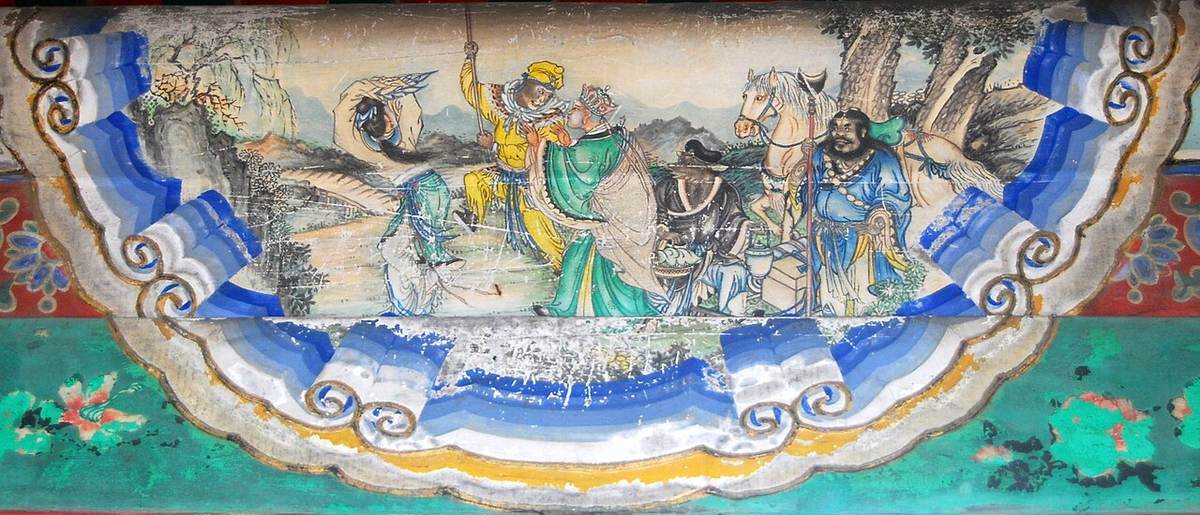
Tang Sanzang walks at center as moral aim, frail in flesh yet firm in direction. Beside him strides Sun Wukong as swift mind, scouting miles ahead yet prone to pride. Behind walks Zhu Bajie, Pigsy, carrying raw appetite and earthy humor. Sha Wujing carries the luggage pole as calm endurance across wide rivers. Beneath Sanzang walks the White Dragon Horse, tamed will carrying the quest day after day.
Mind without aim chases its own tail. Aim without mind falls to the first demon on the trail. Endurance and plain appetite keep both grounded until the west is reached.
Sun Wukong between Five Phases and outer planets
Sun Wukong belongs to Chinese lore and living temples, where sky time turns by the Twenty-Eight Lunar Mansions, the Twelve Earthly Branches, and the Five Phases mirrored in Five Elements Mountain. Linking him to modern Western planets like Uranus is a contemporary symbolic comparison, not traditional Chinese astronomy.
In a modern birth chart, Mercury and Uranus mirror his restless speed. Mercury governs quick speech and tricks, while Uranus marks sudden leaps and sparks that shatter stale rules. When they touch by conjunction, square, or trine, thought flies like a somersault cloud and chafes at slow routine.
Mars and Saturn carry the weight of his training. Mars fires Wukong's staff and grit, while Saturn reflects Five Elements Mountain and the gold hoop, reminding swift wit that timing needs structure. Gemini, Aquarius, and Aries placements, or the third and eleventh houses, often mirror lively curiosity and fierce independence.
Settling the Mind Monkey at the morning table
Approach Great Sage Wukong with respect for temples where families pray for courage and focus. Turn to him when thoughts jump like trapped monkeys, when clever plans spin in loops, or when rebellion needs direction.
Come in early morning, when wind stirs trees outside. Place a cup of spring water or tea beside a small smooth stone on your desk.
Sit tall with your spine straight and both feet on the ground. Touch the center of your brow lightly with one finger, remembering the gold hoop that falls away once your aim is true.
Take three slow breaths down into the belly, following Anne Tucker's counsel to let breath turn monkey mind into unified mind. Name one real task before you today in plain words. Picture spare worries shrinking down like the iron staff until they rest behind your ear as one bright spark of focus.
Do not force silence with anger. Hold that single aim for ten slow breaths while your chest stays wide and loose.
When you finish, set the smooth stone beside your cup and picture any tight ring around your forehead dissolving into open daylight. Step away from noisy screens and ringing phones into a full minute of open stillness. Thank Great Sage Wukong silently, then begin your single chosen task without scattering your mind.
Questions people ask about Sun Wukong
Who is Sun Wukong in Chinese tradition?
Sun Wukong, the Monkey King, is the trickster hero of Journey to the West and a folk deity honored as Qitian Dasheng across Fujian, Taiwan, and Southeast Asia. He stands for a restless mind refined into wisdom.
What does the name Sun Wukong mean?
His religious name Wukong means Awakened to Emptiness. Given by Daoist master Subhuti, it names a mind freed from fixed illusions, able to act swiftly without clinging to pride.
Why was Sun Wukong trapped under Five Elements Mountain?
After wrecking Heaven's banquet, Wukong bet he could leap off the Buddha's palm and mistook five fingers for sky pillars. The Buddha pinned him under Five Elements Mountain for five hundred years so raw pride could turn to patience.
What is the meaning of Sun Wukong's staff and golden hoop?
His iron staff shrinks to a needle or props the sky, showing how attention gathers or expands force. The gold hoop placed by Guanyin stands for inner restraint, vanishing once discipline turns natural.
How can someone connect with Sun Wukong respectfully today?
Shrines offer fruit, tea, and incense to Qitian Dasheng for focus and courage. Sitting tall in the morning with slow breath, naming one true task, and stepping away from noisy screens into stillness honors his path of tamed wit.
The hoop that disappeared
Sun Wukong is the swift mind that outgrows empty pride, bears weight without bitterness, and wakes free at the end of the trail.