At dawn in an old courtyard temple, three slow strikes of the audience drum roll across stone eaves as incense smoke climbs toward the painted rafters. Clerks unroll silk ledgers along wooden benches while the ruler waits behind hanging jade beads, listening before speaking a single word.
Across Chinese temples and home altars, the ruler of Heaven sits in dragon robes behind strings of hanging jade. His formal title is Yuhuang Dadi, the Jade Emperor. Families call him Tiangong, Grandfather Heaven, and honor him on the ninth morning of the New Year.
He is the high administrator of Daoist and folk cosmology. He does not snatch a throne by slaughter or rule through sudden rage. His stone name and his court dress form an instrument built to measure power by restraint, open delegation, and long service.
Living order against dead rule
When people hear the words heavenly bureaucracy, they picture paper stacks and cold delays. Yet living systems organize themselves through layered coordination every second. A forest moves water from root fungi to canopy leaf without a dictator shouting orders.
Chinese philosophy drew a sharp line between mechanical stamp-work and living order, which thinkers called li. Dead rules treat people like identical pieces to be sorted into boxes. Living order weaves sky, earth, and village together like grain inside wood. The I Ching states the rule plainly: when upper and lower unite, every household thrives, and when they stop listening to each other, states fall to ruin.
Maia Nartoomid speaks of cosmic mandate in a similar key. True mandate is written into matter itself. It calls any rule that drifts out of alignment back to truth.
Anne Tucker touches the same shift in her talk with astrologer Pam Gregory. Elitist rulers sometimes hide inside a golden palace and forget the ground below. When that happens, she notes, cycles like Pluto in Aquarius topple the throne so power returns to ordinary hands.
The Jade Emperor is China's picture of what happens when the high seat remembers the ground.
The prince who gave away his palace
The Daoist scripture known as the Yuhuang Benxing Jijing, told beside temple murals from Shanxi to Fujian, preserves the story of how this ruler earned his seat.
Long ago, in a realm called the Kingdom of Wondrous Joy, King Jingde and Queen Baoyue grew old with no heir to keep the land. Night after night they burned incense and asked Heaven for a son. At last Queen Baoyue dreamed of Taishang Laojun riding a dragon and holding an infant in his arms. She woke carrying the child who would become Yuhuang.
As a boy, the prince walked through town gates and saw famine and sorrow in the lanes. When the old king died and the crown passed to the young man, he ruled for only a brief season. He threw open the royal granaries and gave away the silver and silk of the palace until no household in Wondrous Joy went hungry.
Then he stepped down from the throne. He left the capital and walked alone into deep mountains, building a hut beside stone springs. There he sat in stillness and practiced patience across thousands of cosmic ages. He healed beasts and guided lost travelers without asking for a title.
Only after those long ages of service did the high powers call him upward to Lingxiao Hall, the Palace of Mist at the zenith of heaven. From that seat beside the Queen Mother of the West, he took charge of the ministries of rain, thunder, hearth, and city walls.
Even there, Chinese storytellers kept him humble. In the Ming tale Journey to the West, the wild monkey Sun Wukong crashed the Peach Banquet and wrecked the celestial hall when Heaven's clerks snubbed his name. No ledger could bind him until the Buddha stepped in. The story reminded the court that order dies when clerks care more for rank than for life.
Open storehouses and the throne that hears the stove
The prince's mountain years and the monkey's raid point to two rules of true stewardship.
First, lasting authority begins by giving away the crown. A ruler who clings to a hoard fears every rival at the gate. One who opens the storehouse and walks into the hills builds a strength no rebel can rob.
Second, upper office fails the moment it forgets the floor below. Jade stays translucent only while light passes through it. When ministers inside a golden hall stop hearing the Kitchen God's report from the stove and the City God's news from the street, Heaven's mandate cracks from within.
Reading the crown and tablet as a tool
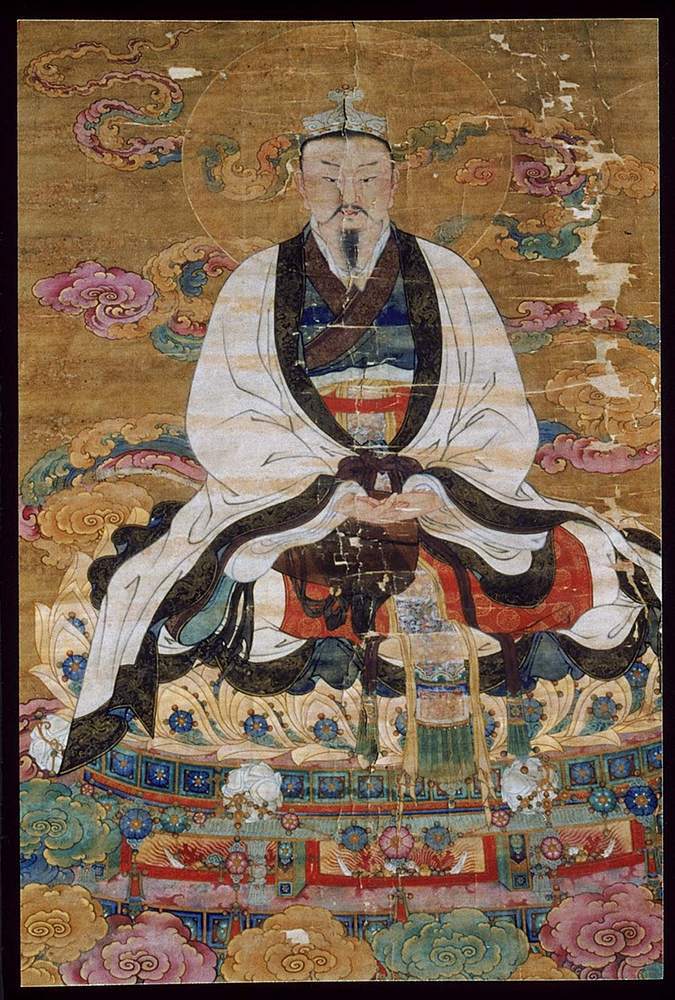
Look closely at the Jade Emperor in the Yuan murals of Yongle Palace or on a temple altar. Each item of court dress serves a clear practical task.
Start with the stone in his name. True jade is born deep beneath mountains under fierce pressure and slow heat. Unlike brittle glass or flash gold, jade feels warm against skin and refuses to shatter under a blow. Power tempered like jade bends stress without snapping into cruelty.
Look next at his flat mortarboard crown, called the mianguan. Twelve strings of jade beads, called mianliu, hang from its front rim across his eyes. A mortal judge stares nakedly and reacts to the first flaw he spots. The bead curtain veils rash glare. It forces the emperor to hear the whole case before his gaze settles.
Against his chest he holds a flat tablet of jade, the hu, pressed upright with both hands. Ministers carried the hu to record decrees before the throne. Held at the heart by the emperor himself, it reminds the highest seat that law binds the ruler before it binds the street.
Around him stretch silk robes stitched with coiled dragons. Beside his court sit the Kitchen God who watches daily meals and the Queen Mother who keeps the orchard of long life. Together they link the roof beam of the cosmos to the smoke rising from a clay stove.
The Jade Emperor and the birth chart
The Jade Emperor belongs to Daoist liturgy and Chinese sky lore. There he reigns over the central enclosure around Polaris while calendars track the twenty-eight lunar mansions and the twelve-year cycle of Jupiter. He does not belong to modern Western horoscopes that include outer planets like Uranus, Neptune, and Pluto.
Still, a modern Western chart uses a few classical pillars that echo his patient stewardship.
Look first at Jupiter and Saturn together. Jupiter rules law, broad vision, and the generous storehouse that feeds a realm. Saturn rules office, endurance, and the slow mountain years that temper stone into jade. Where Jupiter and Saturn meet or trade signs, a person often learns to hold authority without vanity.
Look next at the Sun and the tenth house when a birth time is known. The tenth house marks public duty, office, and what stands visible at noon. Placements there test whether rank serves the village or hides behind high walls.
In Chinese sky lore, the Jade Emperor reigns over the central enclosure around Polaris. There he keeps the weather of the four seasons in step with the throne.
Taking counsel at the Jade Emperor's morning court
Meet the Jade Emperor with respect for the Daoist temples and family altars that honor him. Turn to him when you carry heavy duty, lead a project, or need fair judgment under pressure.
Come in the early morning, when the air is clear, or on the ninth day of the New Year if you keep that calendar. Set a small notebook or ledger, a pen, and one smooth stone on a wooden table before you.
Stand tall behind your table or sit squarely on a straight-backed stool, weight balanced evenly through both heels. Press your palms together, fingers pointing upward against your breastbone. This mirrors the jade tablet held before the heart.
Let your eyelids soften halfway down, as though looking through hanging beads instead of staring in haste. Breathe slowly through the nose for five counts, then breathe out for five counts. Recall the I Ching rule: upper and lower must meet before order holds.
Name one duty or decision sitting in your hands today. Ask silently what action feeds the household instead of feeding pride. Wait three slow breaths without forcing an answer. Let rash heat drop away until one fair step stands clear.
Mark the end of the morning council with care. Write that single fair step inside your ledger, fold the cover shut, and set the book flat on the wooden table. Lower your hands from your chest, bow once toward the table, and go tend your work.
Questions about the Jade Emperor
Who is the Jade Emperor in Chinese tradition?
Yuhuang Dadi, the Jade Emperor, is the high ruler of Heaven in Daoist liturgy and Chinese folk religion. Families honor him as Tiangong, Grandfather Heaven, the keeper of cosmic order and justice.
How did the Jade Emperor earn his throne?
According to the Yuhuang Benxing Jijing, he was a prince of the Kingdom of Wondrous Joy who gave away the royal treasure to feed his people. He practiced stillness in the mountains for ages before ascending to Heaven.
Why do beads hang across the Jade Emperor's eyes?
His imperial crown carries strings of jade beads called mianliu in front of the eyes. They remind any holder of authority to veil hasty judgment and listen patiently before acting.
What is the flat tablet he holds to his chest?
The narrow tablet is called a hu. Held upright before the heart, it stands for inward accountability and faithful record keeping under Heaven's mandate.
How can someone honor the Jade Emperor respectfully?
Offer plain tea or fruit in the morning, hold upright posture with palms pressed before the chest, and weigh one duty fairly. Finish by writing your chosen action in a notebook and folding the cover shut.
The stone tempered by time
The Jade Emperor is the veil of jade before the eye, the power that opened its storehouse before taking its seat.