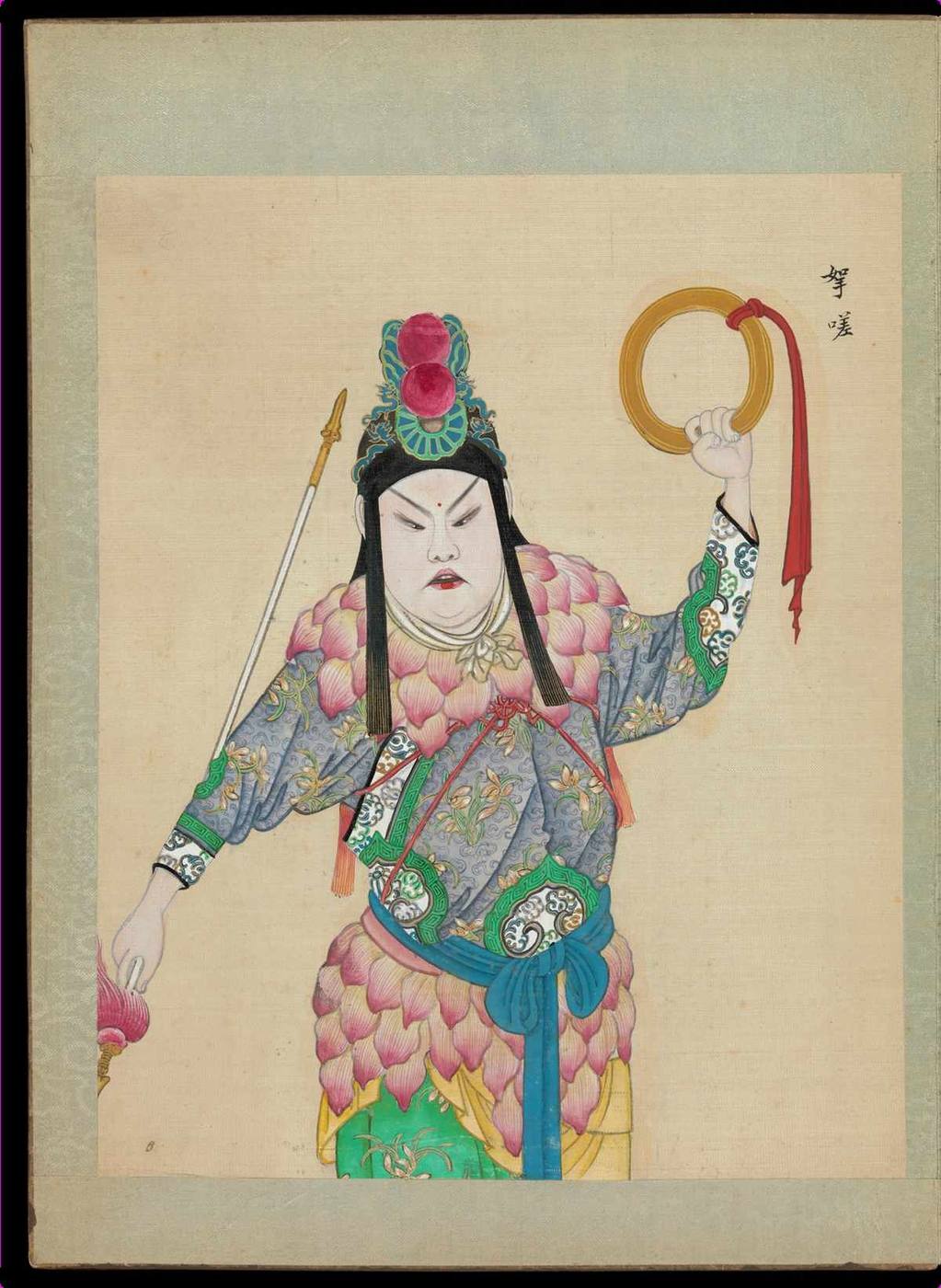
By the swift river below Chentang Pass, two bronze wheels rimmed with wind and fire hiss where sparks meet shallow water. A boy stands between them on the gravel bank, knotting a crimson silk sash across his chest while mountain mist lifts from the reeds.
Daoist altars and Chinese folk temples call that boy Nezha, the Third Lotus Prince. Known as San Taizi and Marshal of the Central Altar, he rides spinning Wind-Fire Wheels with the Red Armillary Sash flying behind his shoulders. Investiture of the Gods tells how he carved away borrowed bone and rose fresh from lotus stems. His story shows how consciousness breaks stagnant debt and builds a new vessel through motion.
Why spinning form stays alive through flow
Stone objects last by locking every piece in place. Shut a rock in a box and it sits unchanged for ages. Living currents work the opposite way. A river eddy holds a clear shape only while water streams through it. Stop the current, and the funnel vanishes in one breath.
Consciousness teachings describe that same wakeful spark. The Law of One records, in Session 78, describe the dark ground of spirit as primeval night until struck by lightning. That sudden flash wakes stalled potential into motion.
Daoist inner craft traces a similar flash along the body's channels when old knots give way and breath moves freely again. Nezha carries that live charge in Chinese lore, joining water and fire in one boy.
The flesh orb at Chentang Pass
This is the story told in Investiture of the Gods and kept across Daoist shrines.
Commander Li Jing guarded Chentang Pass while his wife Lady Yin carried a child for over three years. When labor ended, she did not birth an infant. She delivered a round orb of flesh rolling across the floor.
Li Jing drew his sword in alarm and split the orb open. Out jumped a boy wearing a gold ring on his wrist and a silk sash across his chest. Before noon, master Taiyi Zhenren reached the gate, named the child Nezha, and claimed him as a student.
At age seven, summer heat drove Nezha down to the Eastern Sea to cool off. He dipped his crimson sash into the surf to rinse it. The magic cloth shook the ocean floor and rocked the crystal palace of Dragon King Ao Guang.
Ao Guang sent his third son, Prince Ao Bing, up to the beach to halt the boy. Tempers flared on the sand, and Nezha struck Ao Bing dead and pulled out his dragon sinew. Soon the four Dragon Kings stacked black storm clouds above Chentang Pass and threatened to drown the town unless Li Jing surrendered his son.
Li Jing backed away in fear, blaming Nezha for bringing ruin on their house. Refusing to let neighbors drown or hide behind a trembling father, Nezha drew a blade on the shore. He carved his own flesh back to his mother and broke his own bones back to his father. Stripped of borrowed body and blood debt, his spirit rose free above the sea.
Nezha's spirit drifted homeless until Taiyi Zhenren led him to a pond of sacred lotuses. The master snapped two lotus stalks for bones, folded three petals for a torso, and breathed life into the plant until Nezha stood whole again. Then Taiyi Zhenren set Wind-Fire Wheels beneath his feet and placed a Fire-Tipped Spear in his hand, sending the Third Lotus Prince back into the sky.
Returned bone and the wheel that balances in motion
Look at the shore scene beside the lotus pond. Two laws of rebirth stand out.
First, borrowed forms cannot carry a life that has outgrown its contract. While Nezha owed flesh and bone to Li Jing, his father could use filial duty to silence him before bullies. Giving back what he owed snapped that chain. Only an empty slate lets a new vessel grow.
Second, a spinning wheel holds balance only while moving. Stop a bicycle wheel, and gravity drops it flat on the road. Spin the wheel, and forward motion holds the frame upright. Nezha stands straight because his wheels keep turning.
Reading the lotus, the wheels and the red sash
Stand before a statue of Nezha in a temple hall. The flowers and weapons around his frame tell one story of active craft.
Look first at his lotus body. A lotus sinks its roots in dark mud, lifts a stem through murky water, and opens spotless petals in air. Tom Kenyon writes in his essays on mantras and the Lotus of the Heart that the lotus marks the heart center where agitation softens into open care. Made of lotus, Nezha grows inside fierce conflict without soaking up its rot.
Look down at his heels. Two Wind-Fire Wheels spin beneath his feet, one carrying wind and one carrying fire. Fire scatters upward unless wind aims it. Wind fades into thin air unless fire lifts it. Joined under his ankles, air feeds flame so motion carries him across clouds fast.
In one hand sits the Universe Ring, a heavy circle of gold. A ring marks cyclic return and measure, showing that wild speed still answers to form. Around his shoulders floats the Red Armillary Sash, soft silk strong enough to bind a dragon. Stiff iron snaps under shock, while silk wraps and absorbs force without breaking.
His other hand grips the Fire-Tipped Spear, aiming spinning energy through one sharp point. In battle forms he shows three heads and six arms, watching all sides of the sky while acting at once.
Father, master and rebel as one triangle
Nezha's story never ends in lonely revolt. Three figures form one circuit across his later chapters: Li Jing, Taiyi Zhenren, and Nezha.
Li Jing stands for rigid rule and ancestral fear of offending higher courts. After his rebirth, Nezha chased Li Jing across hills until a Buddhist teacher gave Li Jing a pagoda of gold. That small tower trapped Nezha in rings of fire whenever rage blinded him, forcing father and son to truce.
Taiyi Zhenren holds the third point as craft and cosmic measure. He never sides with cowardice, yet he knows raw fury without a sturdy frame burns out fast. Between fearful elders and reckless youth stands wise craft that turns fire into purpose.
Nezha, the Twenty-Eight Lunar Mansions and modern planets
Nezha belongs to Daoist altars and Chinese sky keeping. There, time turns through the Twenty-Eight Lunar Mansions, the Twelve Earthly Branches, and the Five Phases of water and fire. Connecting him to modern Western planets like Uranus and Pluto is a contemporary symbolic comparison. It is never part of classical Chinese temple astronomy.
In a modern chart, Mars and Uranus show a fierce pairing. Mars brings heat, courage, and the spear tip, while Uranus brings sudden sparks that crack old scripts open. When Mars meets Uranus by square or conjunction, stale rules snap and demand truth.
Pluto and the South Node mirror the shedding at Chentang Pass. Pluto points to stripping down to bone and rising from ashes, while the South Node marks old family debts that no longer fit the road ahead. Aries and Scorpio placements, or planets in the fourth house of roots, often match that call to cut free from stale form.
Greeting the Third Lotus Prince at midday
Approach Nezha with respect for temples that honor him as Marshal of the Central Altar. Turn to him when inherited rules trap your conscience, when courage flags before a needed break, or when old habits need swift air.
Come at dawn or high noon, when daylight moves fast. Set a bowl of clear water on a table with a strip of red silk or a lotus blossom beside it.
Stand upright with knees unlocked, or kneel tall if you prefer stillness. Lay one palm over your belly and one over the center of your chest, remembering Tom Kenyon's lotus opening at the heart.
Take three brisk breaths in through the nose and exhale sharply through the mouth, clearing heavy weight out of your ribs. Picture white lotus roots rising straight through dark water up along your spine until your crown feels light.
Name in one plain sentence the borrowed debt or stale rule you are returning today. Refuse anger for anger's sake. Feel the Wind-Fire Wheels turning smoothly beneath your soles, carrying you into fresh work without dragging old ash along.
When the moment finishes, let the spinning heat settle back into the room. Lift the red silk ribbon from the table and set it smoothly along a sunlit windowsill so the sash rests in open air. Drop your shoulders, thank San Taizi silently for courage, and leave the water bowl untouched until evening when you pour it out onto garden earth.
Questions people ask about Nezha
Who is Nezha in Chinese mythology?
Nezha, also called San Taizi or Third Lotus Prince, is a fierce protector deity in Daoist and Chinese folk tradition. He appears in Investiture of the Gods and Journey to the West as Marshal of the Central Altar.
Why was Nezha reborn from a lotus?
After clashing with the Dragon King's son, Nezha gave back his own flesh and bones to spare his town from flood and end unfair debt to his father. Master Taiyi Zhenren rebuilt his body from lotus stalks and petals because the lotus rises unmarked out of mud.
What are Nezha's main symbols and weapons?
His key emblems are the spinning Wind-Fire Wheels under his feet, the gold Universe Ring, the Red Armillary Sash, and the Fire-Tipped Spear. Together they stand for forward motion, cyclic measure, supple strength, and sharp aim.
How did Nezha and his father Li Jing reconcile?
After his lotus rebirth, Nezha pursued Li Jing until a Buddhist master gave the father a magic pagoda that could hold the youth in check. Forced into truce, father and son later fought side by side.
How can someone honor Nezha respectfully today?
Temples honor him on altars with incense, toys, candy, or red ribbons, especially in Taiwan and Fujian. A calm morning sitting with upright posture, clear breath, and setting a red silk sash on the sill honors his spirit of swift courage.
The wheel beneath the lotus
Nezha is the lightning flash that returns borrowed form, rises whole from mud, and holds balance through bold motion.