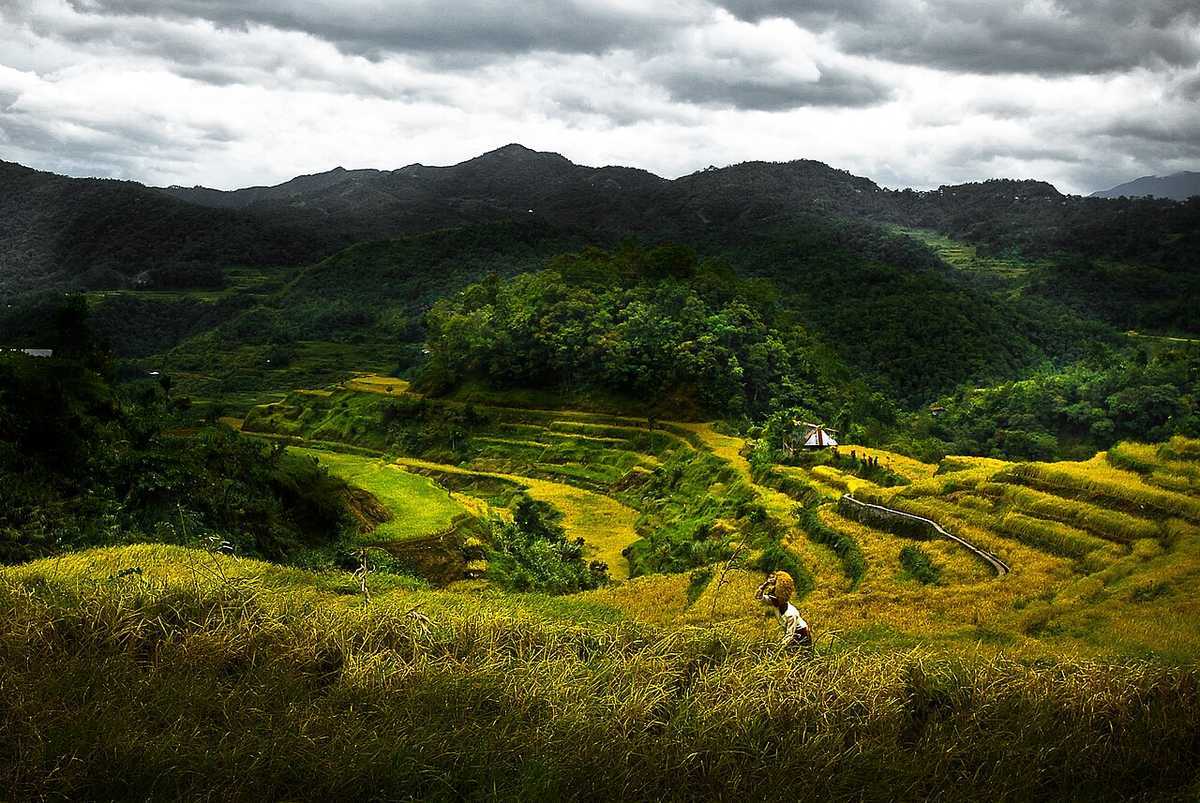
On a narrow stone rice dike in the Cordillera mountains, cold mist settles over flooded terraces carved like giant stairs into the cliff. Water trickles smoothly from pool to pool without wasting a single drop. Inside a nearby hut, a wooden loom clacks as morning light touches the woven cloth.
Ikapati and Idiyanale are the Tagalog deities of farming, plenty, and skilled labor. Ikapati, recorded in early colonial lexicons as Lakapati, is a dual-natured spirit of cultivated soil and full granaries. Idiyanale stands beside her partner Dimangan as guardian of patient craft and purposeful work. Together they reveal an ancient art of abundance built on care, water control, and balance between giving and receiving.
Living loops inside the stone terraces
A mountain rice terrace is a living exchange between forest, stone, and hand. Nothing on the slope survives by taking alone.
High on the Cordillera ridges, mossy forests catch monsoon clouds like a vast sponge. Rain seeps through leaf litter and feeds clear springs that run down into stone-walled paddies. Farmers protect those upper woods because stripping the ridge dries every channel below.
Hand-laid stone dikes slow gravity down. Instead of rushing mud straight into the sea, water pauses on each flat step, drops rich silt around rice roots, and cools the soil. What returns to the field in water and compost climbs back up in the harvest basket. Every wall was laid by hand across centuries so bare rock could feed families year after year.
The child lifted toward the rice field
This is the tradition recorded in early Tagalog dictionaries and village memory.
In 1613, priest Fray Pedro de San Buenaventura printed a Tagalog word book. He listed Lakapati, also called Ikapati, as guardian of tilled fields and full kitchens. He kept one plain fact later writers missed. People honored Lakapati as both male and female inside one body. Open earth and active seed sat together inside one spirit.
When planting started, farmers spilled no blood and laid down no fearful bribes. Instead of animal sacrifice, a parent walked out onto the paddy wall carrying a young child high in both arms before dropping rice seed into the wet mud. Looking over the open fields, they spoke a short prayer asking Lakapati to feed that child and keep hunger from the house.
Beside Lakapati stood Idiyanale, keeper of skilled handcraft, farm tools, and daily diligence, joined with Dimangan of good grain. Villagers knew blessing failed if dikes cracked or stored rice grew mold. Idiyanale watched the wood plow, the woven tray, and rock canal repairs before monsoon rains hit.
Grain returns to the hand that feeds the creek
Two plain rules sit inside Lakapati's prayer and Idiyanale's tools.
First, plenty needs active force and receptive earth inside one vessel. Many cultures split soil into passive mother and plow into harsh father. Lakapati refused that split. Tom Kenyon writes in his notes on Egyptian alchemy that old traditions called this union the Sacred Androgyne. Soil yields grain when open dirt and patient hand move as one.
Second, harvest mirrors how carefully you feed the loop. You cannot demand grain in October if you starved mountain creeks in April. Every seed, husk, and drop of water that returns to dirt climbs back up in the basket.
The dual nature, the lifted child and the wooden plow
The gestures and tools around Ikapati and Idiyanale bind home life directly to the land.
Lakapati's dual nature frees craft from rigid roles. Planting, weaving, mending stone walls, and tending children all belong to one survival craft. Nothing useful is beneath dignity.
Holding a child up to the field puts the smallest member of the house face to face with the mud that will feed them. It ties future life directly to present soil care. You do not poison a stream when your child drinks downstream.
Idiyanale's plow and stone terrace turn steep gravity into flat water steps. Water slows down, drops silt, and feeds roots instead of tearing the mountain down into the sea. Good craft never fights nature with brute speed. It shapes paths where water and labor move smoothly together.
Earth, Venus and Saturn in the sky chart
Connecting Tagalog farm spirits to Western zodiac signs and birth chart houses is a modern overlay, not part of the 1613 Tagalog practice. Readers who draw that parallel often look to Venus, Saturn, the Moon, Taurus, Virgo, and the Lunar Nodes.
Venus brings sweetness, soil richness, and good food shared around a table. Saturn gives stone wall measure and patience to mend a cracked ditch before storm weather hits. When Venus meets Saturn in a sky map, plans turn into brick walls, green beds, and lasting bread.
The Moon rules rain tides, planting nights, and kitchen life at home. Taurus favors firm soil, saved seed, and work shaped by hand. Virgo trims waste so small shares stretch far without sourness.
In modern chart readings, the North Node in Taurus, Virgo, or the second and sixth houses asks for slow steps, wood and soil craft, and plain food that keeps a house fed.
Tending the grain bowl and work table
Ikapati and Idiyanale belong to living Tagalog lore and farm heritage. Use this simple practice when starting handcraft, tending food work, or building patient skill that feeds others without stripping the land.
Set a small clay bowl of uncooked rice grains on a bare wooden table beside a folded woven cloth.
Sit upright with your palms held loosely above the rice. Feel the cool weight under your skin. Each white grain holds rain, sun heat, rock salt, and months of patient toil before reaching your bowl.
Name one craft or home chore to tend well this month. Ask Idiyanale for sure hands. Ask Lakapati for fair flow between what leaves your palms and what returns to keep your table full. Speak short thanks for bread and the hands behind it.
Finish the moment without leaving grain loose on the table. Scoop one pinch of rice and scatter it outside onto open dirt, a flower pot, or a sill dish for birds so part of the seed goes back to the ground. Spread the woven cloth smoothly over the remaining rice, set the covered grain bowl on a shelf, and turn to the work of your hands.
Questions people ask about Ikapati and Idiyanale
Who is Ikapati or Lakapati in Tagalog mythology?
Ikapati, written down in 1613 by priest Pedro de San Buenaventura as Lakapati, is a Tagalog deity of tilled dirt, crops, and full jars. Early books note people honored Lakapati as both male and female inside one form.
Who is Idiyanale in Philippine lore?
Idiyanale is the old Tagalog deity of skilled craft, tools, and hard work. Paired with Dimangan of good crops, Idiyanale watched over wood plows, workshops, and farm labor.
Why did Tagalog farmers lift a child to the field before planting?
Old books say farmers lifted a small child high above open mud while praying to Lakapati to keep hunger away. That act tied home life straight to field soil with zero blood spilled.
What do stone rice terraces teach about craft and land?
Hill rice stairs show how stone work slows rain down, holds slope dirt fast, and keeps whole towns fed year after year without wearing out the hill.
How can someone honor Ikapati and Idiyanale today?
People honor them by cooking without waste, saving seed, keeping tools sharp, and giving fair shares in daily work and neighbor care.
The full basket of Ikapati and Idiyanale
Ikapati and Idiyanale are the sure hand and living soil, the craft that feeds a house without bleeding the ground.